Al Quaraouiyine in Fez: History, Mosque, University and Heritage
In the heart of Fes el-Bali, among the narrow streets, souks and historic monuments of the old medina, stands one of the most important places in Morocco's religious and intellectual history: Al Quaraouiyine.
Founded in the 9th century as a mosque and traditionally attributed to Fatima al-Fihriya, Al Quaraouiyine developed over the centuries into a major religious, intellectual and educational centre.
Theology, Islamic law, Arabic and various fields of knowledge were taught here to generations of scholars and students.
Its history is therefore closely connected to that of Fez, a former political and intellectual capital of Morocco and an important crossroads between the Maghreb, Al-Andalus and sub-Saharan Africa.
Al Quaraouiyine is sometimes described as "the oldest continuously operating university in the world." This description requires some historical context: the institution was founded as a mosque in 859, before gradually developing an important educational role and eventually becoming a university in the modern institutional sense.
Today, Al Quaraouiyine remains one of the most powerful symbols of Morocco's intellectual heritage.
Where Is Al Quaraouiyine?
The Al Quaraouiyine Mosque is located in the heart of Fes el-Bali, the oldest part of the Medina of Fez.
Its location helps explain part of its history.
The old city of Fez initially developed around two major districts situated on opposite banks of the Oued Fes.
One was associated with populations arriving from Al-Andalus, while the other welcomed families originating from Kairouan, in present-day Tunisia.
Al Quaraouiyine was founded in this second district.
The name Al Quaraouiyine, or Al-Qarawiyyin, itself recalls this community from Kairouan.
Today, the monument stands at the centre of an exceptionally dense historic urban fabric, surrounded by souks, funduqs, madrasas and other historic buildings.
Fez in the 9th Century: A City in Transformation
To understand Al Quaraouiyine, it is necessary to return to the origins of Fez.
The city developed under the Idrisid dynasty from the late 8th and early 9th centuries.
Populations from different regions gradually settled there.
According to UNESCO, the historic city consisted of two large fortified districts separated by the Oued Fes: the Andalusian quarter and the Kairouan quarter.
These different communities contributed to the economic, religious and cultural development of the city.
Fez gradually became one of Morocco's most important urban centres.
It was within this context that the story of Fatima al-Fihriya emerged.
Fatima al-Fihriya and the Foundation of Al Quaraouiyine
According to Moroccan historical tradition, Fatima al-Fihriya, also known as Fatima Oum al-Banine, belonged to a family originally from Kairouan that had settled in Fez.
Her father had accumulated considerable wealth.
After his death, Fatima inherited part of his fortune and decided to devote some of it to constructing a new mosque for the local community.
According to historical sources referenced by Al Quaraouiyine University and Morocco's Ministry of Habous and Islamic Affairs, construction traditionally began on the first day of Ramadan in the year 245 AH, corresponding to 859 CE.
The foundation of the mosque is therefore traditionally attributed to Fatima al-Fihriya.
Her story has become one of the best-known narratives in Moroccan heritage: that of a woman who dedicated part of her wealth to establishing a religious institution that would, over the centuries, develop into one of the great intellectual centres of the western Islamic world.
A Mosque Before Becoming a University
One point is essential to understanding the history of Al Quaraouiyine accurately.
In 859, Fatima al-Fihriya did not establish a modern university as we understand the term today.
She founded a mosque.
Teaching subsequently developed gradually around this religious institution.
As in many of the great mosques of the medieval Islamic world, scholars began transmitting knowledge to groups of students.
Lessons often took the form of teaching circles, with students gathering around a scholar or master.
Over time, these teachings became increasingly structured and prestigious.
Al Quaraouiyine therefore gradually evolved from a community mosque into one of the Maghreb's most important centres of learning.
Is Al Quaraouiyine Really the World's Oldest University?
This is probably the most famous question surrounding Al Quaraouiyine.
It is frequently described as the oldest continuously operating university in the world.
This claim is based on the remarkable continuity of teaching associated with the institution since the medieval period.
However, it requires some historical nuance.
The modern concept of a university — with faculties, centralised administration, standardised degrees and an institutional structure comparable to contemporary universities — did not exist in this form in 9th-century Fez.
Al Quaraouiyine was initially a mosque around which a traditional system of advanced education gradually developed.
It is therefore more precise to describe it as one of the world's oldest continuously operating institutions of higher learning, originating from a mosque founded in 859.
The institution was later incorporated into Morocco's modern university system during the 20th century.
This distinction does not diminish its historical significance.
On the contrary, the extraordinary longevity of its intellectual tradition is precisely what makes Al Quaraouiyine so remarkable.
A Major Centre of Learning in the Maghreb
Over the centuries, Al Quaraouiyine became much more than a major mosque.
It established itself as an important centre for the transmission of knowledge.
Students travelled from different regions of Morocco and the wider western Islamic world to study with respected scholars.
Teaching focused particularly on religious and linguistic disciplines, including:
- the Quran;
- Islamic law;
- Maliki jurisprudence;
- Prophetic traditions;
- Arabic language;
- grammar;
- rhetoric;
- logic.
Depending on the period and the scholars teaching in Fez, other fields of knowledge could also form part of intellectual life.
This scholarly activity gradually helped establish Fez as one of the Maghreb's great centres of learning.
The Importance of Maliki Jurisprudence
Al Quaraouiyine played a particularly important role in the teaching and transmission of the Maliki school of jurisprudence.
This school of Sunni Islamic law has historically occupied a central position in Morocco and across much of the Maghreb.
Education in Fez therefore contributed to training generations of jurists, theologians, teachers and religious scholars.
The influence of Al Quaraouiyine extended far beyond the walls of the mosque.
Students trained in Fez carried their knowledge to other cities and regions.
The Almoravids Expand Al Quaraouiyine
The building visible today is very different from the relatively modest mosque founded in the 9th century.
Al Quaraouiyine was expanded, restored and embellished by several Moroccan dynasties.
A major transformation occurred under the Almoravids, who unified the different parts of Fez within a single defensive enclosure in the 11th century.
During the 12th century, under the reign of Ali ibn Yusuf, the mosque underwent an important expansion.
The prayer hall was enlarged and the complex acquired a much more monumental scale.
These transformations contributed significantly to the overall structure that still characterises Al Quaraouiyine today.
Architecture Shaped by Several Dynasties
The architecture of Al Quaraouiyine cannot be attributed to a single period.
It is the result of more than a thousand years of transformations.
Idrisids, Almoravids, Almohads, Marinids, Saadians and Alaouites all maintained, modified or enriched the complex at different points in its history.
This accumulation of historical layers can be seen in:
- courtyards;
- galleries;
- arches;
- fountains;
- carved decoration;
- finely worked wood;
- stucco;
- zellige tilework;
- spaces dedicated to teaching.
The complex illustrates how Moroccan religious architecture evolved across successive dynasties.
The Courtyard of Al Quaraouiyine
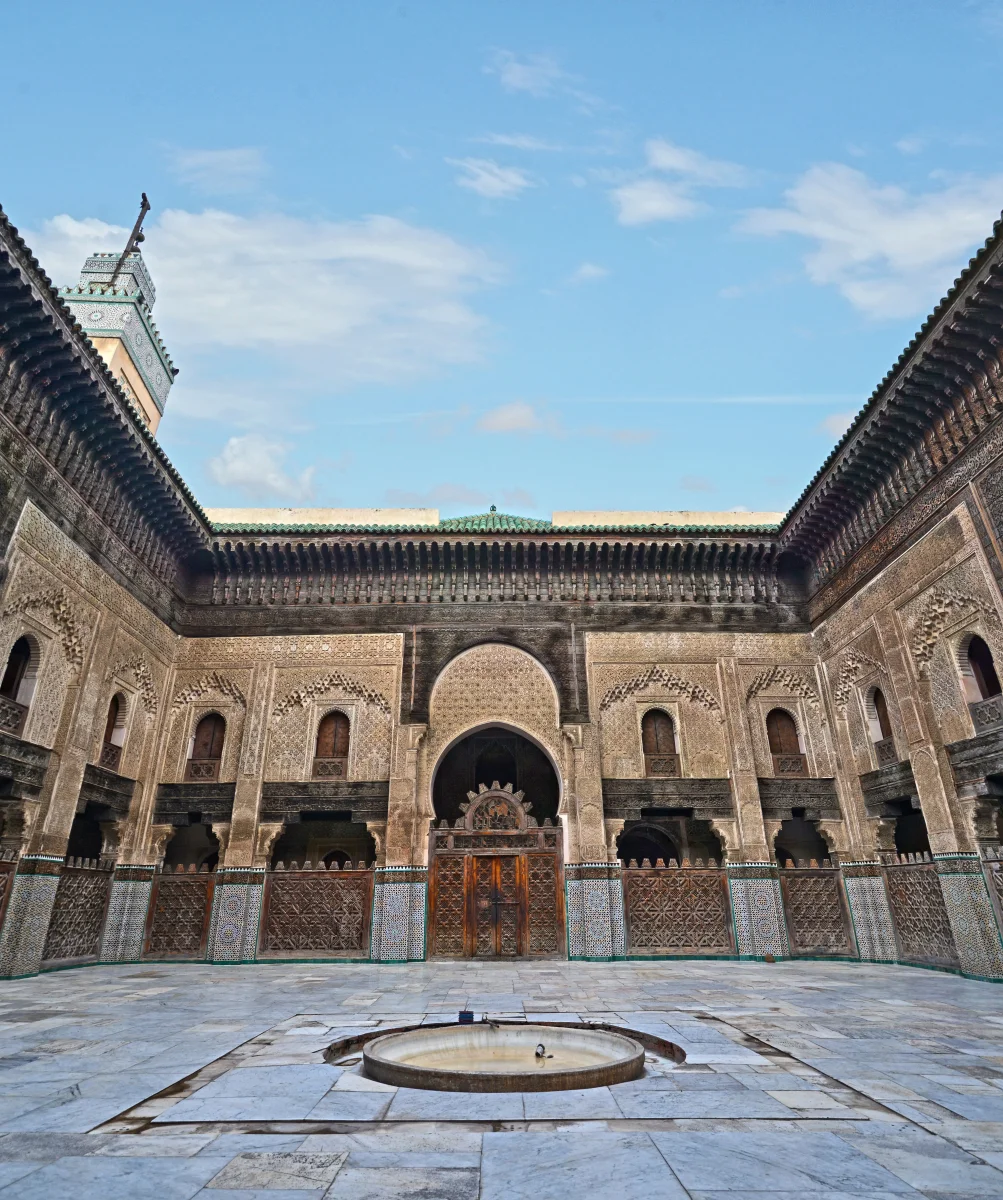
One of the most recognisable spaces of Al Quaraouiyine is its central courtyard.
With its arcades, traditional decoration and elegant pavilions, it has become one of the iconic images of the monument.
Its architecture recalls some of the great religious complexes of Morocco and Al-Andalus.
Proportion, light and water all play an essential role in the composition of the space.
The courtyard also helps provide natural light and ventilation to the surrounding areas.
The Minaret of Al Quaraouiyine
The minaret is another important element of the complex.
Its relatively sober appearance contrasts with some of the mosque's more richly decorated areas.
It bears witness to the early phases of the monument's development and to the evolution of religious architecture in Fez.
Over the centuries, the minaret became one of the historic landmarks of the Al Quaraouiyine district.
The Marinids and Fez's Intellectual Golden Age
Between the 13th and 15th centuries, Fez experienced an especially brilliant period under the Marinids.
In 1276, they founded Fes Jdid, west of the old city.
At the same time, they placed great importance on the intellectual development of Fes el-Bali.
Numerous madrasas were constructed close to Al Quaraouiyine to accommodate and educate students.
Among them were the Al-Attarine Madrasa, the Saffarin Madrasa and several other educational institutions.
A genuine scholarly district gradually developed around the great mosque.
Studying at Al Quaraouiyine therefore meant more than simply attending lessons in the mosque.
Students lived in madrasas, studied with different scholars and participated in a vast intellectual ecosystem in the heart of Fez.
The Al Quaraouiyine Library
Close to the mosque stands one of Morocco's most valuable institutions of written heritage: the Al Quaraouiyine Library.
Its development is particularly associated with the Marinid period.
Over the centuries, rulers and scholars enriched its collections through donations of books and manuscripts.
The library preserves an exceptional written heritage including religious, legal, scientific and literary works.
Some manuscripts are several centuries old.
The library highlights an essential dimension of Al Quaraouiyine's intellectual history: the transmission of knowledge did not depend solely on oral teaching.
It also relied on the copying, preservation and study of manuscripts.
Manuscripts and Written Heritage
In the medieval world, every book was a precious object.
Before modern printing, texts had to be copied by hand by scribes.
Libraries such as Al Quaraouiyine therefore played a fundamental role in preserving knowledge.
Theology, law, language, literature and different sciences could be transmitted from one generation to another through these collections.
Today, these manuscripts represent an important part of Morocco's intellectual heritage.
Al Quaraouiyine and Great Scholars
Throughout its long history, Al Quaraouiyine has been associated with numerous scholars, jurists and intellectuals.
However, caution is necessary when reading some lists circulating online.
Famous historical figures such as Ibn Khaldun, Maimonides or Ibn Rushd are frequently described as having studied or taught directly at Al Quaraouiyine, although the precise nature of their relationship with the institution can be more complex and is not always sufficiently documented.
What is certain is that Fez and Al Quaraouiyine formed a major intellectual environment for centuries, where scholars, manuscripts and scholarly traditions circulated between the Maghreb, Al-Andalus and other regions.
This circulation of knowledge is perhaps one of the most important aspects of Al Quaraouiyine's history.
Al Quaraouiyine at the Heart of the Medina of Fez
Al Quaraouiyine cannot be understood independently of the medina surrounding it.
Around the mosque developed:
- souks;
- artisan workshops;
- madrasas;
- funduqs;
- hammams;
- fountains;
- homes;
- shops.
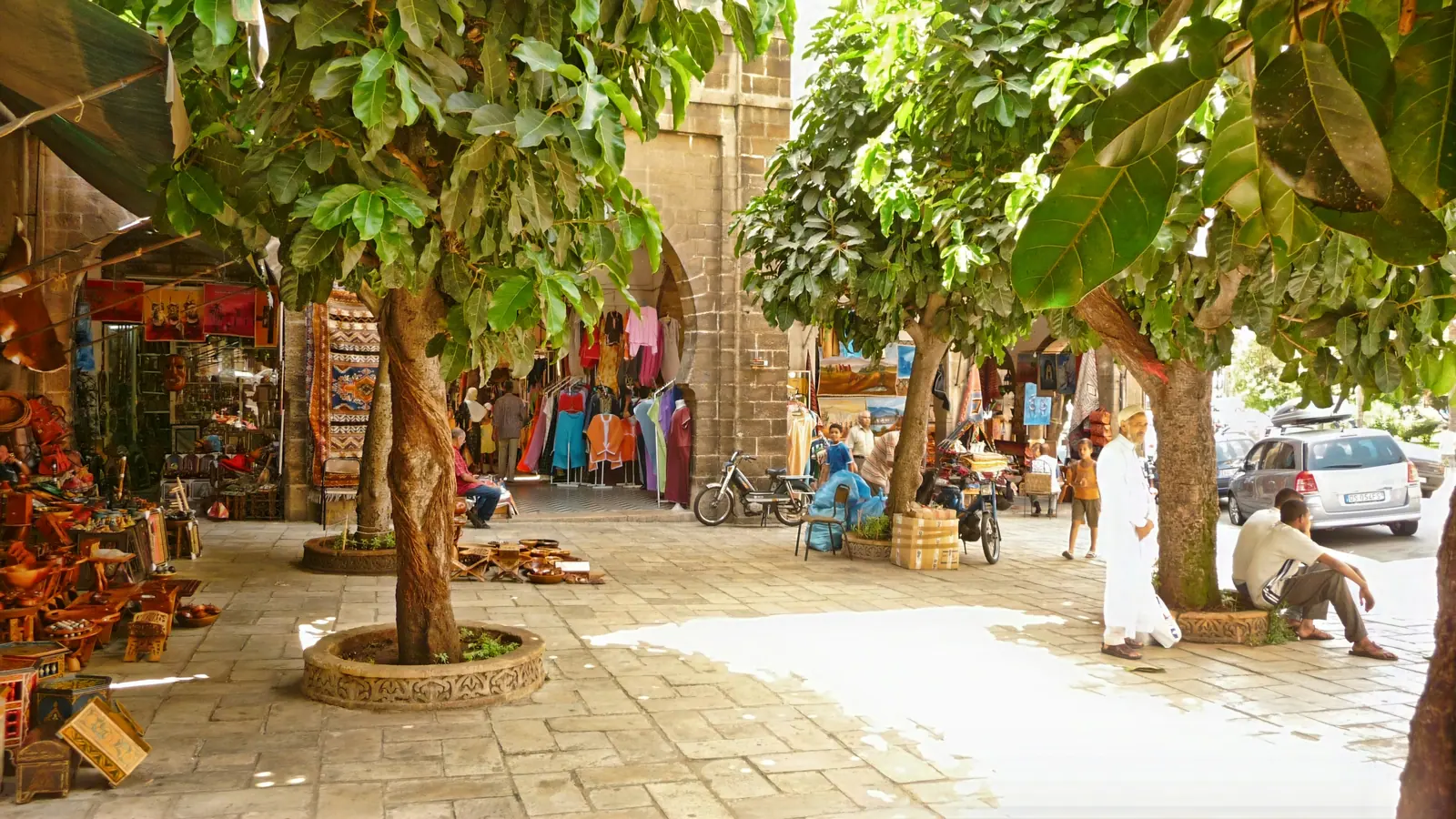
Religion, education, commerce and everyday life therefore intersect within an exceptionally dense urban environment.
This organisation helps explain why the Medina of Fez remains one of the most fascinating historic urban landscapes in the Arab and Islamic world.
Al Quaraouiyine and UNESCO World Heritage
Since 1981, the Medina of Fez has been inscribed on the UNESCO World Heritage List.
Al Quaraouiyine is one of the major monuments within this historic ensemble.
UNESCO highlights the exceptional concentration of religious, civil and military monuments in Fez and the city's importance as one of the historic centres of the Arab-Muslim world.
The medina's architecture reflects more than ten centuries of history and craftsmanship, enriched by Andalusian and other cultural influences.
Al Quaraouiyine is an essential part of this heritage.
For more information, consult the official UNESCO World Heritage Centre — Medina of Fez.
Can You Visit Al Quaraouiyine Mosque?
This is an important point to understand before visiting.
Al Quaraouiyine remains an active mosque and religious site.
Access to the prayer areas is therefore subject to the rules applying to active mosques in Morocco.
Non-Muslim visitors should not approach Al Quaraouiyine as a conventional tourist monument where every interior space can be freely explored.
However, parts of the architecture can be observed from entrances and surrounding streets, depending on current access conditions.
Visitors should always respect worshippers, prayer times and the religious character of the site.
How to Discover Al Quaraouiyine
Even without entering all the religious areas, discovering Al Quaraouiyine remains an essential part of any visit to Fez.
Take time to explore the streets surrounding the mosque.
The urban fabric helps visitors understand the relationship between the monument, the souks, the madrasas and the historic student quarters.
A visit to Al Quaraouiyine can easily be combined with several important monuments nearby.
What to See Near Al Quaraouiyine
Al-Attarine Madrasa
Located very close to the mosque, the Al-Attarine Madrasa is one of the masterpieces of Marinid architecture.
Its zellige tilework, carved wood and stucco decoration provide a remarkable insight into the environment in which students lived and studied in medieval Fez.
Seffarine Square
Seffarine Square is traditionally associated with artisans working with copper and brass.
The sound of hammers striking metal remains one of the characteristic sounds of this part of the medina.
Al-Attarine Souk
The Attarine district was historically associated with merchants selling spices and perfumes.
Its narrow streets lead towards several of the major monuments surrounding Al Quaraouiyine.
Moulay Idriss II Mausoleum
A few minutes away stands the sanctuary dedicated to Moulay Idriss II, a fundamental figure in the history of Fez.
This area therefore forms one of the main religious and historical centres of the medina.
How Much Time Should You Allow for Al Quaraouiyine?
If you only want to explore the immediate surroundings of the mosque, 30 to 45 minutes may be enough.
However, this is not really sufficient to understand the district.
It is better to allow around 2 to 3 hours to explore Al Quaraouiyine and the main monuments nearby.
Half a day provides a more relaxed opportunity to discover the Al-Attarine Madrasa, Seffarine Square, the souks and several other monuments of Fes el-Bali.
What Is the Best Time to Visit Al Quaraouiyine?
The morning is generally an excellent time to explore this part of the medina.
The streets gradually come alive with merchants and craftspeople, while crowds may be lighter than during the middle of the day.
However, visitors should always take prayer times into consideration and respect the religious activity of the mosque.
Al Quaraouiyine is not simply a historic monument: it remains a living religious institution.
Why Is Al Quaraouiyine So Important?
The importance of Al Quaraouiyine does not depend on a single record.
Its significance comes from a much deeper history.
From the foundation of a mosque in the 9th century to the development of a major centre of learning, Al Quaraouiyine spans more than a thousand years of Moroccan history.
It reflects Fez's role as an intellectual capital, the circulation of knowledge between different regions and the importance of education in Morocco's history.
Its architecture also tells the story of the dynasties that shaped the city.
Its manuscripts bear witness to the preservation and transmission of knowledge.
The surrounding madrasas recall the generations of students who travelled to Fez to study.
And its continuing religious activity demonstrates that this heritage does not belong solely to the past.
Al Quaraouiyine is a living heritage site.
It is precisely this continuity between religion, education, architecture and urban life that makes it one of the most important places in Morocco's cultural history.
Practical Information
Location: Fes el-Bali, Medina of Fez
Traditional foundation date: 859
Founder: Fatima al-Fihriya
Original function: Mosque
Historical functions: Mosque, religious education and intellectual centre
Nearby attractions: Al-Attarine Madrasa, Seffarine Square, souks, Moulay Idriss II Mausoleum and the streets of Fes el-Bali
World Heritage: Located within the Medina of Fez, inscribed on the UNESCO World Heritage List since 1981
Access: Al Quaraouiyine remains an active mosque. Access rules for religious areas must be respected and differ from those of a conventional tourist monument.
Sources and References
- Al Quaraouiyine University — Official website
- Moroccan Ministry of Habous and Islamic Affairs — Historic monuments
- UNESCO — Medina of Fez
- Brown University — Al-Qarawiyyin Mosque-University of Fez
MoroccoMuseum tip: Al Quaraouiyine is first and foremost a living place of worship. Respect authorised access areas, worshippers and prayer times. Visitor conditions may change, so check the latest local information before your visit.