Kasbah of the Udayas in Rabat: History, Heritage and Visitor Guide
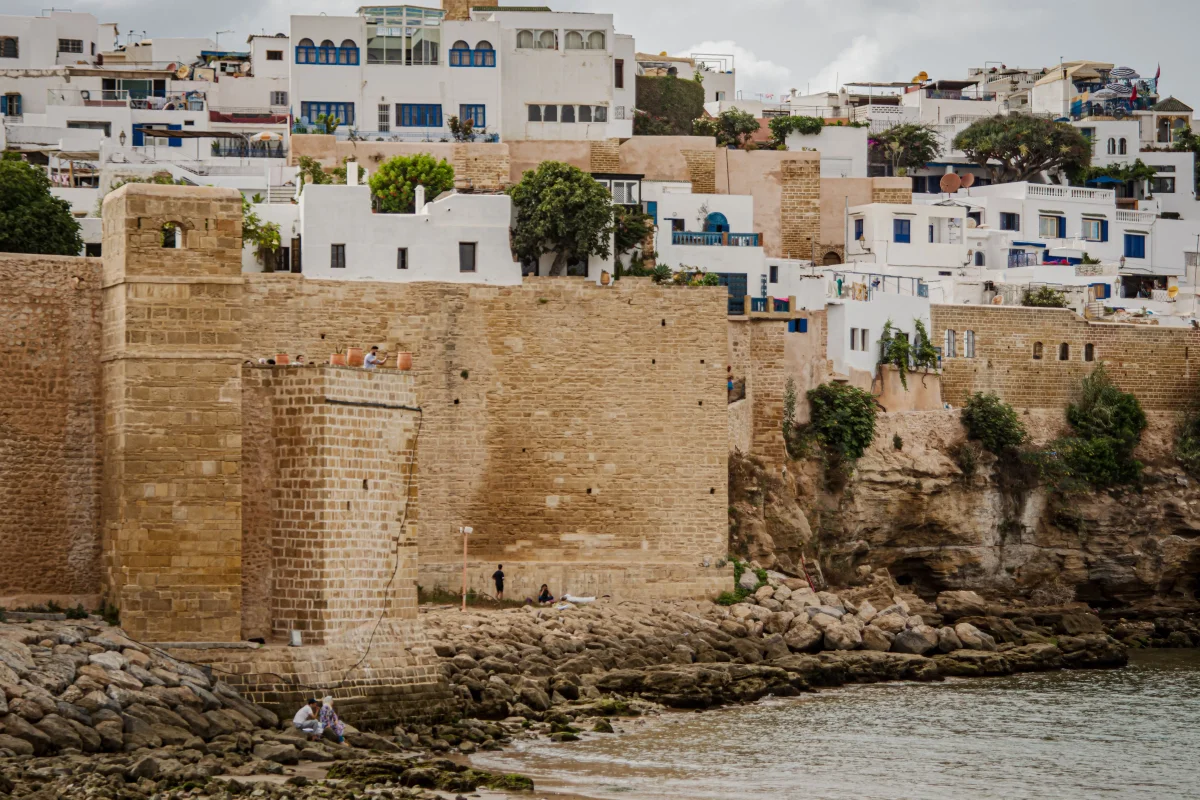
Overlooking the mouth of the Bouregreg River, opposite Salé and just a short walk from Rabat's medina, the Kasbah of the Udayas is one of the Moroccan capital's most remarkable historic sites.
Behind its imposing walls lies a maze of white-and-blue houses, a monumental Almohad gate, an Andalusian-inspired garden, a former royal residence transformed into a museum, and several viewpoints overlooking the river and the Atlantic Ocean.
But the Udayas are much more than a picturesque neighbourhood. The Kasbah is one of Rabat's oldest urban settlements and bears witness to several major periods in Moroccan history, from the Almoravids and Almohads to the Andalusian communities of the 17th century and the Alaouite era.
Today, it forms part of "Rabat, Modern Capital and Historic City: a Shared Heritage", inscribed on the UNESCO World Heritage List in 2012.
Where is the Kasbah of the Udayas?
The Kasbah of the Udayas is located in Rabat, on the left bank of the Bouregreg River, close to where the river meets the Atlantic Ocean.
This location is no coincidence.
From this elevated position, it was possible to monitor access to the river, the Atlantic coastline and movements between Rabat and Salé.
Even today, the relationship between the Kasbah, the Bouregreg, Salé and the ocean remains one of the most spectacular features of the site.
A Kasbah at the Heart of Rabat's Origins
The history of the Udayas is closely connected to the history of Rabat itself.
The site represents one of the city's oldest urban settlements.
Long before becoming the peaceful neighbourhood visitors explore today, this strategic position overlooking the mouth of the Bouregreg primarily served a military purpose.
The Almoravids and the First Fortifications
The site's first major fortifications are associated with the Almoravid period.
Its location made it possible to monitor the mouth of the Bouregreg and control this strategic point on Morocco's Atlantic coast.
However, it was with the arrival of the Almohads in the 12th century that the site underwent its most significant transformation.
The Almohads Transform the Kasbah
The 12th century was a crucial period in the history of Rabat.
Under the Almohads, the city became part of an ambitious political, military and monumental project.
The Kasbah was rebuilt, expanded and strengthened.
The site gradually became associated with the development of Ribat al-Fath, from which the modern name Rabat derives.
The Almohads aimed to develop a major imperial city along the banks of the Bouregreg.
Rabat still preserves several remarkable monuments from this period, including its historic walls, monumental gates, the Hassan Tower and numerous defensive structures.
UNESCO considers this Almohad heritage an essential component of Rabat's outstanding historical value.
Bab Oudaya: The Monumental Gate of the Kasbah
Before even entering the Kasbah, visitors encounter one of its greatest architectural masterpieces: Bab Oudaya, also known as Bab El Kebir.
This imposing gate is a remarkable example of Almohad monumental architecture.
Its purpose went beyond defence.
The monumental character of the gateway also expressed the political power of the Almohad dynasty.
Its large arch is surrounded by carved decoration featuring geometric and vegetal motifs characteristic of the architecture of this period.
Bab Oudaya perfectly illustrates an important feature of Almohad architecture: the combination of military strength, monumental simplicity and refined decoration.
Al-Atiq Mosque
Inside the Kasbah stands the Al-Atiq Mosque, considered one of the oldest mosques in Rabat.
Its presence demonstrates that the Kasbah was not simply a military fortress.
It gradually developed into a genuine urban space containing residential, religious and administrative areas.
The Andalusians and the Revival of the Udayas
Following the Almohad period, the Kasbah underwent several transformations.
Its history entered a new chapter at the beginning of the 17th century.
From 1609 onwards, Moriscos expelled from the Iberian Peninsula settled in the Rabat-Salé region.
Some of these communities contributed to the rehabilitation and development of the Kasbah.
They brought with them traditions and skills deeply influenced by the heritage of Al-Andalus.
This period left a lasting mark on Rabat's historical and cultural identity.
UNESCO also identifies the remains of the 17th-century Morisco, or Andalusian, principality as an important element of the capital's historic heritage.
Rabat, Salé and the Age of the Corsairs
The 17th century also represents one of the most fascinating periods in the history of the Bouregreg estuary.
Rabat and Salé became important maritime centres.
The Kasbah occupied a strategic position from which access to the river and the Atlantic Ocean could be monitored.
This maritime history helps explain the presence of numerous defensive structures overlooking the Bouregreg and the Atlantic coast.
Why Is It Called the "Kasbah of the Udayas"?
The Kasbah's current name is much more recent than the fortress itself.
The Udaya tribe settled in the Kasbah several centuries after its construction.
Their presence gradually gave the monument the name by which it is known today: the Kasbah of the Udayas.
It is therefore important to distinguish between the origins of the monument and the origins of its name.
The Kasbah existed for several centuries before the Udayas settled there.
The White and Blue Streets of the Udayas
Once inside the fortifications, the atmosphere changes completely.
The imposing walls give way to a network of narrow streets, stairways and passages lined with whitewashed houses.
The combination of white and blue has become one of the neighbourhood's most recognisable visual signatures.
Take your time to observe:
- the traditional doors;
- white-and-blue façades;
- narrow streets;
- stairways;
- small passageways;
- views towards the Bouregreg;
- the architecture of the houses.
Above all, the Kasbah remains a living residential neighbourhood.
It is precisely this coexistence between monumental heritage and everyday life that gives the Udayas much of their distinctive character.
The Andalusian Gardens of the Udayas
Close to the former royal residence are the famous Andalusian Gardens.
Orange trees, lush vegetation, geometric paths, fountains and ochre-coloured walls create a striking contrast with the surrounding fortifications.
Despite their name, the gardens visible today do not date directly from the Andalusian period of the 17th century.
The present garden was developed in the early 20th century, inspired by Andalusian garden traditions.
Today, it is one of the most peaceful places within the Kasbah.
The National Museum of Adornment
The Kasbah is also home to the National Museum of Adornment.
The museum occupies a former residence built during the reign of the Alaouite Sultan Moulay Ismail.
Following several transformations and restoration campaigns, the museum reopened in its current form in January 2023.
What Can You See at the National Museum of Adornment?
The permanent exhibition is dedicated to the richness and diversity of Moroccan adornment.
Its collections allow visitors to discover:
- traditional Moroccan jewellery;
- regional ornaments;
- different artisanal techniques;
- materials traditionally used by craftspeople;
- pieces associated with traditional clothing;
- an important collection of Amazigh jewellery.
The jewellery on display should therefore not be viewed simply as decorative objects.
It also reflects social, regional and artisanal traditions transmitted from one generation to another.
For up-to-date visitor information, consult the National Foundation of Museums.
The Moorish Café of the Udayas
Another emblematic place within the Kasbah is the Moorish Café, often known as the Café Maure.
Located in a privileged position, it offers remarkable views over the Bouregreg River and Salé.
But the appeal of this location goes beyond enjoying a mint tea.
From the heights of the Kasbah, it becomes immediately clear why this particular position was chosen for a fortress.
The view extends across the mouth of the Bouregreg, Salé and the Atlantic Ocean.
The landscape itself therefore helps visitors understand the strategic importance of the site.
The Kasbah of the Udayas and UNESCO
Since 2012, the Kasbah of the Udayas has formed part of the UNESCO World Heritage property known as:
"Rabat, Modern Capital and Historic City: a Shared Heritage".
The UNESCO designation does not apply solely to the Kasbah.
It encompasses a much larger urban ensemble illustrating different periods in Rabat's history.
These include:
- remains from the Almohad period;
- historic walls and gates;
- the medina;
- Andalusian heritage;
- the 20th-century modern city;
- several monumental and landscaped areas.
This exceptional combination of different historical periods helps explain why Rabat has an urban identity distinct from many other historic Moroccan cities.
The official listing can be consulted on the UNESCO World Heritage Centre.
How Long Do You Need to Visit the Kasbah of the Udayas?
To explore the streets, fortifications, Andalusian Gardens and viewpoints at a relaxed pace, allow approximately 1 to 1.5 hours.
If you also want to visit the National Museum of Adornment, it is better to allow around 2 to 3 hours for the entire visit.
Avoid rushing through the Udayas.
Much of the site's appeal lies in simply walking through it and experiencing the transition between military architecture, traditional homes, gardens and landscapes.
What Is the Best Time to Visit?
The morning is particularly pleasant for exploring the narrow streets in a quieter atmosphere.
However, the late afternoon offers especially beautiful light over the walls, the Bouregreg and the Atlantic Ocean.
For photography, this time of day also provides excellent views from the higher parts of the Kasbah.
Opening Hours of the Kasbah of the Udayas
Access hours to the Kasbah and the various sites within it may vary.
It is therefore advisable to check the latest official information from Visit Rabat before your visit.
The Kasbah's access hours should not be confused with those of the National Museum of Adornment, which has its own opening days and hours.
What to See Near the Kasbah of the Udayas
The Kasbah can easily be included in a full day dedicated to exploring Rabat's cultural heritage.
Rabat Medina
The Medina of Rabat is located immediately next to the Kasbah.
After visiting the Udayas, you can continue exploring its historic streets, shops and residential neighbourhoods.
Hassan Tower
The Hassan Tower is one of Rabat's most important monuments from the Almohad period.
Visiting it after the Udayas provides a better understanding of the ambitious monumental project developed by the Almohads in Rabat.
Mohammed V Mausoleum
Located next to the Hassan Tower, the Mohammed V Mausoleum is one of the great monuments of modern Moroccan architecture.
Chellah
The Chellah offers yet another perspective on Rabat's long history.
The site combines ancient archaeological remains with an important medieval Marinid complex.
By combining the Kasbah of the Udayas, Hassan Tower and Chellah, visitors can explore several major periods of Rabat's history in a single day.
Why Visit the Kasbah of the Udayas?
Within a relatively small area, the Kasbah of the Udayas brings together several essential dimensions of Moroccan heritage.
Visitors encounter a medieval fortress, Almohad architecture, the legacy of Andalusian communities, a former Alaouite residence, a museum dedicated to Moroccan traditions and a neighbourhood that remains inhabited today.
The Udayas also help visitors understand the historical relationship between Rabat and its natural environment.
From the walls, the Bouregreg is no longer simply part of the scenery.
It becomes one of the keys to understanding why a fortress was established at this precise location.
It is this dialogue between history, architecture, community and landscape that makes the Kasbah of the Udayas one of Rabat's essential heritage sites.
Practical Information
Location: Kasbah of the Udayas, Rabat
Recommended visit duration: 1 to 1.5 hours for the Kasbah; 2 to 3 hours including the museum
Highlights: Bab Oudaya, Al-Atiq Mosque, historic streets, Andalusian Gardens, National Museum of Adornment, Moorish Café and views over the Bouregreg
World Heritage: Part of Rabat's UNESCO World Heritage property since 2012
Sources and References
- UNESCO — Rabat, Modern Capital and Historic City: a Shared Heritage
- National Foundation of Museums
- Visit Rabat
- Museum With No Frontiers
MoroccoMuseum tip: opening hours, admission conditions and visitor information may change. Always check the latest official information before your visit.