Hassan Tower and Mohammed V Mausoleum in Rabat: History, Architecture and Visitor Guide
Overlooking the Bouregreg valley, Hassan Tower and the Mohammed V Mausoleum form one of Rabat's most iconic monumental ensembles.
At first glance, the two monuments may appear to belong to the same architectural complex. Yet almost eight centuries separate them.
Hassan Tower is the unfinished minaret of an immense mosque begun in the late 12th century under the Almohad caliph Yaqub al-Mansur. The Mohammed V Mausoleum, built in the 20th century, honours the sovereign closely associated with Morocco's independence.
Between the two monuments stretches a vast esplanade filled with columns, the remains of the ambitious Almohad mosque.
In a single place, visitors can therefore encounter two fundamental periods of Moroccan history: the age of the great medieval empires and the emergence of modern Morocco.
Since 2012, the complex has formed part of "Rabat, Modern Capital and Historic City: a Shared Heritage", inscribed on the UNESCO World Heritage List.
Where Are Hassan Tower and the Mohammed V Mausoleum?
Hassan Tower and the Mohammed V Mausoleum are located in Rabat, on a vast esplanade overlooking the Bouregreg valley.
From the site, visitors can enjoy views towards Salé, the river and several landmarks of the Moroccan capital.
This location was not chosen by chance.
At the end of the 12th century, the Almohads intended to transform Rabat into a major imperial capital.
The Hassan Mosque was designed to become one of the most important monuments of this ambitious project.
Rabat Under the Almohads
To understand Hassan Tower, it is necessary to return to the 12th century, when the Almohad Empire controlled a vast territory across the Maghreb and Al-Andalus.
The Almohads were then at the height of their political and military power.
Their monumental architecture still bears witness to this period.
Among the great monuments associated with the dynasty are:
- the Koutoubia Mosque in Marrakech;
- the Giralda in Seville;
- the monumental walls and gates of Rabat;
- the Hassan Mosque and its immense minaret.
Under the reign of Caliph Abu Yusuf Yaqub al-Mansur, Rabat became the focus of an ambitious urban project.
The ruler intended to develop a great imperial city known as Ribat al-Fath.
It was in this context that construction of the Hassan Mosque began.
An Immense Mosque for a New Capital
The Hassan Mosque was not intended to be an ordinary neighbourhood mosque.
The project was monumental.
According to heritage documentation concerning Rabat, the complex occupied a vast rectangle measuring approximately 183 metres by 139 metres.
The ambition was to create one of the largest sanctuaries in the western Islamic world.
An immense prayer hall, courtyards and hundreds of architectural supports were planned to structure the complex.
At the heart of this monumental project stood an enormous minaret: what we now know as Hassan Tower.
Yaqub al-Mansur and the Construction of Hassan Tower
Construction is closely associated with the reign of Yaqub al-Mansur, one of the most important rulers of the Almohad dynasty.
His reign, from 1184 to 1199, marked a period of considerable political and military power.
Historical sources place the beginning of the great Hassan Mosque project in the late 12th century.
However, the ruler's ambition would never be fully realised.
In 1199, Yaqub al-Mansur died.
Construction stopped.
The gigantic mosque remained unfinished.
Why Is Hassan Tower Unfinished?
Hassan Tower was intended to be considerably taller than the monument visible today.
According to Rabat's World Heritage documentation, the surviving minaret stands at approximately 45 metres, while the original project may have reached around 85 metres, excluding its upper lantern.
Had the project been completed, Hassan Tower would have surpassed some of the most famous Almohad minarets.
But the death of Yaqub al-Mansur in 1199 brought construction to a halt.
The mosque was never completed.
Over the following centuries, the complex gradually deteriorated.
The 1755 Earthquake
Another major event profoundly affected the history of the site: the great earthquake of 1755, commonly associated with the Lisbon earthquake.
Its effects were felt across a wide area of the Atlantic coast.
The Hassan Mosque suffered further damage.
Elements already weakened over the centuries disappeared, and the former sanctuary gradually acquired the appearance of the monumental ruins visible today.
The numerous columns standing at the foot of Hassan Tower still allow visitors to imagine the extraordinary scale of the original project.
A Forest of Columns in the Heart of Rabat
The esplanade is one of the most striking parts of the visit.
Rows of columns and pillars of varying heights occupy the former mosque.
Today the space is open to the sky, but it was originally intended to form part of a vast prayer hall.
Walking among the columns makes it easier to appreciate the scale of the structure imagined by the Almohads.
These remains are therefore much more than decorative ruins.
They reveal the plan of an architectural project that was never fully completed.
The Architecture of Hassan Tower
Hassan Tower is built of dressed stone.
Its massive silhouette is characteristic of the great Almohad minarets.
One of the most remarkable features of the monument, however, is the decoration of its façades.
Each side displays different decorative compositions.
Visitors can observe:
- polylobed arches;
- interlacing motifs;
- geometric patterns;
- decorative bands;
- stone-carved ornamentation.
This variety prevents the façades from becoming repetitive and gives the monument considerable visual richness.
Hassan Tower, the Koutoubia and the Giralda: One Architectural Family
Hassan Tower is frequently compared with two other famous monuments: the Koutoubia in Marrakech and the Giralda in Seville.
The comparison is well founded.
All three belong to the great Almohad architectural tradition of the 12th century.
They share several characteristics: powerful volumes, square towers, geometric decoration and an emphasis on monumentality.
Yet each has its own identity.
The Koutoubia became one of the great symbols of Marrakech.
The Giralda, originally constructed as a minaret and transformed over the centuries, now dominates Seville Cathedral.
Hassan Tower, however, remained unfinished.
This characteristic is precisely part of what makes it exceptional.
The Ramp Inside the Minaret
The internal organisation of the great Almohad minarets is another interesting architectural feature.
Rather than relying solely on narrow staircases, circulation inside Hassan Tower was organised around ramps.
This design made it possible to ascend progressively through the tower around its central core.
It demonstrates the remarkable architectural expertise achieved by Almohad builders.
From an Unfinished Mosque to a Symbol of Rabat
For several centuries, the Hassan site remained primarily associated with the ruins of the ambitious Almohad project.
During the 20th century, however, its history entered a new chapter.
Following Morocco's independence in 1956, King Mohammed V became deeply associated with the country's national memory.
After his death in 1961, the Hassan Tower site was chosen for his mausoleum.
A new monument would therefore rise opposite the remains of the 12th-century mosque.
Mohammed V and the History of Modern Morocco
Sultan and later King Mohammed V occupies a central place in the history of modern Morocco.
His reign spanned the period of the French Protectorate, the rise of the Moroccan nationalist movement and the country's return to independence.
In 1953, the French authorities exiled him and members of his family.
This episode considerably strengthened his symbolic position within the nationalist movement.
Mohammed V returned to Morocco in 1955.
The following year, Morocco regained its independence.
The sovereign consequently became one of the principal figures associated with the restoration of Moroccan sovereignty.
He died in 1961.
The Construction of the Mohammed V Mausoleum
Construction of the Mohammed V Mausoleum began in the early 1960s.
The monument was built between 1962 and 1971.
Its location carries strong symbolic significance.
Facing Hassan Tower, the monumental legacy of the Almohad Empire, the new mausoleum placed the memory of modern Morocco within a landscape already representing centuries of national history.
The result is therefore more than a royal tomb.
It creates an architectural dialogue between medieval Morocco and modern Morocco.
Monumental Moroccan Architecture
The Mohammed V Mausoleum is one of the major examples of 20th-century Moroccan architecture inspired by the country's traditional artistic heritage.
From the outside, the building is immediately recognisable by its white marble façades and pyramidal roof covered with green tiles.
Green has a strong presence in Moroccan religious and royal architecture.
The contrast between the white exterior and green roof gives the monument its distinctive silhouette.
Zellige, Carved Wood and Moroccan Craftsmanship
Inside the mausoleum, visitors discover the richness of Moroccan decorative arts.
Among the elements to observe are:
- zellige tilework;
- carved and painted wood;
- geometric decoration;
- sculpted plaster;
- calligraphic motifs;
- marble;
- gilded details.
The ensemble demonstrates the expertise of Moroccan maâlems, or master craftspeople.
The mausoleum is therefore both a place of national memory and a remarkable demonstration of the continuity of traditional Moroccan craftsmanship into the 20th century.
What Is Inside the Mohammed V Mausoleum?
The mausoleum contains the tomb of King Mohammed V.
It also houses the tombs of his two sons:
- King Hassan II;
- Prince Moulay Abdallah.
From the upper gallery accessible to visitors, it is possible to look down into the central funerary chamber.
The atmosphere is very different from the open esplanade outside.
The silence, decoration and ceremonial guards give the interior a solemn character.
The Royal Guards
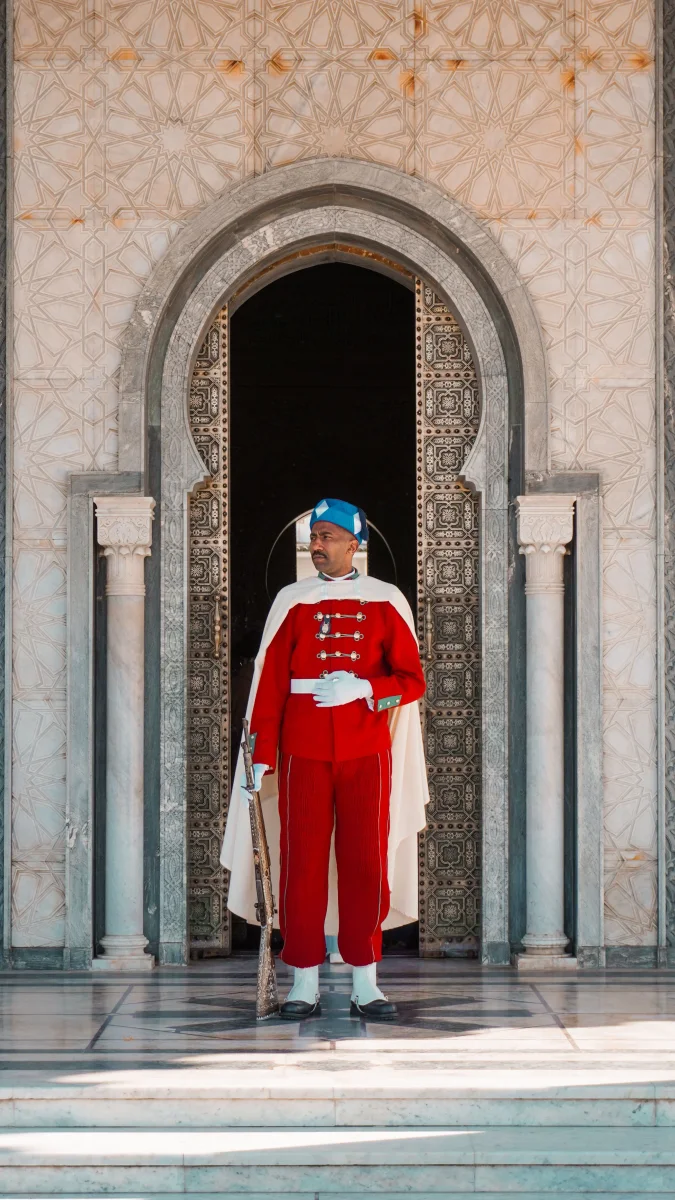
The entrances to the mausoleum are traditionally guarded by members of the Moroccan Royal Guard in ceremonial uniform.
Their presence contributes to the formal character of the monument.
Visitors should remember that this is not simply a tourist attraction.
The mausoleum is first and foremost a royal necropolis and a place of national memory.
A respectful attitude should therefore be maintained throughout the visit.
Two Monuments Separated by Eight Centuries
One of the most fascinating aspects of the Hassan site is the contrast between its two principal monuments.
On one side stands Hassan Tower, the surviving element of a gigantic 12th-century Almohad project.
On the other stands the Mohammed V Mausoleum, constructed in the 20th century.
Between them stretch the remains of the unfinished mosque.
Within only a few dozen metres, visitors symbolically cross almost eight centuries of Moroccan history.
Few sites in Morocco make this historical continuity so immediately visible.
Hassan Tower, the Mohammed V Mausoleum and UNESCO
Since 2012, the Hassan Mosque and Mohammed V Mausoleum have formed part of the World Heritage property:
"Rabat, Modern Capital and Historic City: a Shared Heritage."
The UNESCO inscription includes several historic ensembles across Rabat and illustrates the relationship between the different periods that shaped the capital.
The Hassan site forms a specific component of this World Heritage property.
The tower represents the monumental ambitions of the 12th-century Almohads, while the mausoleum reflects contemporary Moroccan architecture and the national history of the 20th century.
For more information, consult the UNESCO World Heritage Centre.
What Should You See During Your Visit?
A visit to the site should not be limited to taking a photograph of Hassan Tower.
Take time to examine its different elements.
Hassan Tower
Walk closer to the minaret to observe the different decorative compositions on its façades.
As you move around the tower, you will notice that the patterns are not identical on every side.
The Remains of the Mosque
Walk among the columns of the former mosque.
They provide a much clearer understanding of the scale of the Almohad project than a photograph of the tower alone.
The Mohammed V Mausoleum
First observe the exterior architecture before entering.
Inside, take time to examine the zellige, carved wood, marble and other decorative details.
Views Across Rabat and Salé
The elevated position of the site also provides attractive views over the Bouregreg valley and the Rabat-Salé urban area.
How Much Time Should You Allow?
Allow approximately 1 to 1.5 hours to explore Hassan Tower, walk across the esplanade and visit the Mohammed V Mausoleum at a relaxed pace.
Visitors particularly interested in architecture and history can easily spend longer.
Much of the site's interest lies in its details.
Do not focus only on the tower: look at the columns, the minaret's façades, the perspectives across the esplanade and the interior decoration of the mausoleum.
What Is the Best Time to Visit?
The morning generally provides pleasant conditions for a visit and good light for observing architectural details.
The late afternoon can also be particularly attractive for photography, when softer light falls across the stone of Hassan Tower.
Access to the Mohammed V Mausoleum may occasionally be modified during official ceremonies or special events.
Opening Hours
According to information currently published by Visit Rabat, Hassan Tower is open daily from 9:00 am to 6:00 pm.
The Mohammed V Mausoleum has its own visiting hours and access conditions may vary.
As opening hours can change during official ceremonies, religious holidays or special events, visitors should check the latest information before travelling.
Consult Visit Rabat for current practical information.
What to See Near Hassan Tower
Hassan Tower is an excellent starting point for exploring several other major heritage sites in Rabat.
Kasbah of the Udayas
The Kasbah of the Udayas continues the story of Rabat's Almohad and Andalusian heritage.
Its fortifications, Bab Oudaya, white-and-blue streets and views across the Bouregreg make it one of the capital's essential historic sites.
Chellah
Chellah reveals an even older chapter of Rabat's history.
The site combines ancient archaeological remains with an important medieval Marinid necropolis.
Medina of Rabat
The Medina of Rabat offers another side of the city, with narrow streets, souks and traditional urban heritage.
By combining Hassan Tower, the Mohammed V Mausoleum, the Kasbah of the Udayas and Chellah, visitors can experience several major periods of Rabat's history in a single day.
Why Visit Hassan Tower and the Mohammed V Mausoleum?
Few places make the historical depth of Rabat so easy to understand.
Hassan Tower tells the story of the ambitions of a dynasty that once ruled a vast territory extending across the Maghreb and Al-Andalus.
Its columns recall a monumental project that was abruptly interrupted.
Facing them, the Mohammed V Mausoleum represents another fundamental chapter: Morocco's independence and the emergence of the modern nation.
The two monuments do not belong to the same period.
Nor were they built for the same purpose.
Yet their presence on the same esplanade creates one of the most powerful heritage landscapes in the Moroccan capital.
Hassan Tower represents an unfinished vision of medieval Morocco; the Mohammed V Mausoleum places the memory of modern Morocco within this historic landscape.
It is this encounter between Almohad architecture, national memory, Moroccan craftsmanship and the urban landscape that makes the Hassan site one of Rabat's essential visits.
Practical Information
Location: Boulevard Mohammed Lyazidi, Rabat
Monuments: Hassan Tower, remains of the Hassan Mosque and Mohammed V Mausoleum
Period of Hassan Tower: 12th century, Almohad period
Commissioned by: Caliph Yaqub al-Mansur
Current height of Hassan Tower: approximately 45 metres
Mohammed V Mausoleum: constructed between 1962 and 1971
Burials: Mohammed V, Hassan II and Prince Moulay Abdallah
Recommended visit duration: approximately 1 to 1.5 hours
World Heritage: component of the Rabat property inscribed on the UNESCO World Heritage List since 2012
Nearby: Kasbah of the Udayas, Medina of Rabat and Chellah
Sources and References
- UNESCO — Rabat, Modern Capital and Historic City: a Shared Heritage
- Visit Rabat — Hassan Tower
- Visit Rabat — Mohammed V Mausoleum
- Museum With No Frontiers — Hassan Mosque
MoroccoMuseum tip: the Mohammed V Mausoleum is a place of national memory and a royal necropolis. Dress and behave respectfully during your visit. Opening hours and access conditions may change during official ceremonies, so check the latest information before travelling.