Heri es-Souani in Meknes: Moulay Ismail's Monumental Granaries
Just a few minutes from the historic centre of Meknes, behind the imposing walls of the former imperial city, stands one of the most impressive architectural complexes built during the reign of Sultan Moulay Ismail: Heri es-Souani, also spelled Hri Souani or Heri Souani.
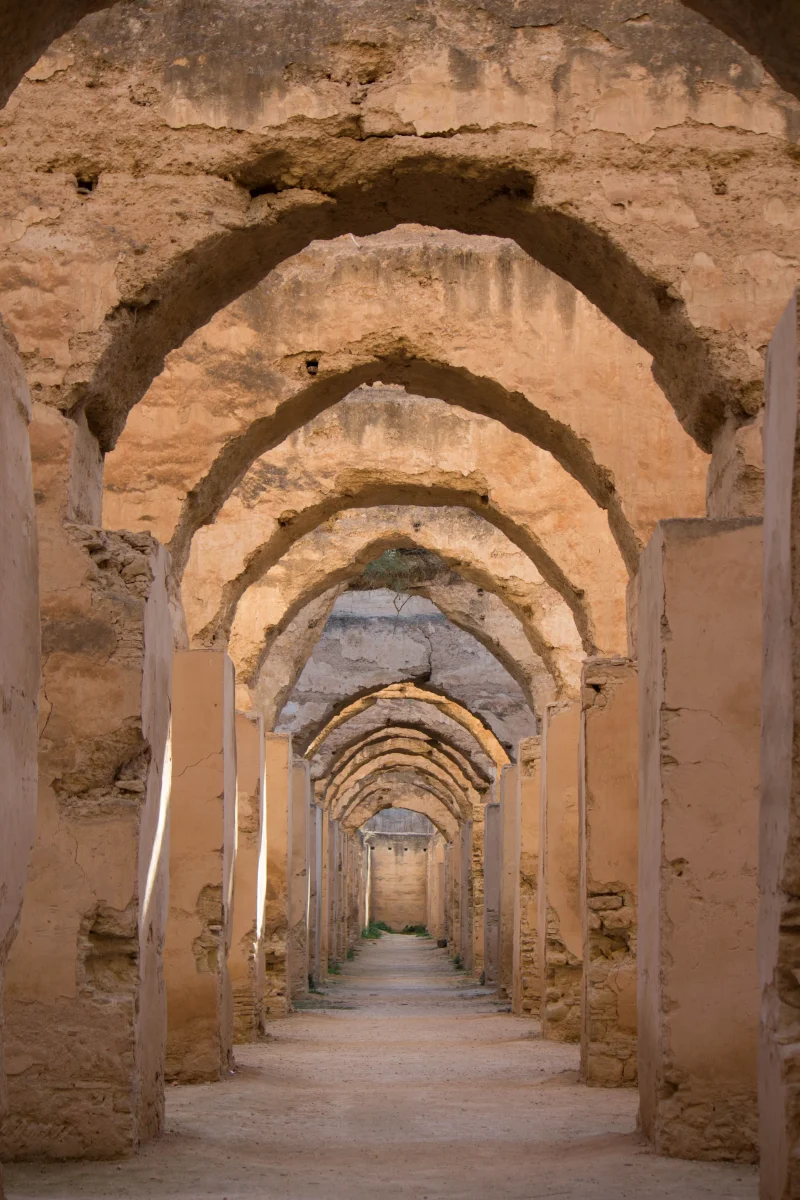
Its long rows of arches, massive walls and former vaulted halls give the monument an almost surreal atmosphere today.
Yet this spectacular architecture once served a very practical purpose.
Heri es-Souani formed part of the vast infrastructure designed to supply the imperial city of Meknes, particularly through enormous grain-storage areas and a remarkable hydraulic system associated with Dar Al Ma, the "House of Water".
To understand the monument, we need to return to the period when Moulay Ismail transformed Meknes into his imperial capital.
Moulay Ismail and the Rise of Imperial Meknes
When Moulay Ismail came to power in 1672, he chose Meknes as his capital.
His reign, which lasted until 1727, profoundly transformed the city.
Alongside the old medina, an immense imperial city developed, composed of palaces, gardens, defensive walls, monumental gates, military areas, food reserves and hydraulic infrastructure.
This transformation explains why Meknes is now home to major monuments such as Bab Mansour, the Mausoleum of Moulay Ismail, El Hedim Square and the Heri es-Souani complex.
The exceptional concentration of historic monuments contributed to the inscription of the Historic City of Meknes on the UNESCO World Heritage List in 1996.
What Was Heri es-Souani Used For?
Heri es-Souani is often described in tourist guides as the former royal stables of Moulay Ismail.
However, this description needs some clarification.
The complex visible today mainly corresponds to vast granaries and storage areas, associated with the hydraulic installations of Dar Al Ma.
Its purpose was strategic: to maintain substantial reserves capable of supplying the imperial city.
The actual royal stables formed part of a larger complex of imperial buildings.
Understanding this distinction helps reveal the extraordinary organisation of the city created by Moulay Ismail.
Granaries Designed to Store Grain
The dimensions of Heri es-Souani demonstrate the importance placed on storing essential resources.
The buildings were constructed with particularly thick walls.
This architecture helped maintain relatively stable temperatures inside the storage areas, an important advantage for preserving grain in the climate of Meknes.
The halls were organised around massive pillars and repeating arches.
Even today, these alignments create some of the most impressive architectural perspectives in Meknes.
Dar Al Ma: The House of Water
Close to the granaries stands Dar Al Ma, literally the "House of Water".
This infrastructure was an essential part of the hydraulic system serving the imperial city.
Mechanisms including water wheels were used to draw and distribute the water required by different parts of the complex.
Water was essential for the operation of the palaces, gardens, military installations and animals housed within the imperial city.
Heri es-Souani should therefore not be understood as an isolated monument.
It formed part of an extensive logistical and hydraulic system designed for an imperial capital.
The Agdal Basin
Beside the complex lies the vast Agdal Basin, also known as Sahrij Souani.
This large artificial reservoir formed part of the hydraulic infrastructure of the imperial city.
It provided an important water reserve used particularly for the gardens and other needs of the royal complex.
Today, the basin creates a striking contrast with the surrounding walls and monumental structures.
Walking around Sahrij Souani also provides a better sense of the enormous area once occupied by the imperial city of Meknes.
Monumental and Functional Architecture
Unlike Moroccan palaces richly decorated with zellige, carved wood and sculpted plaster, Heri es-Souani impresses primarily through its scale and structure.
Here, architecture was above all functional.
The massive walls, pillars, arches and long halls responded to practical requirements for storage and preservation.
Yet this simplicity creates an exceptionally powerful visual effect.
The succession of arches produces dramatic patterns of light and shadow, making Heri es-Souani one of the most photogenic historic monuments in Meknes.
The 1755 Lisbon Earthquake
Parts of the imperial city of Meknes were damaged over the centuries.
The powerful Lisbon earthquake of 1 November 1755, which was felt across large areas of Morocco, is frequently associated with damage to several monumental structures in Meknes.
The open and partially ruined sections visible today contribute to the spectacular appearance of Heri es-Souani.
Despite these transformations, the surviving remains still provide a remarkable impression of the scale of Moulay Ismail's building projects.
Heri es-Souani and the Imperial City of Meknes
To fully understand Heri es-Souani, it is useful to include the monument in a broader exploration of imperial Meknes.
Bab Mansour
Standing opposite El Hedim Square, Bab Mansour is probably the most famous monumental gateway in Meknes.
It was one of the great symbolic entrances to the imperial city.
Discover our complete guide to Bab Mansour in Meknes.
Mausoleum of Moulay Ismail
The Mausoleum of Moulay Ismail contains the tomb of the ruler who transformed Meknes during the late 17th and early 18th centuries.
Visiting the mausoleum provides further historical context for understanding the reign of Moulay Ismail.
Read our guide to the Mausoleum of Moulay Ismail in Meknes.
El Hedim Square
Located between the medina and the imperial city, El Hedim Square is one of the most emblematic public spaces in Meknes.
It lies directly opposite Bab Mansour and provides an excellent starting point for exploring the city's historic heritage.
What to See Around Heri es-Souani
A visit to Heri es-Souani can easily be included in a full day exploring Meknes.
Among the main places to discover are:
- Heri es-Souani
- Dar Al Ma
- Agdal Basin / Sahrij Souani
- Mausoleum of Moulay Ismail
- Bab Mansour
- El Hedim Square
- Medina of Meknes
Together, these monuments reveal different aspects of the former imperial capital: royal power, defence, religion, food supplies and urban organisation.
Meknes, Volubilis and Moulay Idriss Zerhoun
Meknes is also an excellent base for exploring several major historic sites in northern Morocco.
Around 30 kilometres away are the Roman ruins of Volubilis, one of Morocco's most important archaeological sites.
A few kilometres from Volubilis lies the historic town of Moulay Idriss Zerhoun, which developed around the sanctuary of Moulay Idriss I.
It is therefore possible to combine the imperial heritage of Meknes with visits to Volubilis and Moulay Idriss Zerhoun.
Why Visit Heri es-Souani?
Heri es-Souani offers an opportunity to discover a different side of Moroccan architecture.
Here, the story is not simply about decoration or royal prestige.
The monument primarily reveals the logistical organisation behind a vast imperial capital.
Food reserves, water supplies, infrastructure and monumental buildings were conceived as interconnected parts of the same urban system.
This is precisely what makes Heri es-Souani particularly fascinating.
It shows that the power of Moulay Ismail's Meknes depended not only on its palaces and fortifications, but also on the infrastructure required to sustain them.
Tips for Visiting Heri es-Souani
Allow enough time to observe the different parts of the complex and the striking perspectives created by its arches.
For photography, morning and late-afternoon light can highlight the monument's impressive volumes and architectural details.
You can also use your visit to explore the nearby Agdal Basin.
Opening hours, access conditions and admission fees may change, so it is recommended to check current official information before visiting.
Heri es-Souani: Another Side of Meknes Heritage
Heri es-Souani is one of the best places to understand the extraordinary urban ambitions of Moulay Ismail.
Behind its enormous walls and rows of arches once stood infrastructure essential to the functioning of the imperial capital.
After exploring the monument, continue your journey with our guide to Meknes and its heritage, then discover Bab Mansour, the Mausoleum of Moulay Ismail and the archaeological site of Volubilis.