Al-Attarine Madrasa in Fez: a Marinid masterpiece in the heart of the Medina
Just a few steps from the Al Quaraouiyine Mosque and University, in the heart of the maze-like streets of Fez el-Bali, stands one of the most refined monuments of Marinid architecture: the Al-Attarine Madrasa.
At first glance, the monument appears relatively discreet from the narrow streets of the Medina.
But once you step through the doorway, the contrast is spectacular.
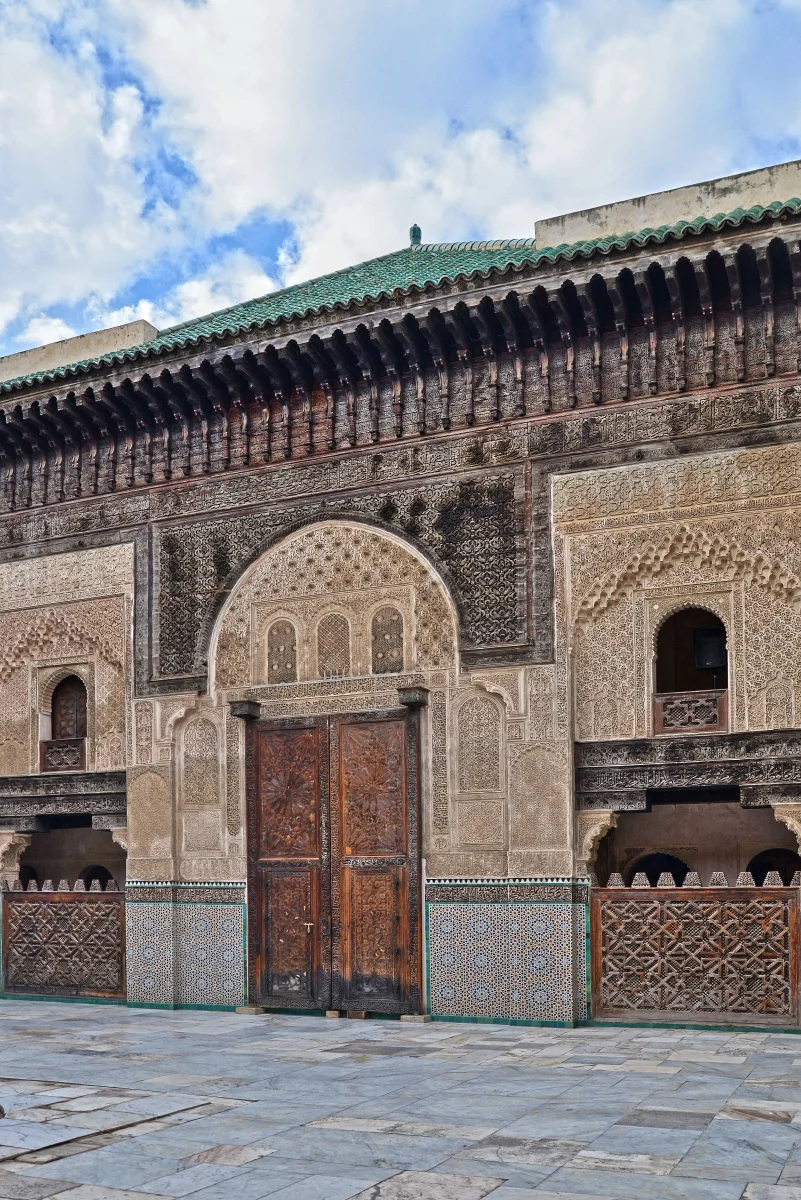
Geometric zellige, finely carved stucco, sculpted cedarwood, calligraphy and marble surround a central courtyard whose proportions and decorative richness reflect the extraordinary level of craftsmanship achieved by the artisans of Fez in the 14th century.
Built between 1323 and 1325 during the reign of the Marinid sultan Abu Sa'id Uthman II, Al-Attarine was primarily an institution dedicated to education and student accommodation.
Its location was no coincidence.
The madrasa stands immediately beside Al Quaraouiyine, which was already one of the main religious and intellectual centres of Fez.
It was also built in the historic district of merchants selling perfumes, spices and aromatic products.
This commercial environment gave the madrasa its name: Al-Attarine, meaning “the perfumers” or “the merchants of spices and perfumes”.
The madrasa therefore offers a glimpse into several dimensions of Fez within a single monument:
education, religion, craftsmanship, commerce and architecture.
Where is the Al-Attarine Madrasa?
The Al-Attarine Madrasa is located in Fez el-Bali, the oldest part of the Medina of Fez.
It stands very close to the Al Quaraouiyine Mosque and the historic commercial district surrounding it.
This location is essential to understanding its original purpose.
During the Middle Ages, students attending lessons around Al Quaraouiyine needed places where they could live and study.
Madrasas provided accommodation, particularly for students who came from other neighbourhoods, cities or regions.
Al-Attarine was therefore part of a genuine intellectual ecosystem made up of mosques, madrasas, libraries, teachers, students and markets.
The Medina of Fez has been listed as a UNESCO World Heritage Site since 1981.
It still preserves much of its historic urban fabric, including mosques, madrasas, funduqs, palaces, residences, workshops, fountains and souks.
Why is it called Al-Attarine?
The name Al-Attarine is directly linked to the district in which the madrasa was built.
The Arabic term attar traditionally refers to a merchant dealing in perfumes, aromatic substances, spices or medicinal products.
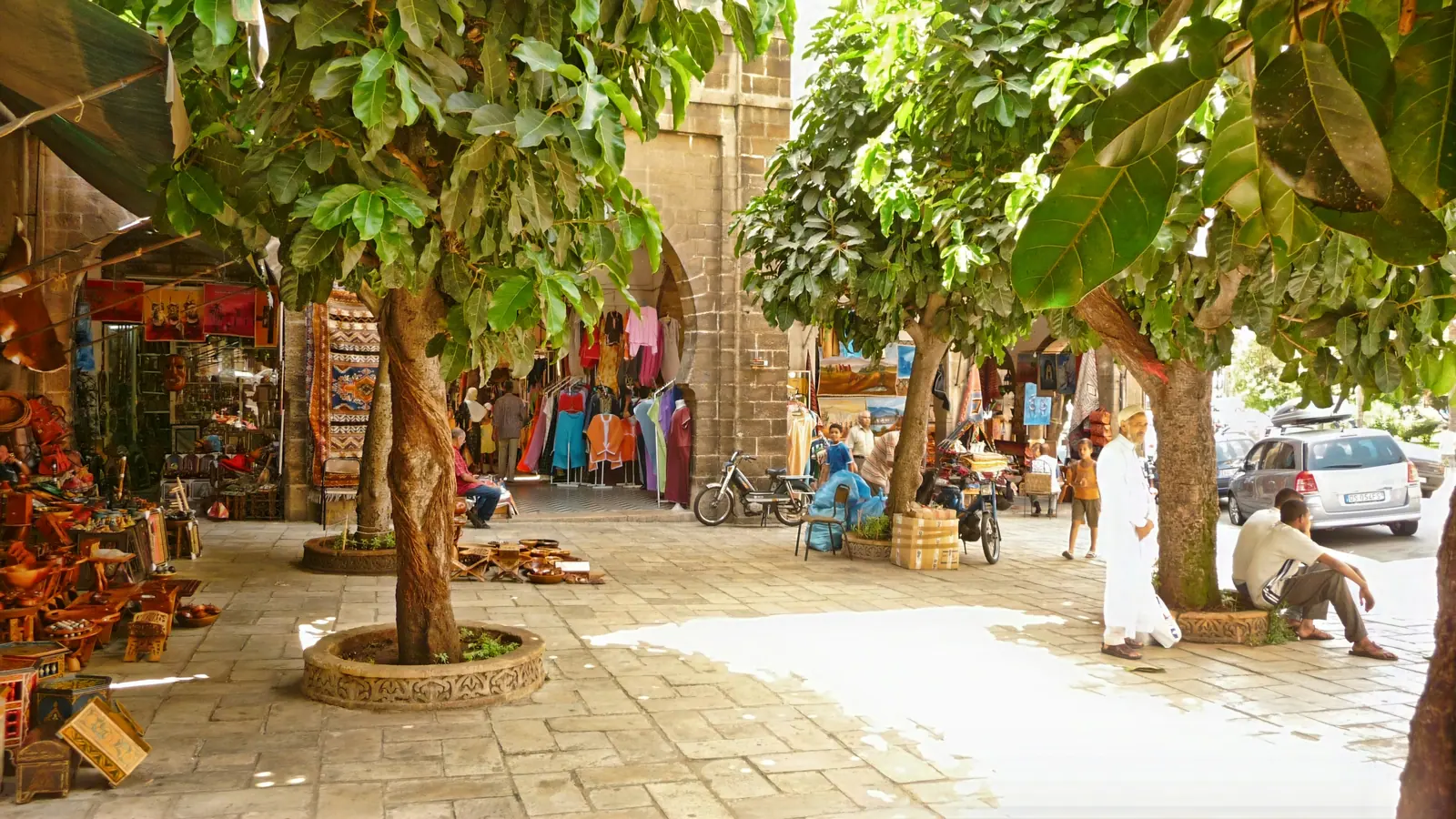
The Al-Attarine Souk developed close to Al Quaraouiyine.
A variety of precious and aromatic goods could be found there, including:
- spices;
- perfumes;
- aromatic plants;
- oils;
- incense;
- medicinal products;
- various goods associated with fragrances and personal care.
The proximity between the madrasa and this souk illustrates an essential characteristic of Fez.
In the traditional Medina, religious, educational, craft and commercial activities were not separated into completely independent districts.
Instead, they formed an extremely dense urban network.
A student could leave his room, cross a bustling souk and reach a place of learning within just a few minutes.
What is a madrasa?
A madrasa is historically an educational institution associated with the Islamic world.
In medieval Morocco, these establishments played an important role in religious and intellectual education.
Students could study subjects including:
- the Quran;
- Islamic law;
- Maliki jurisprudence;
- Arabic;
- grammar;
- theology;
- various sciences and intellectual disciplines depending on the teachers and the period.
But a madrasa was not simply a classroom.
It could also provide accommodation for students.
Small rooms were arranged around the courtyard and on the upper floors.
The madrasa was therefore simultaneously a place of study, a residence and a space for community life.
The Marinids and the golden age of Fez's madrasas
To understand Al-Attarine, we need to go back to the 13th and 14th centuries.
Fez was experiencing a particularly important period in its history under the Marinid dynasty.
The Marinid rulers transformed the city into a major political and intellectual centre.
In 1276, they founded Fez Jdid, the new royal city, while also investing heavily in the old Medina of Fez el-Bali.
One of the most visible aspects of their policy was the construction of madrasas.
Several major institutions were established, including:
- Seffarine Madrasa;
- Sahrij Madrasa;
- Al-Attarine Madrasa;
- Bou Inania Madrasa;
- other institutions dedicated to students and education.
These monuments reinforced Fez's position as a city of knowledge.
They also allowed the Marinid rulers to affirm their role as patrons of religious education and scholarly institutions.
Abu Sa'id Uthman II: the founder of Al-Attarine
The construction of the Al-Attarine Madrasa was commissioned by the Marinid sultan Abu Sa'id Uthman II.
He ruled Morocco in the early 14th century.
His reign was marked by several architectural and religious projects.
The foundation of Al-Attarine formed part of this policy.
Construction began in 1323, corresponding to the year 723 AH.
It was completed in 1325.
The speed of construction is remarkable considering the richness of the decoration.
Zellige craftsmen, plaster carvers, woodworkers, calligraphers, masons and other specialists had to work together to create a coherent architectural ensemble.
1323-1325: just a few years to create a masterpiece
Around two years were enough to complete most of the monument.
This gives us an idea of the highly developed organisation of the building trades in 14th-century Fez.
A madrasa such as Al-Attarine required the expertise of many specialists.
The building also had to meet practical requirements:
- accommodating students;
- providing spaces for teaching;
- incorporating a prayer hall;
- organising circulation;
- providing light and ventilation;
- ensuring access to water.
Yet these functions also had to be integrated into prestigious architecture.
The result is one of the finest examples of Marinid art.
A relatively compact architecture
Al-Attarine is not a gigantic monument.
Its impact comes instead from the way its architecture makes use of a relatively compact space.
The madrasa is embedded within an extremely dense urban fabric.
There was no possibility here of creating vast gardens or monumental exterior perspectives.
The architects therefore concentrated the main visual impact around the interior courtyard.
From the narrow streets outside, visitors can barely imagine the richness concealed within.
Once through the doorway, the space suddenly opens up.
This principle is characteristic of many traditional Moroccan monuments and residences:
architectural richness is primarily revealed on the inside.
The central courtyard: the heart of the madrasa
The central courtyard is naturally the focal point of the monument.
It organises the different parts of the building.
Around it are the prayer hall, entrances to the rooms and circulation areas.
The courtyard is also where most of the decoration is concentrated.
Several materials immediately catch the eye:
zellige, marble, carved stucco, cedarwood and calligraphy.
This layering creates a genuine vertical progression.
The most resistant materials generally occupy the lower sections.
More delicate and lightweight decoration appears higher up.
The courtyard therefore becomes a kind of living catalogue of Morocco's great decorative arts.
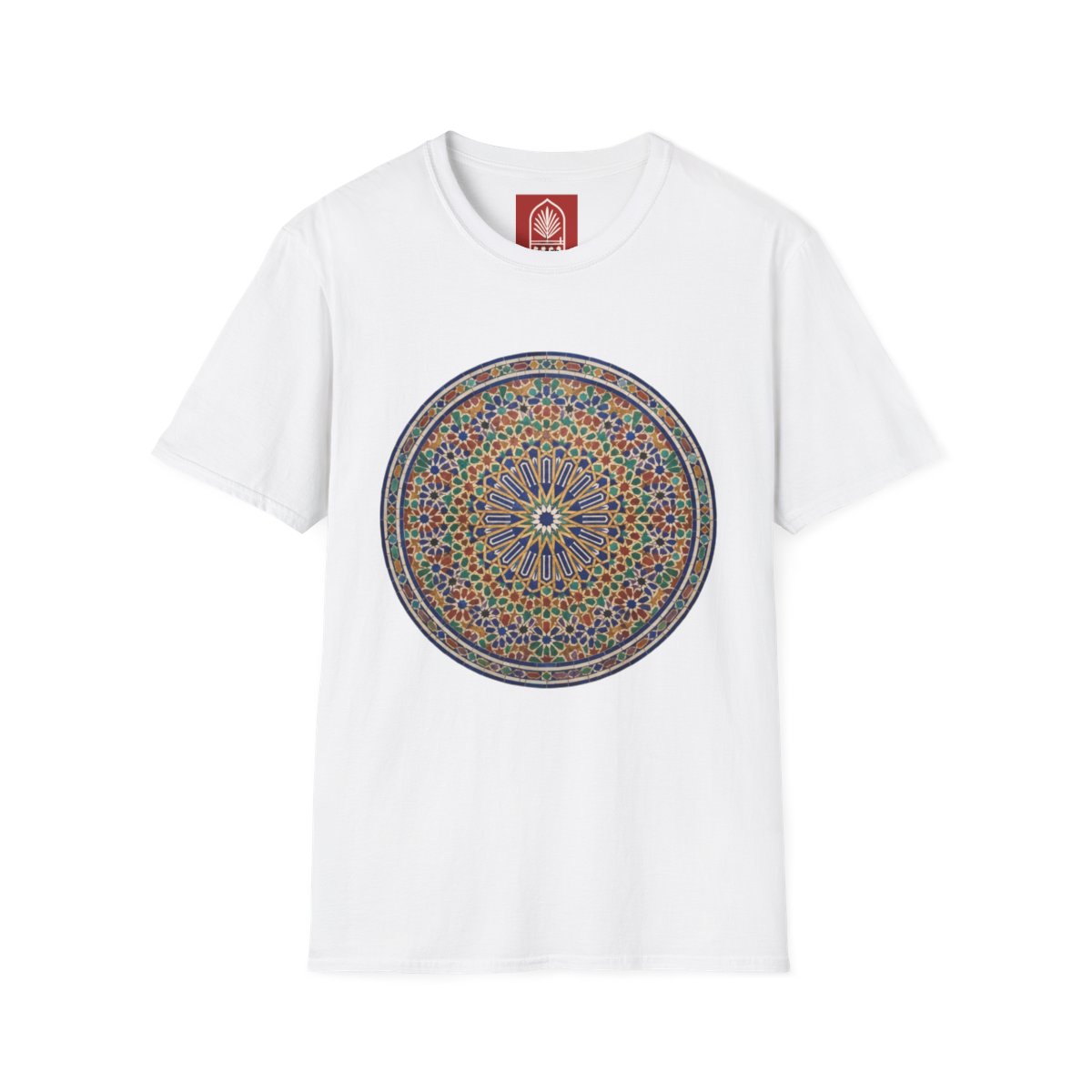
Zellige: geometry and precision
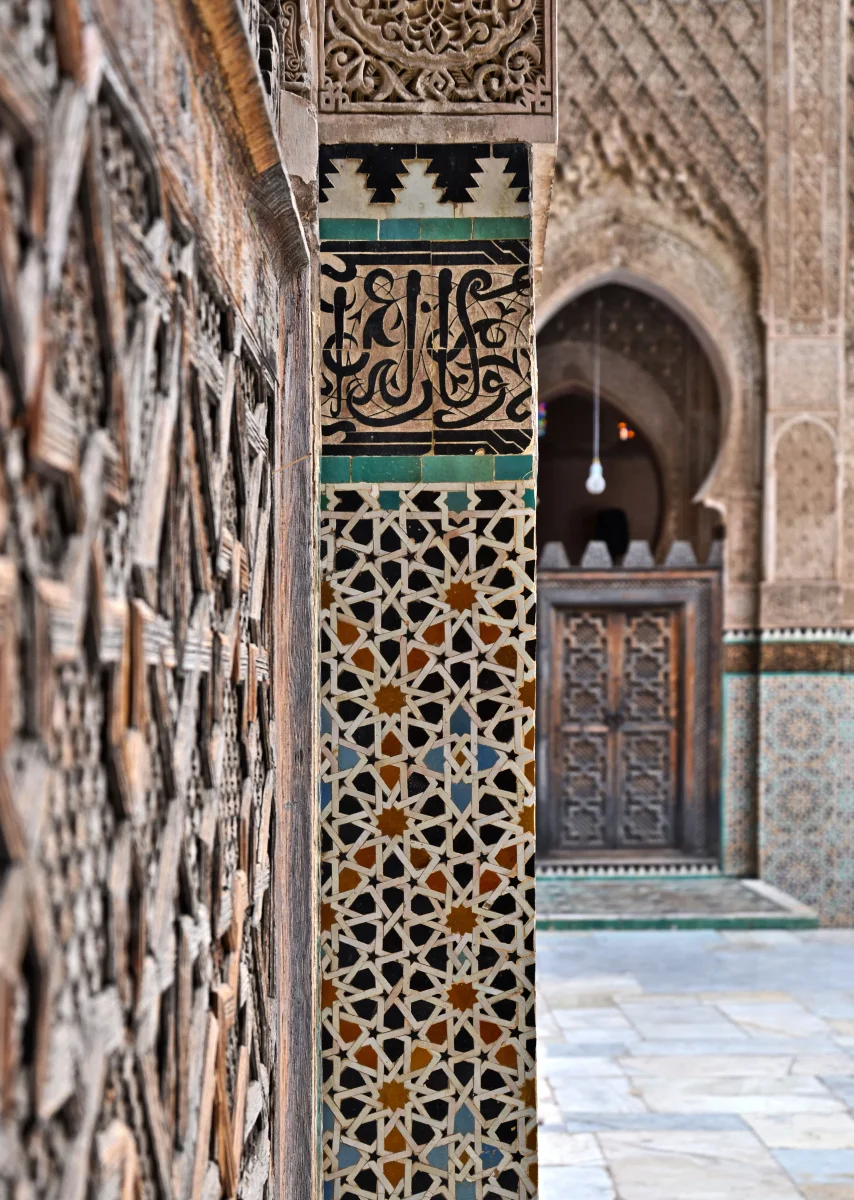
The lower sections of the courtyard are extensively decorated with zellige.
This technique involves cutting glazed terracotta tiles into small geometric shapes before assembling them into complex compositions.
These are not simply tiles printed with a pattern.
Each individual element is cut and then integrated into a much larger design.
Craftsmen use a variety of shapes:
- stars;
- polygons;
- diamonds;
- crosses;
- interlacing patterns;
- radial compositions.
The entire design is based on extremely precise geometric organisation.
From a distance, the decoration appears continuous.
Up close, you discover that it consists of hundreds or even thousands of individual pieces.
The complexity of the pattern emerges from the combination of relatively simple elements.
The colours of the zellige
The zellige of Al-Attarine uses several colours characteristic of the Moroccan tradition.
The compositions play with contrasts between different shades.
But the beauty of the decoration does not depend on colour alone.
Above all, it relies on geometric rhythm.
Patterns repeat, intersect and develop according to principles of symmetry.
To truly appreciate the zellige, try looking first at:
the overall composition and then at the individual pieces that form it.
This makes it easier to understand the enormous amount of work required to create a single panel.
Carved stucco
Above the zellige, the walls are covered with carved stucco.
This material allows for a much finer level of detail.
Craftsmen work the plaster before it has completely hardened.
They carve extraordinarily intricate patterns into its surface.
These include:
- arabesques;
- vegetal motifs;
- geometric patterns;
- interlacing designs;
- calligraphy.
Light plays an essential role.
The carvings are not extremely deep, but they are sufficient to create delicate shadows.
As a result, the decoration appears to change according to the direction of the light.
At certain times, the patterns appear particularly distinct.
At others, they become much more subtle.
Calligraphy: when writing becomes architecture
At Al-Attarine, Arabic calligraphy is directly integrated into the decoration.
Inscriptions extend across different architectural bands.
In Islamic architecture, writing can serve several purposes.
It may convey a religious formula.
It may communicate a text.
It can refer to the foundation of the monument or to the ruler who commissioned it.
But it also has an aesthetic dimension.
The shape of the letters, their rhythm and their arrangement contribute to the architectural composition.
At Al-Attarine, calligraphy should therefore not be seen as decoration added afterwards.
Writing is part of the building itself.
Cedarwood
The upper sections feature important structures made of cedarwood.
This material is closely associated with the historic architecture of Fez.
The Middle Atlas is home to significant cedar forests that supplied highly prized timber for centuries.
The wood has several qualities:
- strength;
- durability;
- relative ease of carving;
- aesthetic qualities;
- the possibility of being painted or assembled into complex structures.
At Al-Attarine, cedar is used for various architectural and decorative elements.
Doors, lintels, gallery elements and upper structures demonstrate the exceptional skill of the city's woodworkers.
Zellige, stucco and wood: three crafts forming a single architecture
One of the most fascinating aspects of Al-Attarine is the way different crafts seem to merge together.
A craftsman specialising in zellige does not work in the same way as a plaster carver.
A woodworker uses completely different tools and knowledge.
Yet when looking at the courtyard, none of these techniques appears completely isolated.
The zellige visually prepares the transition to the stucco.
The stucco follows the architectural lines.
Wood completes the upper sections.
Calligraphy connects different surfaces.
Several crafts therefore come together to create a single composition.
This coherence largely explains Al-Attarine's reputation.
Marble and prestigious materials
The madrasa's decoration is not limited to zellige, wood and stucco.
Marble also contributes to the richness of the ensemble.
Its use creates more restrained surfaces that contrast with the density of the surrounding patterns.
In monumental architecture, this kind of contrast is important.
A building entirely covered in complex patterns could become visually difficult to read.
Simpler surfaces allow the eye to rest before encountering another richly decorated area.
This alternation contributes to the overall balance of the courtyard.
The prayer hall
The madrasa also contains a prayer hall.
It lies beyond the courtyard.
Its presence reminds us that medieval education in an institution such as Al-Attarine was deeply connected with religious life.
The hall includes a mihrab, indicating the qibla, the direction of Mecca.
Its decoration continues the artistic vocabulary found throughout the rest of the building.
For the students, the different spaces therefore formed a coherent whole.
They could move from their rooms to their studies and then to prayer without leaving the institution.
More than thirty rooms for students
Behind the spectacular decoration of the courtyard are much simpler spaces.
The Al-Attarine Madrasa contains more than thirty rooms intended for students.
According to information preserved by Discover Islamic Art, these rooms were still accommodating around sixty students in the early 20th century.
This detail is particularly interesting.
It reminds us that the monument we now visit as an architectural masterpiece remained a genuine place of study and everyday life until relatively recent times.
The rooms are naturally far more modest than the courtyard.
The contrast is revealing.
The courtyard represented the institution.
The room served the student's everyday needs.
How did a student live at Al-Attarine?
A student living in the madrasa had a small room.
Daily life revolved around several activities:
- studying;
- reading;
- memorisation;
- lessons with teachers;
- prayer;
- discussions with other students.
Books at the time were manuscripts.
Before the spread of modern printing, gaining access to knowledge often involved consulting or copying texts.
The proximity of Al Quaraouiyine was therefore particularly important.
Students could live at Al-Attarine while benefiting from the intellectual environment that had developed around the great mosque.
Ibn al-Banna and scientific learning
Sources from Discover Islamic Art also mention the presence at Al-Attarine of the renowned scholar Ibn al-Banna al-Marrakushi, a 14th-century mathematician.
His name is associated with teaching at the madrasa.
This detail highlights an important point.
The intellectual history of madrasas should not be reduced to the simplified idea that only religious subjects were taught.
The great centres of medieval learning could also accommodate or transmit disciplines such as mathematics and other sciences.
Fez was fully part of this intellectual environment in the medieval Maghreb.
Al-Attarine and Al Quaraouiyine
The proximity between the madrasa and Al Quaraouiyine is essential.
The two institutions did not have exactly the same function.
But they belonged to the same educational landscape.
Al Quaraouiyine was a major religious and intellectual centre.
The surrounding madrasas complemented this environment by providing accommodation for students.
Several historic institutions associated with this culture of learning can be found within just a few minutes' walk.
This density helps explain why Fez could attract students from sometimes distant regions.
A city organised around knowledge
When visiting Fez el-Bali today, it is easy to view each monument separately.
But during the Middle Ages, these institutions were interconnected.
A madrasa could accommodate students.
A mosque could host teaching.
Libraries preserved manuscripts.
Souks supplied paper, ink, food, clothing and objects needed for daily life.
Funduqs accommodated merchants and travellers.
Craftsmen produced objects and maintained buildings.
The city itself formed an infrastructure for knowledge.
Al-Attarine is one of the best places to understand this organisation.
Al-Attarine and Bou Inania: two masterpieces to compare
Fez is home to another particularly famous Marinid monument: the Bou Inania Madrasa.
The two madrasas were built a few decades apart and provide an excellent opportunity to compare the evolution of Marinid architecture.
Al-Attarine was completed in 1325.
Bou Inania was built later, between 1350 and 1355.
Both monuments use similar decorative techniques:
- zellige;
- carved stucco;
- worked wood;
- calligraphy.
But their functions and organisation differ.
Bou Inania, in particular, also served as a Friday mosque and has its own minaret.
Al-Attarine is more directly connected to the intellectual environment of Al Quaraouiyine.
Visiting both monuments on the same day is therefore an excellent way to discover Marinid architecture.
Al-Attarine and the Nejjarine Museum
Nearby is the Nejjarine Museum of Wooden Arts and Crafts.
This visit complements Al-Attarine particularly well.
At the madrasa, visitors can observe wood directly integrated into the architecture.
At Nejjarine, they can deepen their understanding of traditional Moroccan woodworking crafts, tools and uses.
Together, the two visits allow you to move from the monument to the technique behind it.
You no longer see only a carved door.
You begin to imagine the craftsman, his tools, the material and the many hours required to create it.
Decoration reflecting the prestige of knowledge
Why devote so many resources to decorating a school?
It is an important question.
Today, we often associate educational institutions with primarily functional architecture.
In the Marinid context, however, the madrasa also fulfilled a symbolic role.
It represented:
- the prestige of knowledge;
- the power of the founding ruler;
- the importance of religion;
- the intellectual reputation of the city;
- the excellence of its craftsmen.
The spectacular decoration of Al-Attarine should therefore be understood as a genuine political, religious and cultural language.
The monument demonstrates that knowledge deserved prestigious architecture.
Al-Attarine in the UNESCO-listed Medina of Fez
Since 1981, the Medina of Fez has been listed as a UNESCO World Heritage Site.
UNESCO notes in particular that Fez reached its height under the Marinids during the 13th and 14th centuries.
Many of the Medina's most important historic monuments date precisely from this period.
UNESCO also highlights the continuity of architectural skills developed over more than ten centuries.
Al-Attarine is a remarkable example of this history.
To learn more, visit UNESCO — Medina of Fez.
Why is Al-Attarine considered a masterpiece?
Al-Attarine does not impress through sheer size.
It impresses through its artistic density and balance.
Almost every important surface contributes to the composition.
Yet the decoration never feels as though it has been added without organisation.
Each material has a specific role.
The zellige provides structure.
The stucco adds delicacy and lightness.
The wood brings depth and warmth.
The marble creates visual breathing spaces.
The calligraphy transforms writing into architecture.
The light gradually reveals the relief of the decoration.
The overall impression is that architecture and decoration were conceived together.
This is probably one of the reasons why Al-Attarine is regularly regarded as one of the great achievements of Marinid architecture in Fez.
What to look for during your visit
The madrasa can be visited relatively quickly.
But that would be a shame.
Its greatest interest lies in the details.
The zellige composition
Do not look only at the colours.
Get close enough to understand how the small geometric pieces are assembled.
The transitions between materials
Notice where the zellige ends and the stucco begins.
Then observe the transition towards the wood.
The inscriptions
The calligraphic bands are not secondary elements.
They form part of the monument's visual organisation.
The carved wood
Look up.
A significant amount of craftsmanship can be found in the upper sections.
The student rooms
If they are accessible during your visit, compare their simplicity with the richness of the courtyard.
This contrast helps reveal the building's true purpose.
The prayer hall
Observe how it is integrated into the main axis of the courtyard.
Take the time to look up
In many historic monuments, visitors mainly focus on what is at eye level.
At Al-Attarine, much of the decoration is above you.
Cornices, carved wood, inscriptions and upper structures deserve careful attention.
Try visually exploring the monument from the floor towards the ceiling.
Start with the zellige.
Then move to the stucco.
Identify the inscriptions.
Finish with the wood.
This vertical reading helps reveal the decorative logic of the building.
How long should you spend at Al-Attarine?
For a standard visit, around 30 to 45 minutes should give you enough time to properly observe the madrasa.
Visitors interested in architecture, Islamic art or photography can easily spend longer.
The size of the monument is not what determines the length of the visit.
The details do.
A single section of wall may combine several different craft techniques.
It is therefore best to explore slowly.
When should you visit the Al-Attarine Madrasa?
The madrasa is located in a very busy part of Fez el-Bali.
The morning can be particularly pleasant for discovering this area of the Medina before the busiest periods of the day.
Natural light also interacts beautifully with the relief of the decoration.
Depending on the time of day, some stucco patterns become more or less visible.
As opening hours and access conditions may change, it is advisable to check locally available information before your visit.
What to see around the Al-Attarine Madrasa
The madrasa lies in one of the richest heritage areas of Fez.
Several major monuments are within walking distance.
Al Quaraouiyine
The Al Quaraouiyine Mosque and University is located very close by.
It is an essential landmark for understanding the intellectual history of the city.
Nejjarine Museum
The Nejjarine Museum of Wooden Arts and Crafts provides a deeper insight into traditional Moroccan woodworking.
Al-Attarine Souk
The historic commercial district directly recalls the origin of the madrasa's name.
Although activities have evolved over time, the commercial environment remains essential to understanding the monument.
Seffarine Square
Seffarine Square has historically been associated with metalworking.
It offers another perspective on Fez's craft heritage.
Bou Inania Madrasa
Higher up in the Medina, the Bou Inania Madrasa perfectly complements a visit to Al-Attarine.
Together, the two monuments allow visitors to compare two major masterpieces of 14th-century Marinid architecture.
A heritage itinerary around Al-Attarine
For a coherent exploration of the historic heart of Fez, you can follow a route such as:
Nejjarine Museum → Al-Attarine Souk → Al Quaraouiyine → Al-Attarine Madrasa → Seffarine Square.
For a longer visit:
Bab Boujloud → Bou Inania Madrasa → Talaa Kebira → Nejjarine Museum → Al Quaraouiyine → Al-Attarine Madrasa → Seffarine Square.
This itinerary reveals several dimensions of the Medina:
- architecture;
- religion;
- education;
- craftsmanship;
- commerce;
- urban organisation.
The monuments then cease to appear as isolated attractions.
Instead, they become different parts of the same historic city.
Why visit the Al-Attarine Madrasa?
Al-Attarine is one of those monuments that helps visitors understand Fez beyond its narrow streets and souks.
It tells the story of a city where knowledge was integrated into the urban environment.
Students lived in the rooms surrounding the courtyard.
Teachers passed on their knowledge.
Al Quaraouiyine stood just a few steps away.
Outside, merchants selling perfumes, spices and other products filled the souk with activity.
And to build the madrasa, some of the city's finest craftsmen worked with zellige, plaster, wood and marble.
All of this came together within just a few dozen metres.
Perhaps this is what makes Al-Attarine so important.
It does not merely tell the story of Marinid architecture.
It tells us how a city of knowledge functioned in the 14th century.
Today, students no longer occupy the madrasa as they once did.
But their presence can still be felt in the organisation of the building.
The rooms remain.
The prayer hall preserves its historical role within the architecture.
The proximity of Al Quaraouiyine is still evident.
And the courtyard continues to testify to the extraordinary craftsmanship of the artisans of Fez.
Al-Attarine was not simply a beautiful school. It formed part of an urban system dedicated to the transmission of knowledge.
That is the story to look for behind the zellige and carved decoration.
Practical information
Name: Al-Attarine Madrasa
Other names: Madrasa al-'Attarin / Al-Attarine Madrasa
Location: Fez el-Bali, Medina of Fez
Dynasty: Marinid
Founder: Sultan Abu Sa'id Uthman II
Construction began: 1323
Completed: 1325
Historical function: educational institution and student residence
Number of rooms: more than 30 rooms intended for students
Architecture: zellige, carved stucco, cedarwood, marble and calligraphy
Nearby: Al Quaraouiyine, Nejjarine Museum, Al-Attarine Souk, Seffarine Square and Bou Inania Madrasa
Recommended visit duration: approximately 30 to 45 minutes
World Heritage: located within the Medina of Fez, a UNESCO World Heritage Site since 1981
Sources and references
- UNESCO — Medina of Fez
- Archnet — Madrasa al-'Attarin, Fez
- Discover Islamic Art — Al-Attarine Madrasa
- UNESCO — Islamic Architecture of Al-Andalus and the Maghreb
- UNESCO — International Campaign for the Safeguarding of the Medina of Fez
MoroccoMuseum tip: don't look at Al-Attarine simply as a richly decorated courtyard. Start by observing the zellige at floor level, then gradually move your gaze upwards towards the stucco, inscriptions and carved wood. Then think about the small rooms surrounding this space: behind the spectacular architecture was a genuine residence where students lived and studied just a few steps from Al Quaraouiyine.