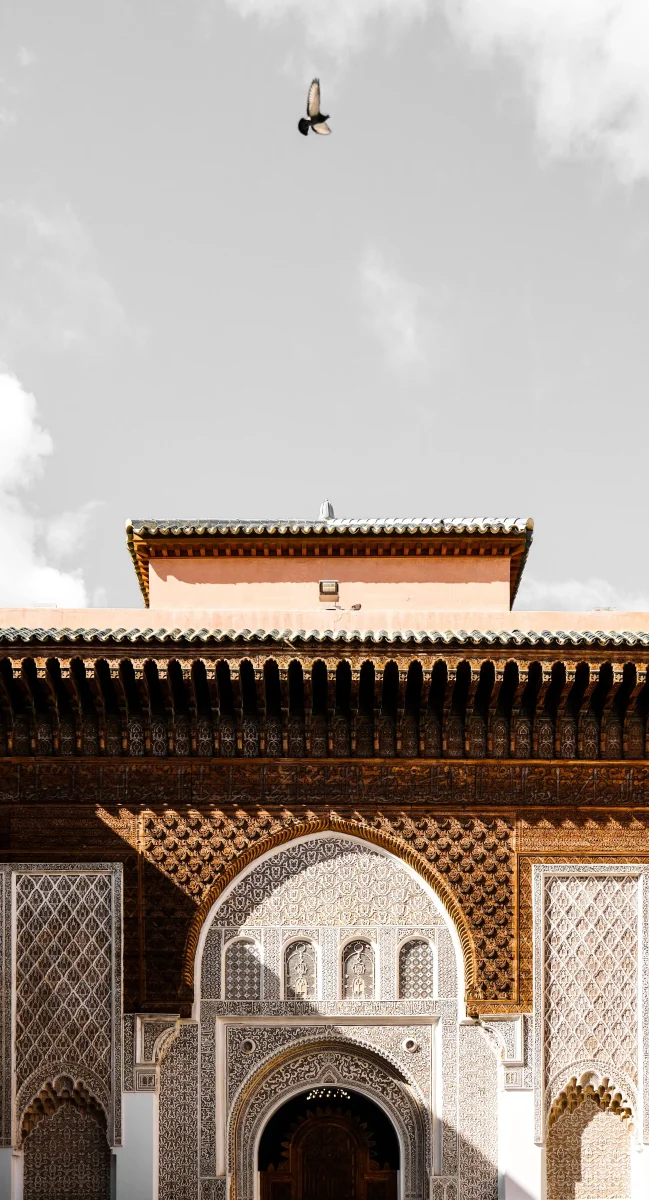
Bou Inania Madrasa in Fez: A Marinid Masterpiece at the Heart of the Medina
In the heart of Fez el-Bali, along one of the medina's main thoroughfares, stands one of the most refined monuments of medieval Moroccan architecture: the Bou Inania Madrasa.
Zellige, carved cedar wood, chiselled stucco, calligraphy and a monumental courtyard come together here in a décor of remarkable richness.
But Bou Inania is not simply a monument to be admired.
In the 14th century, it functioned simultaneously as a place of learning, a student residence and a mosque.
Students lived here, studying the Quran, religious law and various other disciplines under their teachers, while the prayer hall also welcomed the faithful.
Built under the reign of the Marinid sultan Abu Inan Faris between 1350 and 1355, it belongs to one of the most brilliant periods in the history of Fez.
The city was then one of the great political, religious and intellectual centres of the Maghreb.
Even today, the Bou Inania Madrasa helps us understand how architecture, education and religion could be brought together within a single monument.
Where Is the Bou Inania Madrasa Located?
The Bou Inania Madrasa stands in Fez el-Bali, at the heart of the historic medina of Fez.
It borders Talaa Kebira, one of the medina's principal historic thoroughfares.
This location is particularly interesting.
Unlike several other madrasas in Fez, built in the immediate vicinity of the Al Quaraouiyine mosque, Bou Inania is situated in the western part of the medina.
It also lies along a route naturally taken by visitors entering the old city from the Bab Boujloud area.
The medina of Fez has been inscribed on the UNESCO World Heritage List since 1981.
UNESCO considers it one of the largest and best-preserved historic cities in the Arab-Muslim world.
Its urban fabric still brings together mosques, madrasas, funduqs, workshops, palaces, traditional houses, souks and fountains.
The Bou Inania Madrasa is fully part of this exceptional historic ensemble.
What Is a Madrasa?
A madrasa is historically an educational institution associated with the Islamic world.
In medieval Morocco, madrasas played a particularly important role in religious and intellectual training.
They mainly welcomed students who came to follow the teaching of masters specialised in various disciplines.
Subjects taught could include:
- the Quran;
- Islamic law;
- Maliki jurisprudence;
- the Arabic language;
- grammar;
- theology;
- religious traditions.
Madrasas also offered rooms allowing students from other towns or regions to live close to their teachers.
They were therefore at once schools, residences and places of knowledge transmission.
In Fez, their development was closely linked to the intellectual prestige of Al Quaraouiyine and to the policy of the Marinid sovereigns.
The Marinids and the Intellectual Golden Age of Fez
To understand Bou Inania, one must go back to the 14th century.
Morocco was then governed by the Marinid dynasty.
The Marinid sovereigns attached particular importance to Fez.
In 1276, they founded Fez Jdid, a new royal city located near the old medina.
But they also invested heavily in the religious and educational institutions of Fez el-Bali.
Several madrasas were built or developed during this period.
Among the most famous are:
- the Seffarine Madrasa;
- the Sahrij Madrasa;
- the Al-Attarine Madrasa;
- the Bou Inania Madrasa.
These institutions notably allowed students coming to follow the teachings given in Fez to be accommodated.
Building madrasas was also a way for sovereigns to affirm their role as protectors of religion, education and knowledge.
Bou Inania represents one of the high points of this monumental policy.
Sultan Abu Inan Faris: The Man Behind the Madrasa
The Bou Inania Madrasa bears the name of its founder, the Marinid sultan Abu Inan Faris.
Abu Inan became sovereign in the mid-14th century, succeeding his father, the powerful sultan Abu al-Hasan.
His reign was relatively short, but marked by significant architectural activity.
Bou Inania is probably his most famous monument in Fez.
The madrasa was initially known under a name linked to the sovereign's title, but the name Bou Inania gradually became established.
The project reflects the sultan's ambition.
He did not simply wish to build a residence for students.
The monument was also meant to have a genuine religious function and to embody the prestige of his reign.
Building Bou Inania Between 1350 and 1355
An inscription preserved within the monument allows the start of construction to be precisely dated.
Building began in 1350, corresponding to the year 751 of the Hijra.
Work was completed around 1355.
In just a few years, craftsmen, architects and master decorators created one of the most sophisticated ensembles of Marinid architecture.
The cost of construction appears to have been considerable.
A well-known traditional anecdote recounts that when the accounts for the building work were presented to Sultan Abu Inan, he refused to be troubled by the sums spent, considering that the monument's beauty justified its cost.
Even though this story belongs partly to tradition, it perfectly illustrates the reputation for architectural richness associated with Bou Inania.
A Different Kind of Madrasa
Bou Inania has one important distinguishing feature.
It was not simply a school.
It also served as the neighbourhood's Friday mosque.
This dual function is unusual for a Moroccan madrasa.
It explains several architectural characteristics of the monument, notably the presence of a minaret overlooking the street.
A mosque hosting Friday collective prayer required the elements necessary for this religious function.
Bou Inania is therefore a hybrid monument:
madrasa, student residence and mosque all at once.
This combination partly explains its scale and the exceptional richness of its architecture.
The Minaret of Bou Inania
From the streets of the medina, one of the first visible elements is the minaret of Bou Inania.
It rises above the buildings of Talaa Kebira.
Its presence immediately distinguishes Bou Inania from most other Moroccan madrasas.
The minaret is decorated according to traditional Moroccan architectural vocabulary.
It notably features geometric compositions and zellige elements.
Its silhouette recalls the monument's particular religious role.
In the medieval period, it also served to visually inscribe the madrasa within the religious landscape of Fez.
Entering Bou Inania
Coming from the bustle of Talaa Kebira, passing into the interior of the madrasa produces an immediate change of atmosphere.
The street is narrow, busy with shops and full of activity.
A few metres further on, visitors discover a space built around a perfectly organised central courtyard.
This transition between the urban exterior and the architectural interior is one of the characteristic features of the medina's great monuments.
The exterior façades can remain relatively discreet.
The richness reveals itself mainly inside.
Bou Inania offers one of the most impressive examples of this.
The Central Courtyard
The central courtyard forms the architectural heart of the madrasa.
It organises the entire building.
Around it develop the prayer hall, the teaching spaces and the access points to the students' rooms.
The floor and the lower parts of the walls display extensive zellige decoration.
Higher up appear carved stucco and wooden elements.
This organisation creates a genuine visual progression.
The decoration changes with height:
zellige at the base, stucco in the middle, wood in the upper sections.
This principle is found in several great Moroccan monuments.
The Zellige of Bou Inania
Zellige occupies an essential place in the madrasa's décor.
These mosaics are made from small pieces of glazed terracotta, cut and then assembled according to precise geometric compositions.
Craftsmen use different shapes to create complex patterns.
Stars, polygons and interlacing designs come together according to a particularly elaborate mathematical logic.
Zellige also has a practical function.
Installed on the lower parts of the walls, it forms a solid surface that is more resistant to moisture.
But at Bou Inania, this technical function also becomes an art form.
Geometry transforms the wall into a visual composition.
The Carved Stucco
Above the zellige panels appears another material characteristic of Moroccan architecture: carved stucco.
Craftsmen work the still-soft plaster to create motifs of extraordinary finesse.
Visible elements include:
- arabesques;
- plant motifs;
- geometric compositions;
- calligraphic inscriptions;
- interlacing patterns.
The relatively shallow depth of the carving allows light to create very fine shadows.
Depending on the time of day, the motifs therefore appear to change.
At Bou Inania, the walls become almost like textile surfaces sculpted into the material.
Calligraphy as Decoration and Message
Bou Inania's decoration is not purely geometric.
Arabic calligraphy also occupies an essential place.
Several inscriptions run across the walls and architectural elements.
In Islamic religious architecture, writing has a particular function.
It can convey verses, religious formulas, information about the monument, or references to the sovereign who commissioned its construction.
The written word thus becomes architecture in its own right.
At Bou Inania, the inscriptions should therefore not be seen merely as ornaments.
They are part of the meaning of the building.
Cedar Wood
In the upper parts of the madrasa, carved wood plays a major role.
Cedar is particularly associated with the historic architecture of Fez.
Sourced notably from the forests of the Middle Atlas, it has qualities that explain its use in Morocco's great monuments.
It is resistant, relatively easy to work, and particularly well suited to carving.
At Bou Inania, wood appears notably in the doors, lintels, ceilings and various decorative elements.
Carved and sometimes painted, it completes the combination of zellige and stucco.
Three Materials, One Decorative Scheme
One of Bou Inania's great achievements lies in the combination of three major crafts:
- zellige;
- carved stucco;
- worked cedar wood.
Each material has its own techniques.
Each craft requires specialised artisans.
Yet when brought together, they appear to belong to a single composition.
This ability to unite different crafts into a coherent whole is one of the defining features of Moroccan architecture.
Bou Inania is one of the best places in Fez to observe this convergence.
The Prayer Hall
Beyond the courtyard lies the prayer hall.
It reminds visitors that Bou Inania was not simply a school.
The monument also possessed a religious function fully integrated into its architecture.
The hall is oriented towards the qibla and includes the mihrab, a niche indicating the direction of Mecca.
The decoration here retains the richness characteristic of the whole ensemble.
The passage from the courtyard to the prayer hall helps illustrate how teaching and religion were closely connected within the madrasa.
For the students who lived here, learning was not separate from religious practice.
Both were part of the same daily environment.
The Students' Rooms
Behind the monumentality of the decoration lay a much simpler reality: students actually lived in the madrasa.
The upper levels contained small student cells.
These rooms were far more modest than the central courtyard.
They were mainly used for sleeping, reading and studying.
This contrast is particularly interesting.
The communal spaces, designed to represent the institution and the prestige of its founder, were decorated spectacularly.
The students' private spaces were much more modest.
This reminds us that Bou Inania was not simply a ceremonial monument.
It was a place where people lived.
How Did Students Live in a Madrasa?
Students sometimes came from distant regions to study in Fez.
A madrasa provided them with accommodation close to the places where teaching took place.
Daily life was organised around study, prayer and community life.
Students could attend the lessons of one or more teachers and then continue their studies independently.
Manuscripts played an essential role.
Before modern printing, books were copied by hand.
Studying therefore also involved consulting, copying and memorising texts.
Much of Fez's prestige rested on this ecosystem of mosques, madrasas, libraries, teachers and students.
Bou Inania and Al Quaraouiyine
The Bou Inania Madrasa must be understood within the wider intellectual network of medieval Fez.
At the heart of this network was naturally Al Quaraouiyine.
Founded in the 9th century as a mosque, Al Quaraouiyine gradually became one of the leading centres of learning in the Maghreb.
Various institutions for students developed around it.
The Marinid madrasas helped strengthen this intellectual environment.
Bou Inania therefore forms part of a much broader history:
that of Fez as a city of learning.
Bou Inania and the Al-Attarine Madrasa
Just a few minutes' walk separate Bou Inania from another Marinid masterpiece: the Al-Attarine Madrasa.
The two monuments offer an opportunity to compare two major expressions of 14th-century architecture.
Al-Attarine was built a few decades earlier, during the reign of Sultan Abu Sa'id Uthman II.
Bou Inania belongs to the following generation.
Both buildings use zellige, carved stucco and wood.
However, their locations, proportions and functions are not entirely identical.
Visiting both helps visitors understand that Marinid architecture did not simply reproduce a single model.
Each madrasa adapted its organisation to its location and function.
Dar al-Magana: The Clock Opposite Bou Inania
Directly opposite the madrasa stands one of the most intriguing elements of Fez's heritage: Dar al-Magana.
Its façade contains several elements associated with an ancient water-powered or hydraulic clock.
The mechanism was connected to the Bou Inania complex.
Its exact operation has long attracted the attention of historians and specialists in ancient technologies.
The façade still preserves a series of brackets and openings that formed part of the mechanism.
Although the complete system is no longer operational, Dar al-Magana remains a remarkable testimony to the scientific and technological history of Fez.
When visiting Bou Inania, remember to look across Talaa Kebira as well.
Architecture Financed to Last
Like many major religious institutions in the medieval Islamic world, Bou Inania benefited from revenues generated by properties placed under the system of habous, also known as waqf.
This system made it possible to dedicate certain revenues permanently to the maintenance and operation of an institution.
Shops, land or other properties could contribute to financing a mosque, madrasa or charitable institution.
This economic organisation is essential for understanding how major educational institutions could function over the long term.
A madrasa did not only require money to be built.
Its maintenance, teachers and daily operations also had to be financed.
Bou Inania and the World Heritage of Fez
The Bou Inania Madrasa is located within the Medina of Fez, which has been inscribed on the UNESCO World Heritage List since 1981.
UNESCO highlights the exceptional richness of the city's architecture and the continuity of techniques developed over more than ten centuries.
Local, Andalusian, Eastern and African influences came together in Fez to create an exceptional urban heritage.
Bou Inania perfectly illustrates this history.
The monument brings together architecture, calligraphy, geometry, woodworking and artisanal craftsmanship within a space that was also dedicated to education and religion.
To learn more, visit UNESCO — Medina of Fez.
Why Is Bou Inania Considered a Masterpiece?
The beauty of Bou Inania does not simply come from the abundance of its decoration.
It lies in its balance.
Zellige structures the lower sections.
Stucco lightens the central surfaces.
Wood brings warmth and depth to the upper sections.
Calligraphy extends across these different materials.
Water and light complete the composition.
Every detail is rich, yet none appears entirely separate from the others.
Architecture and decoration work together as a single composition.
This mastery explains why Bou Inania is regularly regarded as one of the finest achievements of Marinid architecture.
What to Observe During Your Visit
It is easy to enter Bou Inania, photograph the courtyard and leave a few minutes later.
But doing so would mean missing much of what makes the monument exceptional.
Take time to observe the details.
The Zellige at Ground Level
Move closer to the geometric compositions.
Try to distinguish the individual pieces that form the patterns.
The Inscriptions
Look up towards the calligraphic bands.
Writing is an integral part of the architecture.
The Woodwork
Observe the differences between purely structural elements and the finely carved pieces.
The Central Courtyard
Stand in several different places.
The perspectives change depending on the angle from which you view the galleries, prayer hall and upper levels.
The Minaret
Do not forget to observe it from the street.
It is one of Bou Inania's most distinctive features.
Dar al-Magana
Before leaving the area, look at the façade opposite the madrasa and the remains of its famous clock mechanism.
How Much Time Should You Allow to Visit Bou Inania?
For a first visit, allow approximately 30 to 45 minutes.
Visitors interested in architecture, photography or art history can easily spend longer.
The madrasa is not enormous.
Its richness lies mainly in its details.
It is therefore better to slow down rather than try to move quickly through every space.
When Should You Visit the Bou Inania Madrasa?
The morning can be particularly pleasant for exploring the medina and discovering Bou Inania before the busiest periods of the day.
Light also plays an important role in how the monument is perceived.
Depending on the time of day, shadows reveal the relief of the stucco, the colours of the zellige and the carvings of the wood in different ways.
As access conditions and opening hours may change, it is advisable to check locally available information before your visit.
What to See Around Bou Inania?
The madrasa's location makes it very easy to include in a walking itinerary through Fes el-Bali.
Bab Boujloud
The famous Bab Boujloud, often known as the Blue Gate, is located nearby.
It is one of the main entrances to the medina.
Talaa Kebira
The madrasa opens directly onto Talaa Kebira, one of the main historic streets of Fez.
Walking downhill along it takes you through souks, workshops, shops and monuments towards the religious heart of the medina.
Al Quaraouiyine
The Al Quaraouiyine Mosque and University is one of Fez's great intellectual landmarks.
Its history helps explain why so many madrasas were built throughout the city.
Nejjarine Museum
Housed in an 18th-century funduq, the Nejjarine Museum of Wooden Arts and Crafts offers a deeper understanding of Moroccan artisanal expertise.
After observing the carved wood of Bou Inania, a visit to Nejjarine becomes particularly interesting.
Al-Attarine Madrasa
The Al-Attarine Madrasa is another masterpiece of Marinid architecture.
Visiting Al-Attarine and Bou Inania on the same day allows you to directly compare two of the finest educational monuments of medieval Fez.
A Heritage Itinerary Through Fes el-Bali
To understand the intellectual and artisanal history of Fez, one particularly coherent itinerary is:
Bab Boujloud → Bou Inania Madrasa → Talaa Kebira → Nejjarine Museum → Al Quaraouiyine → Al-Attarine Madrasa → Seffarine Quarter.
This route allows visitors to discover several dimensions of the city:
- Marinid architecture;
- education;
- religion;
- commerce;
- craftsmanship;
- the organisation of the medina.
Rather than visiting each monument as an isolated site, this itinerary helps reveal the connections between them.
Why Visit the Bou Inania Madrasa?
Bou Inania alone embodies much of what makes the heritage of Fez exceptional.
First, it tells the story of the Marinids, a dynasty that made the city one of the great political and intellectual centres of medieval Morocco.
It also tells the story of the students who came to live and study in the madrasas.
It demonstrates the extraordinary level achieved by Moroccan craftsmen in zellige, stucco, woodwork and calligraphy.
Finally, its dual function as both a madrasa and a mosque reminds us that in medieval Fez, education, religion and urban life were deeply interconnected.
But perhaps the true richness of Bou Inania becomes most apparent when we stop seeing it only as a spectacular monument.
Imagine the rooms occupied by students.
Teachers passing on their knowledge.
Worshippers entering for prayer.
Craftsmen spending years working on the walls, wood and mosaics.
Merchants moving along Talaa Kebira just outside the entrance.
Bou Inania was not a backdrop. It was part of the everyday life of Fez.
And it is precisely this relationship between monumental beauty and living history that makes it one of the essential places to discover in the medina today.
Practical Information
Name: Bou Inania Madrasa
Location: Talaa Kebira, Fes el-Bali, Fez
Dynasty: Marinid
Founder: Sultan Abu Inan Faris
Construction began: 1350
Completed: around 1355
Historic functions: madrasa, student residence and Friday mosque
Architecture: zellige, carved stucco, cedar wood, calligraphy and geometric decoration
Distinctive feature: a minaret, notably linked to its function as a mosque
Recommended visit duration: approximately 30 to 45 minutes
Nearby: Bab Boujloud, Dar al-Magana, Al Quaraouiyine, Al-Attarine Madrasa, Nejjarine Museum and the souks of Fez
World Heritage: located within the Medina of Fez, inscribed on the UNESCO World Heritage List since 1981
Sources and References
- UNESCO — Medina of Fez
- Discover Islamic Art — Bou Inania Madrasa in Fez
- Archnet — Madrasa al-Bu'inaniya, Fez
- UNESCO — International Campaign for the Safeguarding of the Medina of Fez
MoroccoMuseum tip: do not simply photograph the central courtyard. Begin by observing the zellige at ground level, then gradually move your gaze upwards towards the stucco and finally the carved wood. Reading the architecture from bottom to top helps reveal how several different crafts were brought together to create a single architectural composition. When leaving, also take a moment to look at the façade of Dar al-Magana opposite the madrasa.