The Mellah of Marrakech: History of the Jewish Quarter, Synagogue and Heritage
Just a few minutes from El Badi Palace and Place des Ferblantiers lies one of Marrakech's most distinctive historic districts: the Mellah, the city's historic Jewish quarter.
Its narrow streets, houses with balconies, shops, places of remembrance and the Salat Al Azama Synagogue tell an essential part of Marrakech's history, as well as the much older story of Morocco's Jewish communities.
The Mellah is not simply a neighborhood to cross on the way from one monument to another.
It offers a different perspective on Marrakech, shaped by several communities, distinctive craft traditions and centuries of commercial and cultural exchange.
Even today, a walk through the Mellah reveals this heritage through its architecture, handicrafts, places of worship and the Miara Jewish Cemetery.
The Foundation of the Marrakech Mellah in the 16th Century
The creation of the Mellah of Marrakech dates back to the 16th century, during the reign of the Saadian sultan Abdallah al-Ghalib.
The year 1558 is traditionally given as the date of its foundation, although historical research suggests that the establishment and final organization of the quarter probably took place over several years.
The district was established close to the royal Kasbah, in an area directly connected to the political center of Marrakech.
Its location was no coincidence.
Just a short walk away are today's El Badi Palace, built several decades later during the reign of Sultan Ahmad al-Mansur, and the Saadian Tombs.
The Mellah was therefore part of a particularly important area of Saadian Marrakech.
Over the centuries, it developed simultaneously as a residential district, a commercial center and a community space.
Merchants, artisans and families lived there around synagogues, markets and community institutions.
Why Is the Neighborhood Called the “Mellah”?
The term mellah historically refers to the Jewish quarters of several Moroccan cities.
The first Mellah was established in Fez in the 15th century, before this urban model appeared in other cities across the kingdom.
Over time, the word became closely associated with the historic Jewish quarters of Morocco.
Each Mellah, however, has its own history.
The Marrakech Mellah developed within the particular context of the Saadian dynasty and the city's growing political importance during the 16th century.
Its proximity to the royal palace was also an important characteristic of its location and organization.
More Than 2,000 Years of Jewish History in Morocco
The history of the Marrakech Mellah belongs to a much broader story.
Jewish presence in the territory of present-day Morocco dates back more than two thousand years, long before the arrival of Islam in North Africa.
Over the centuries, different communities developed in cities, rural regions, mountain areas and along the country's major trading routes.
This history therefore extends far beyond the Mellahs.
Jewish communities were established in Fez, Essaouira, Meknes, Rabat, Salé, Tetouan, Tangier, Sefrou and many other parts of Morocco.
Moroccan Jewish communities played important roles in commerce, craftsmanship, international trade, medicine, music and the intellectual life of the country.
Jewish Communities Before the Arrival of the Sephardim
Jewish communities already established in Morocco before the major migrations from the Iberian Peninsula are often referred to as Toshavim, meaning the communities already living in the country.
They had their own religious, linguistic and cultural traditions.
In some regions, Jewish communities had lived for generations alongside Amazigh or Arabic-speaking populations.
This diversity is essential to understanding Moroccan Judaism.
It was not a tradition born from a single migration.
Morocco's Jewish history developed through several communities and over many centuries.
1492: The Arrival of Sephardic Jews from the Iberian Peninsula
The year 1492 marked a major turning point in the Jewish history of the Maghreb.
Following the expulsion of Jews from the Spanish kingdoms, many Sephardic families left the Iberian Peninsula.
Some found refuge in Morocco.
These newcomers, often known as Megorashim, joined Jewish communities that were already established in several Moroccan cities.
They brought their religious traditions, culture, languages and commercial networks with them.
Gradually, local and Sephardic traditions met, blended or coexisted.
This history is particularly important for understanding Marrakech's Salat Al Azama Synagogue.
Salat Al Azama Synagogue
Hidden behind a relatively discreet doorway in the narrow streets of the Mellah, the Salat Al Azama Synagogue is today one of the most important places for discovering Marrakech's Jewish heritage.
It is also known as the Lazama Synagogue.
Its history is strongly associated with Sephardic communities who arrived in Morocco following the expulsions from the Iberian Peninsula.
Some traditions trace its origins to the late 15th century.
However, the architectural history of the building is more complex: as the present Mellah was established several decades later, it is preferable to distinguish the age of the community and its religious tradition from that of the building visible today.
This distinction provides a better understanding of a site that has evolved and been transformed over the centuries.
A Synagogue Organized Around an Interior Courtyard
From the street, there is little indication of what lies behind the walls.
Once inside, visitors discover an architectural layout centered around a central courtyard, a principle found in many traditional Moroccan buildings.
This organization recalls the riads and houses of the Medina.
The galleries, wooden elements, decorated surfaces and arrangement around the courtyard demonstrate how a Jewish place of worship could be fully integrated into the vocabulary of Moroccan architecture.
The architecture of Salat Al Azama therefore tells its own story of cultural encounters.
A Living Place of Worship
Salat Al Azama is not simply a historical monument.
The synagogue retains a religious function and remains an important place of remembrance for Marrakech's Jewish community.
This dimension is essential when visiting.
Entering Salat Al Azama is not simply about discovering an old building transformed into a tourist attraction.
It means entering a place that belongs to a religious and community tradition that remains alive today.
Respect and discretion are therefore naturally recommended.
The Museum at Salat Al Azama Synagogue
Part of the complex also presents documents and objects connected to Moroccan Jewish history.
Photographs, religious objects, documents and other elements of memory help place the synagogue within a much broader historical context.
The visit is particularly interesting for understanding why the Jewish history of Marrakech cannot be separated from the wider history of Morocco.
To prepare your visit, see the Salat Al Azama Synagogue page.
Practical Information
Admission: approximately 10 MAD, payable on site.
Listed opening hours: Sunday to Thursday from 9:00 am to 6:30 pm, Saturday from 9:00 am to 4:00 pm, closed on Friday.
Opening hours at a place of worship may change during religious holidays or under special circumstances.
It is therefore advisable to check the latest practical information before visiting.
The Distinctive Architecture of the Mellah
One of the most interesting things to do in the Mellah is simply to look up at the façades.
Some houses have a different layout from those found in other parts of the Medina.
Balconies, wooden galleries and windows facing the street contribute to the neighborhood's distinctive visual identity.
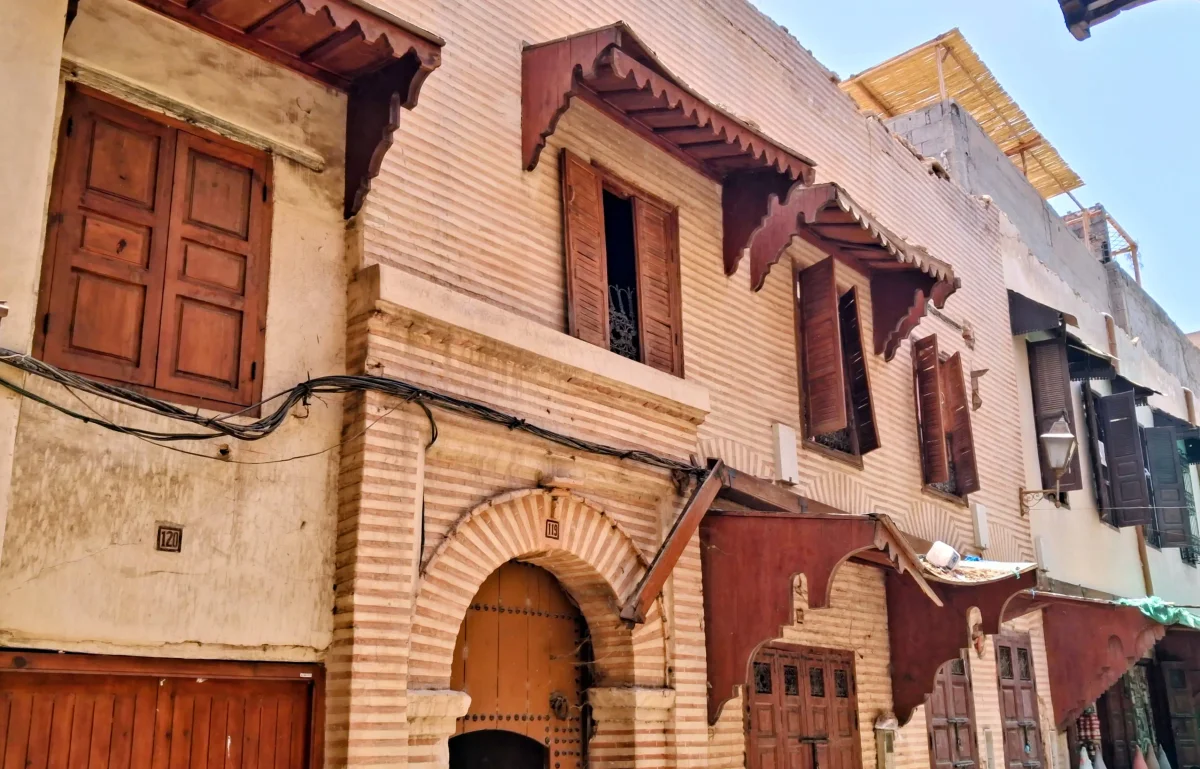
In many traditional houses in the Medina, family life is primarily organized around an interior courtyard.
The exterior façade therefore tends to remain relatively simple.
In some streets of the Mellah, openings, balconies and structures visible from the public space create a different relationship between the house and the street.
Limited space and the historical density of the neighborhood also encouraged the development of taller buildings.
These details are now among the most easily recognizable architectural features of the Mellah.
A Neighborhood of Artisans and Merchants
For several centuries, the Mellah was also an important economic area of Marrakech.
Moroccan Jewish communities were particularly active in trades related to commerce, jewelry, metalworking, textiles and international exchange.
This commercial history can still be perceived in the identity of some streets today.
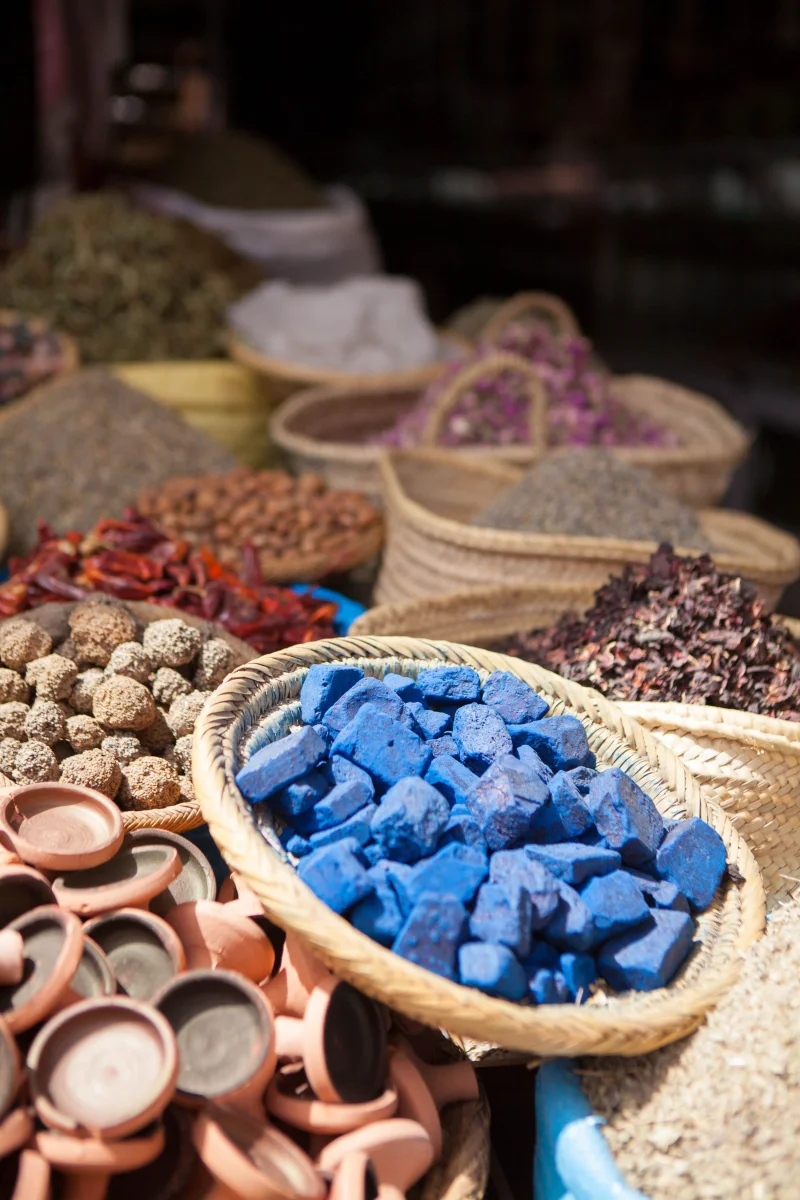
Shops selling spices, herbs, jewelry, antiques and handicrafts can still be found throughout the neighborhood.
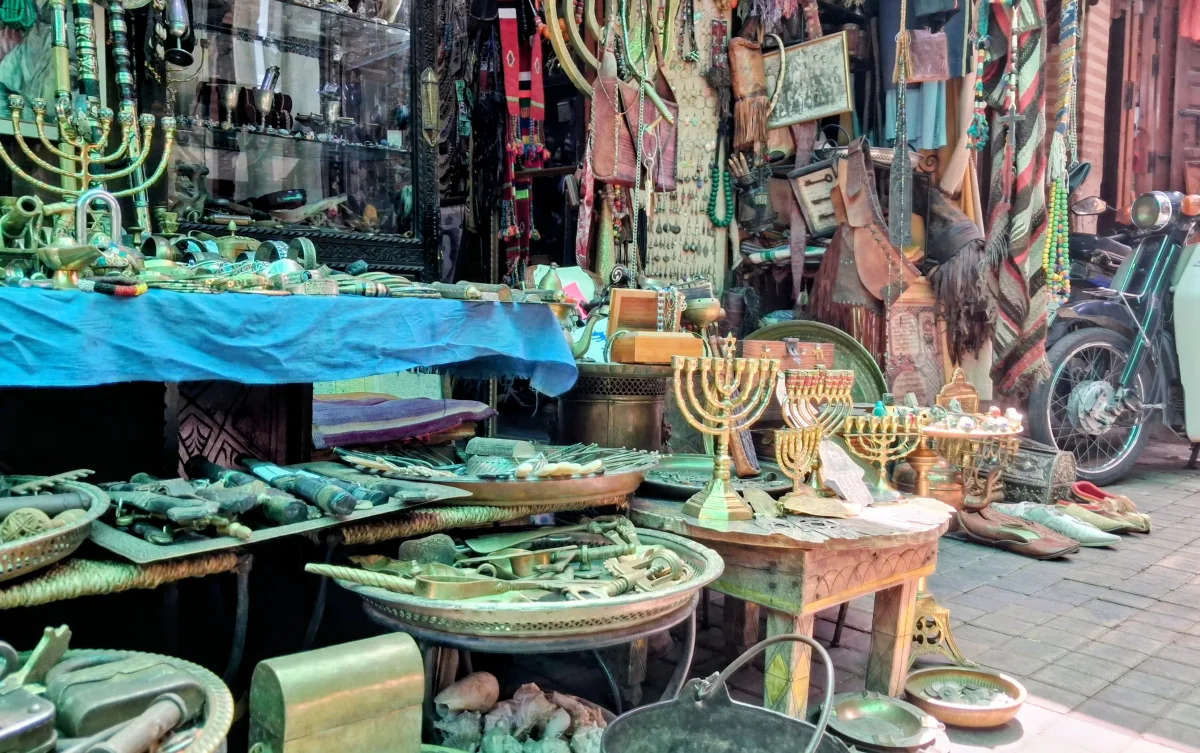
Among the objects displayed in some shops, visitors may notice menorahs, copper or brass objects and various symbols connected to the religious and cultural history of the neighborhood.
These objects are a reminder that the Mellah's commercial history cannot be separated from its craft traditions.
Khamsa, Amulets and Protective Symbols
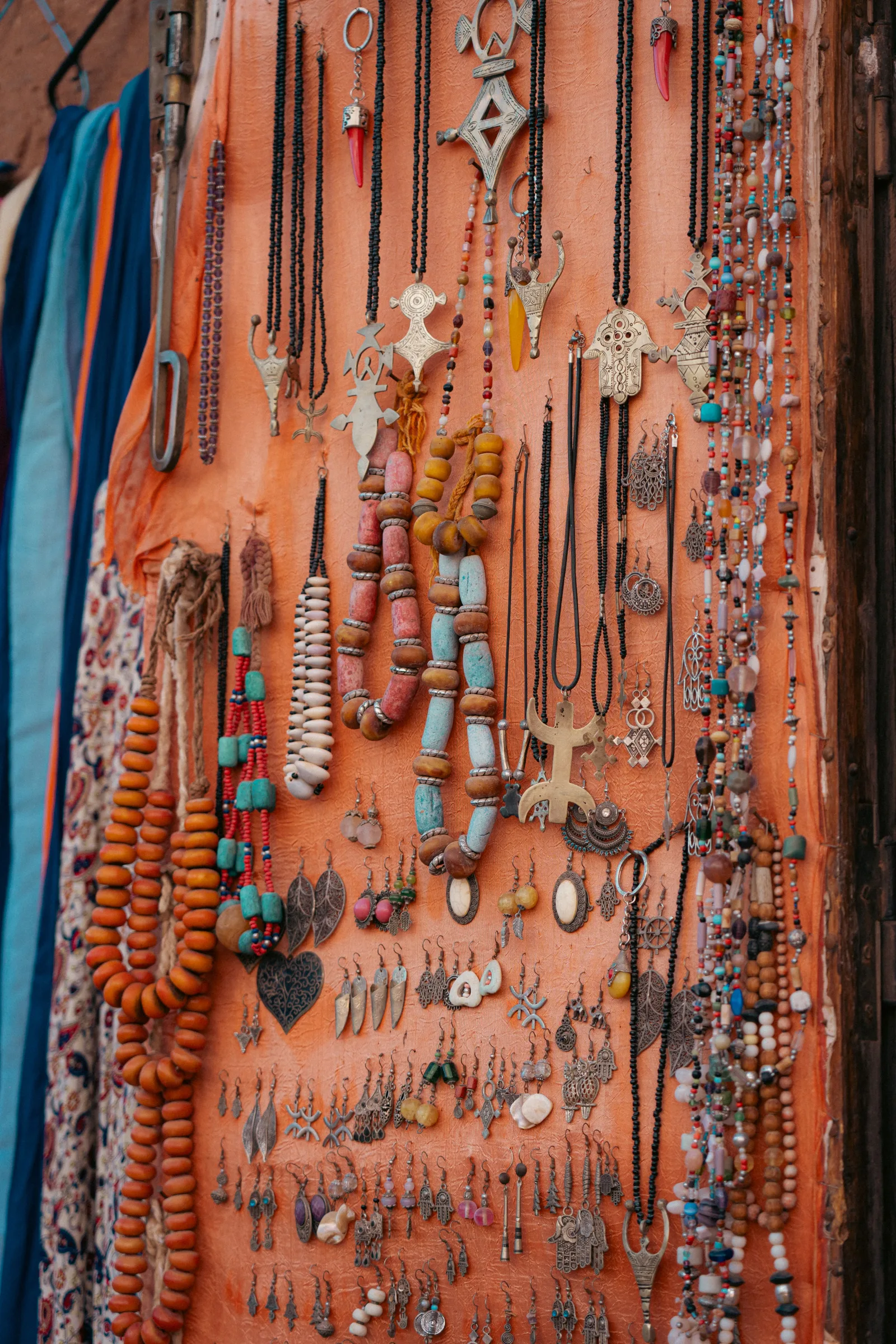
While exploring the shops of the Mellah, visitors will also encounter numerous pendants, amulets and decorative objects.
Among them, the khamsa, recognizable by its open-hand shape, appears frequently.
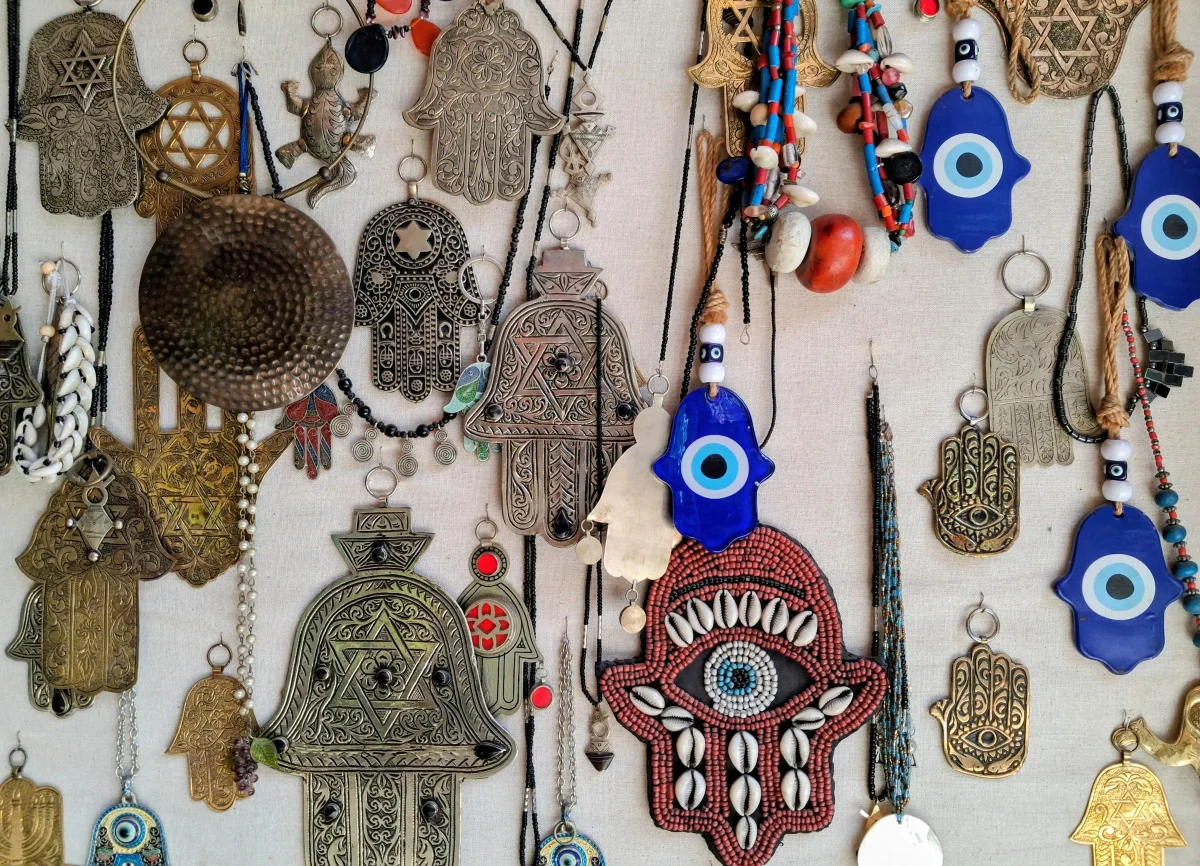
The khamsa has a particularly interesting history in the Maghreb and the wider Mediterranean world.
Used as a protective symbol, it crosses different cultural and religious traditions.
In North African Jewish traditions, it is sometimes associated with the Hand of Miriam.
In popular Muslim traditions, it may be known by different names, including the Hand of Fatima.
Beyond these particular interpretations, its presence in Moroccan craftsmanship illustrates how certain symbols have circulated between different communities.
Looking at these objects in the Mellah therefore offers more than the opportunity to find an artisanal souvenir.
They too tell part of Morocco's cultural history.
Heritage Hidden in Small Details
The Mellah reveals itself as much through its monuments as through the small details of everyday life.
An old doorway.
A wooden balcony.
An engraved star.
A menorah displayed among copper objects.
A khamsa hanging in a shop.
An old photograph preserved inside the synagogue.
Taken individually, these elements may seem modest.
Together, they gradually reconstruct the historical identity of the neighborhood.
This is why the Mellah deserves to be explored slowly.
Commerce, Diplomacy and Exchanges with Europe
During certain periods of Moroccan history, Jewish merchants also acted as intermediaries between Morocco and foreign commercial networks.
Their knowledge of languages, trading routes and communities established in different Mediterranean and Atlantic ports could provide an important advantage.
This history was not limited to Marrakech.
In Essaouira, the story of the Tujjar as-Sultan, or “Merchants of the Sultan,” provides a particularly important example of the role played by certain Jewish merchants in Morocco's international trade during the 18th and 19th centuries.
The history of Marrakech's Mellah should therefore be understood within the much wider geography of Morocco's Jewish communities.
The Miara Jewish Cemetery
Close to the Mellah lies another essential site of Marrakech's Jewish heritage: the Miara Jewish Cemetery, also spelled Miaara.
This vast cemetery is several centuries old and is one of the main places of remembrance for Marrakech's Jewish community.
Generations of families, rabbis and community figures have been buried here.
Its landscape is very different from that of many European cemeteries.
A multitude of pale tombs extends across a large open space beneath the Marrakech sky.
Some graves are anonymous, while others belong to well-known figures from the community.
The site bears witness to the historical importance and longevity of the Jewish presence in Marrakech.
A Place of Remembrance, Not Simply an Attraction
If you visit Miara, it is important to remember that this is first and foremost a cemetery and a place of remembrance.
A discreet and respectful attitude is therefore recommended.
The silence and simplicity of the site contrast strongly with the commercial activity of the surrounding streets.
This change in atmosphere is also part of discovering the Mellah.
Within just a few minutes' walk, visitors can move from a busy market to a synagogue and then to a vast historic cemetery.
The Gradual Departure of Much of the Community
During the 20th century, particularly from the middle of the century onward, the demographics of Morocco's Jewish communities changed profoundly.
Many families gradually left Morocco to settle in Israel, France, Canada and other countries.
The Marrakech Mellah experienced the same transformation.
Houses once occupied by Jewish families changed ownership and the neighborhood gradually evolved.
The Mellah's present-day population is very different from the community that once lived there.
However, the departure of much of the population did not erase its memory.
Synagogues, cemeteries, archives, objects, family traditions and architecture continue to bear witness to this history.
The Restoration of the Mellah
In recent decades, several rehabilitation projects have taken place in the neighborhood.
Façades, streets, souks and heritage elements have undergone restoration work aimed at improving the area while preserving its historical memory.
This restoration forms part of a broader recognition of the place of Jewish heritage within Moroccan history.
The historic name Mellah has also regained an important presence in the urban landscape.
Today, the neighborhood is once again one of the major heritage stops in the Medina of Marrakech.
A Heritage Still Present in Moroccan Culture
Jewish heritage is an integral part of Morocco's cultural history.
Music, cuisine, craftsmanship, architecture, pilgrimages, religious traditions and family histories still bear witness to centuries of contact between communities.
Exploring this heritage therefore helps visitors understand that Moroccan history was shaped by multiple influences.
The Mellah of Marrakech is one of the most accessible places to discover this history.
Discovering the Mellah means discovering a part of Morocco's history.
The Mellah Today: A Living Neighborhood
The Mellah is not an open-air museum.
It remains a living neighborhood of Marrakech.
Its streets are filled with residents, shops, markets, visitors and artisans.
It is precisely this continuity that makes walking through the district so interesting.
An old wooden balcony may stand above a contemporary shop.
A historic synagogue may be hidden behind a busy street.
A craft stall may display both traditional Moroccan objects and symbols recalling the neighborhood's Jewish past.
History and everyday life continue to overlap here.
How to Visit the Mellah of Marrakech
The Mellah lies in the southern part of the Marrakech Medina, immediately beside the Kasbah.
One of the easiest ways to enter the district is through Place des Ferblantiers.
Its location makes it easy to combine several heritage visits without spending time traveling across the city.
From the square, the Salat Al Azama Synagogue and El Badi Palace are both within walking distance.
The Saadian Tombs are also located within the same historic area.
Recommended Itinerary Through the Mellah and Kasbah
1. Start at Place des Ferblantiers
Take a few minutes to observe the activity around the square before entering the streets of the Mellah.
The shops and workshops already provide a glimpse of the historical importance of metalworking in this part of Marrakech.
2. Observe the Architecture of the Neighborhood
Do not focus only on monuments.
Look at the balconies, windows, doors and façades.
Sometimes these small architectural details tell the neighborhood's story better than a major monument.
3. Visit Salat Al Azama Synagogue
Allow around 30 to 45 minutes to explore the synagogue and the areas dedicated to the history of the community.
→ Discover Salat Al Azama Synagogue
4. Explore the Streets of the Mellah
Continue on foot through the commercial streets.
Look at the craft shops, spices, metal objects, jewelry, amulets and architectural traces of the historic neighborhood.
5. Discover the Miara Cemetery
If the site is accessible during your visit, continue your exploration of Marrakech's Jewish heritage at the Miara Cemetery.
Visit it as a place of memory rather than simply another tourist attraction.
6. Visit El Badi Palace
Finish with El Badi Palace, located nearby.
Combining the two is particularly interesting because it reveals two different aspects of Saadian Marrakech: royal power and the social history of the Mellah.
7. Continue to the Saadian Tombs
If you still have time, continue to the Saadian Tombs.
You can then connect three major places associated with the history of Saadian Marrakech in a single walk.
Mellah, El Badi and the Saadian Tombs: Understanding Saadian Marrakech
Visiting these places together allows you to understand the district as a historical whole rather than as a collection of separate attractions.
The Mellah was established under Abdallah al-Ghalib.
A few decades later, Ahmad al-Mansur commissioned the monumental El Badi Palace.
Nearby, the Saadian Tombs preserve the memory of the dynasty.
Within just a few hundred meters, visitors can therefore discover several dimensions of 16th-century Marrakech: royal power, architecture, religion, commerce and urban organization.
This proximity makes the southern Medina one of the most interesting parts of Marrakech for travelers who want to understand the history of the city.
Continue Exploring the Medina
The Mellah is also an excellent place from which to understand the diversity of the Marrakech Medina.
Mouassine, the Kasbah, the Mellah, the souk districts and the city's major squares each have their own history.
Taking the time to explore several neighborhoods reveals a Marrakech that is much richer than the city seen only from its main tourist routes.
The city's heritage is not found only behind the doors of its palaces.
It can also be read in its streets.
Tips for Exploring the Mellah
The best way to discover the Mellah is to walk slowly and observe.
Do not look only for the synagogue or cemetery.
Pay attention to façades, objects displayed in shops, old doors, balconies and architectural details.
Avoid photographing local residents directly without their permission.
Inside the synagogue and cemetery, behave respectfully in a manner appropriate to religious sites and places of remembrance.
Finally, leave some time without a precise itinerary.
Part of the Mellah's appeal lies precisely in its smaller streets and the details you discover while walking.
Discover the Mellah and the Heritage of the Kasbah
The Mellah is one of the best places to begin understanding the cultural and historical diversity of Marrakech.
Combine your walk with the Salat Al Azama Synagogue, El Badi Palace and the Saadian Tombs to discover several centuries of history within the same area of the Medina.
🕍 Discover Salat Al Azama Synagogue
📍 Explore Marrakech's heritage
Continue Discovering Morocco
Moroccan heritage tells a story shaped by dynasties, religions, migrations, exchanges and traditional skills.
From the historic Jewish quarters of Marrakech and Essaouira to the madrasas of Fez, from royal palaces to archaeological sites, every place reveals another part of Morocco's history.
📖 Read our guides & inspiration
🏛️ Discover Morocco's heritage