Nejjarine Museum in Fez: The Art of Woodworking in a Historic Funduq
In the heart of the Medina of Fez, among the commercial lanes, artisan workshops and historic monuments of Fes el-Bali, lies one of the finest examples of adaptive reuse of Moroccan architectural heritage: the Nejjarine Museum of Wooden Arts and Crafts.
The museum does more than display objects.
Its building is itself an essential part of the visit.
Housed in the Nejjarine Funduq, a former caravanserai built in the early 18th century, the museum offers visitors the opportunity to discover both the traditional architecture of Fez and several centuries of Moroccan woodworking expertise.
Carved doors, furniture, artisan tools, architectural elements, musical instruments and objects from everyday life tell the story of a society in which wood played an essential role.
But to truly understand Nejjarine, it is important to imagine the place before it became a museum.
For generations, merchants arrived here with their goods and animals, traded in the medina and spent the night in rooms arranged around the large central courtyard.
Today, travellers have replaced the merchants.
And the former funduq has become one of the most interesting places for understanding the craftsmanship and urban heritage of Fez.
Where Is the Nejjarine Museum?
The Nejjarine Museum is located on Nejjarine Square, in the heart of the historic Medina of Fez.
Its surroundings are particularly important for understanding the monument.
The name Nejjarine is linked to carpenters and woodworkers who were historically active in this part of the medina.
Around the square are the funduq, artisan workshops and a remarkable historic fountain.
The museum is situated in Fes el-Bali, the oldest part of the city.
The Medina of Fez has been inscribed on the UNESCO World Heritage List since 1981.
Founded in the 9th century, it preserves an exceptional urban fabric composed of mosques, madrasas, funduqs, palaces, houses, workshops and fountains.
Nejjarine should therefore not be understood as an isolated monument, but as part of a historic urban environment that remains alive today.
What Is a Funduq?
To understand the Nejjarine Museum, it is first necessary to understand the original function of the building.
A funduq was an establishment intended primarily for merchants and travellers.
In Morocco's major commercial cities, these buildings played an essential role.
They made it possible to:
- accommodate merchants;
- store goods;
- shelter transport animals;
- facilitate commercial exchanges;
- protect merchandise during a stay in the city.
Their architectural organisation was particularly well suited to this function.
Spaces were generally arranged around a central courtyard.
The ground floor was mainly used for merchandise, commercial activity and sometimes animals.
The upper floors contained rooms and other spaces used by merchants.
Funduqs therefore formed an essential part of the urban commercial infrastructure.
In Fez, a city located at the crossroads of important trade routes, they were particularly numerous.
The Nejjarine Funduq: An 18th-Century Monument
The Nejjarine Funduq is generally dated to 1711, during the reign of the Alaouite Sultan Moulay Ismail.
It was built in a district closely associated with commercial and artisanal activity.
Its original function was to accommodate merchants passing through Fez, along with their goods.
The building follows a plan characteristic of Moroccan funduqs.
A monumental entrance leads into a large central courtyard.
Around it rise several levels of galleries providing access to the different rooms.
This arrangement perfectly met the needs of merchants.
Goods could be unloaded and stored on the lower levels, while travellers occupied rooms on the upper floors.
But Nejjarine is also distinguished by the exceptional quality of its architecture.
It was not merely a functional building.
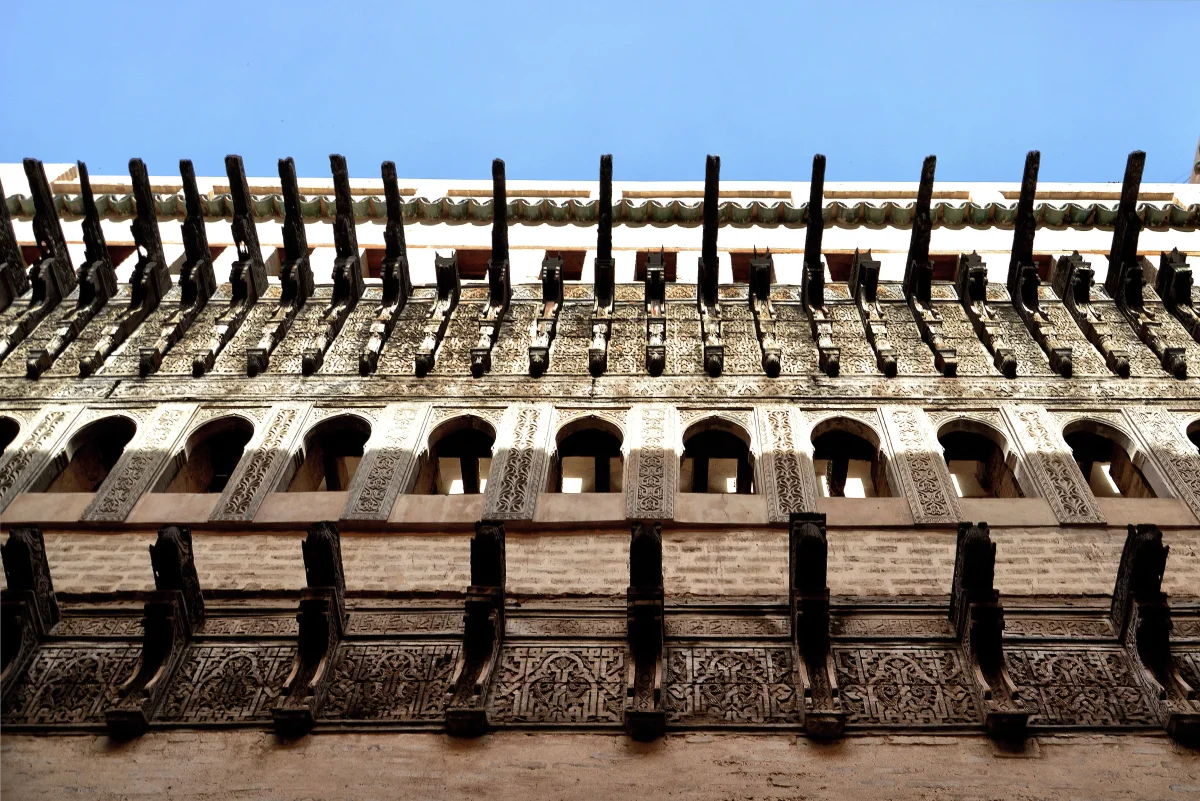
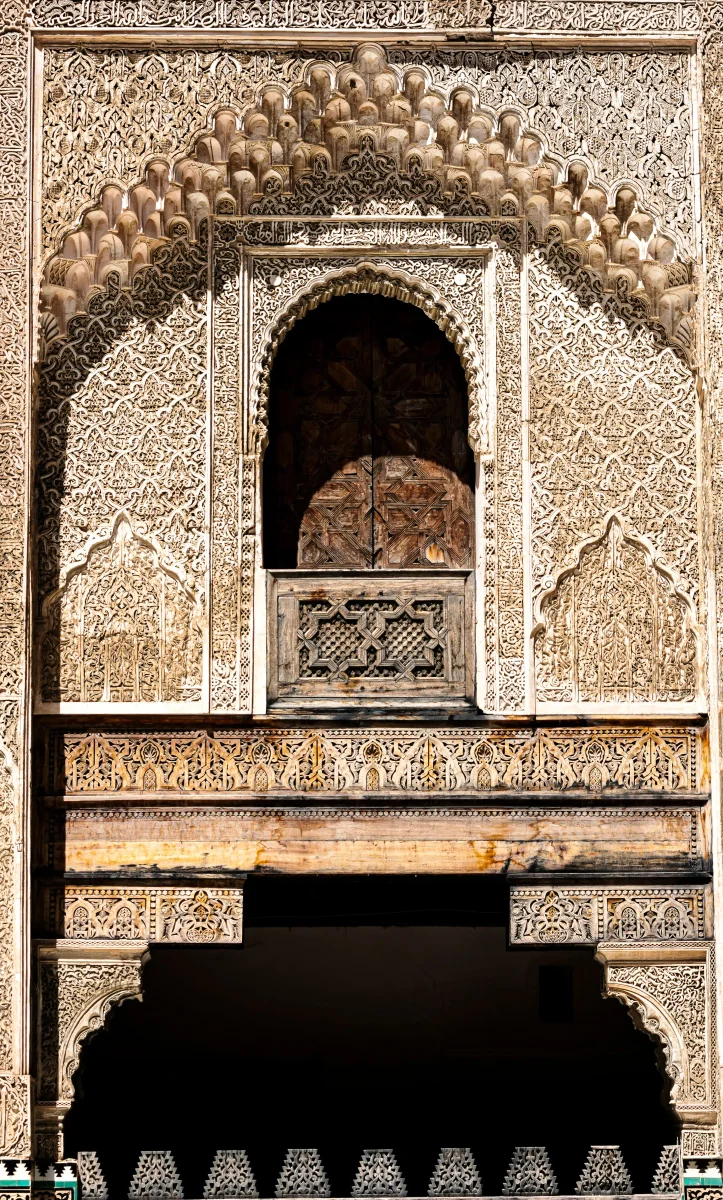
The decoration of its portal, galleries, woodwork and ornamental details reflects the importance of aesthetics in traditional Moroccan urban architecture.
Architecture to Observe Before the Collections
During a visit to the Nejjarine Museum, it would be a mistake to head immediately towards the display cases.
The building deserves to be observed in its own right.
Visitors enter through a particularly elaborate monumental portal.
Once inside, the central courtyard reveals the vertical organisation of the funduq.
Superimposed galleries surround the patio and create an impressive perspective when looking towards the upper floors.
Several materials and decorative techniques characteristic of Moroccan architecture can be seen throughout the building:
- carved wood;
- painted wood;
- worked plaster;
- zellige;
- geometric motifs;
- arches;
- balustrades;
- calligraphic elements.
This combination illustrates a fundamental characteristic of traditional Moroccan architecture:
decoration is not simply added to the building; it forms an integral part of its identity.
Nejjarine Square and Its Fountain
The visit does not really begin inside the museum.
It begins on Nejjarine Square.
In front of the funduq stands a historic fountain that forms a remarkable architectural ensemble with the building.
The present fountain is attributed to the reign of Sultan Moulay Abderrahmane in the 19th century.
It is particularly notable for its zellige decoration and carved elements.
In the traditional medina, a public fountain was far more than a decorative feature.
Access to water was part of the city's essential infrastructure.
Fountains, hammams, mosques, communal ovens, souks and funduqs together formed the network of facilities around which everyday life was organised.
Observing the Nejjarine fountain therefore also helps visitors understand how the historic medina functioned.
Nejjarine and the Carpenters' District
The name of the place is no coincidence.
In Arabic, nejjar means carpenter.
The square and surrounding streets were historically associated with craftsmen working with wood.
This relationship between the building and its surroundings largely explains why the former funduq is now dedicated to the arts and crafts of wood.
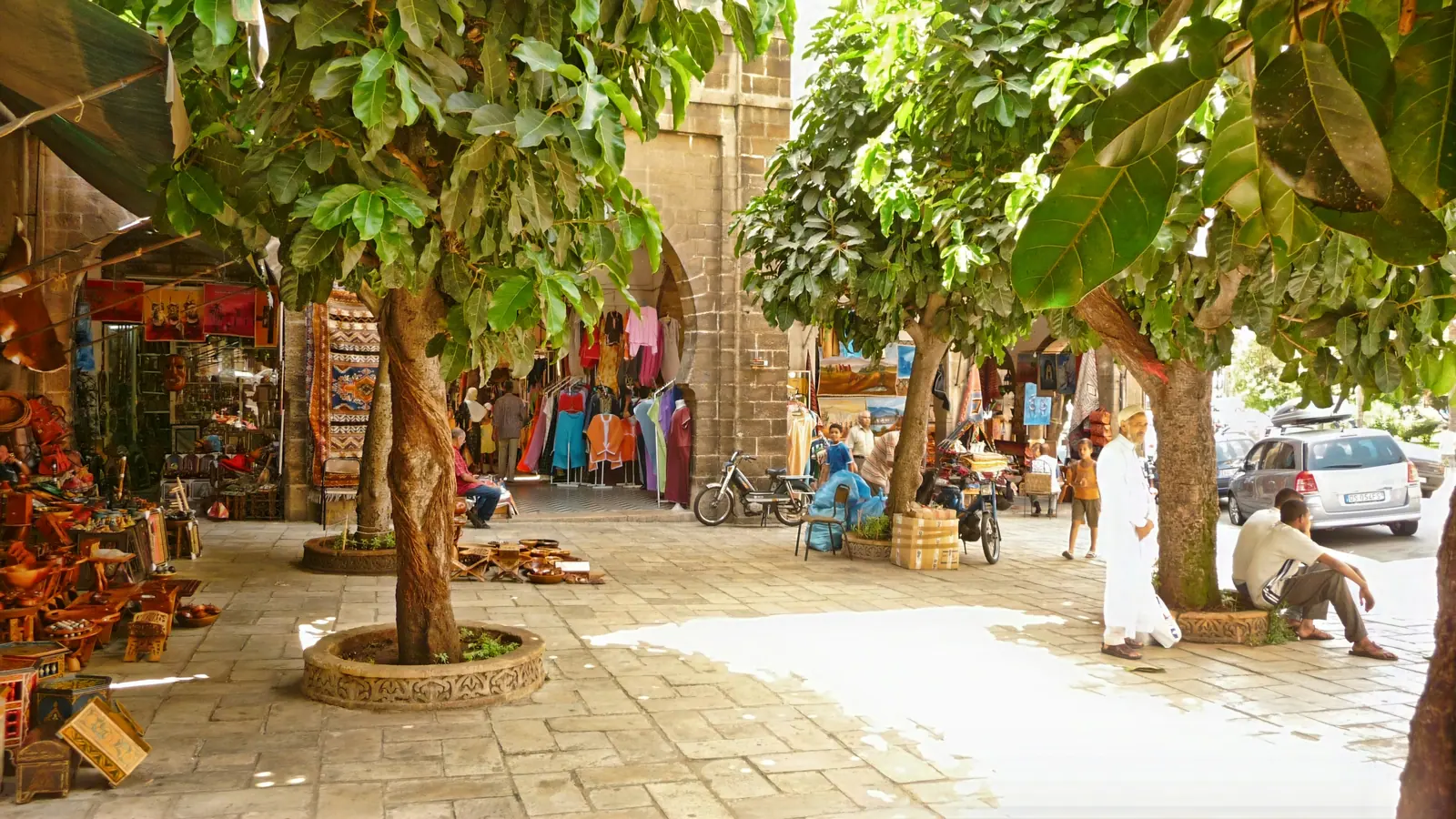
In Fez, traditional trades were often grouped by district.
Some areas were associated with tanners, others with coppersmiths, weavers or carpenters.
This organisation created distinctive urban environments in which sounds, smells, raw materials and artisan gestures became part of the identity of a street or neighbourhood.
Around Nejjarine, wood naturally occupied a central place.
Wood in Moroccan Architecture
Wood is one of the major materials used in traditional Moroccan architecture.
In houses, palaces, madrasas and mosques, it could be used for:
- doors;
- ceilings;
- beams;
- mashrabiyas;
- balustrades;
- chests;
- furniture;
- decorative elements.
Cedar, particularly associated with the forests of the Middle Atlas, has played an especially important role in the architectural history of Fez.
Its strength and aesthetic qualities allowed craftsmen to create elements that were both structural and decorative.
Carved, painted, assembled or engraved, wood became a true artistic medium.
The Nejjarine Museum helps visitors understand this diversity.
From Tree to Work of Art
One of the museum's strengths is showing that behind every object lies a craft.
Before a carved door, chest, piece of furniture or architectural element can be produced, several stages are necessary.
The wood must be selected, dried, cut, assembled, carved and sometimes painted or decorated.
These processes require a precise understanding of the material.
Over the centuries, Moroccan craftsmen developed an extremely rich decorative vocabulary combining:
- geometry;
- vegetal motifs;
- calligraphy;
- repetitive compositions;
- symmetry.
Traditionally, mastery of these techniques was passed down through workshops.
The apprentice observed the maâlem, or master craftsman, before gradually acquiring the gestures and knowledge necessary to practise the craft.
What Can You See at the Nejjarine Museum?
The museum's collections explore the many uses of wood in Moroccan society.
Visitors can discover:
- woodworking tools;
- historic doors;
- architectural elements;
- furniture;
- chests;
- domestic objects;
- musical instruments;
- religious objects;
- carved or painted pieces;
- various examples of traditional craftsmanship.
The diversity of the collections illustrates one essential idea:
wood was present in almost every aspect of daily life.
It played a role in architecture, furniture, music, religious practices, writing and numerous crafts.
The Tools of the Craftsmen
Some objects on display may appear more modest than the large carved doors or richly decorated pieces.
Yet the woodworking tools are among the museum's most interesting exhibits.
They allow visitors to move from the finished object to the process of making it.
Planes, saws, carving tools and measuring instruments remind us that artisanal heritage is based above all on gestures and techniques.
A wooden work is not simply the result of a design.
It is the result of knowledge of the material, experience and technical mastery acquired over time.
Wood in Everyday Life
The museum also presents numerous objects connected with domestic life.
Chests, furniture, supports and various accessories show how present wood was in Moroccan homes.
Some objects were primarily functional.
Others combined daily use with decoration.
This boundary between useful object and artistic object is one of the most interesting characteristics of traditional craftsmanship.
A chest could be used to store clothes while displaying a carefully carved façade.
A door could secure a house while also becoming one of its principal decorative elements.
Wood and Music
Wood also plays an essential role in the production of many traditional musical instruments.
The museum preserves different instruments that illustrate the relationship between material, craftsmanship and musical culture.
Making an instrument requires particular expertise.
The choice of wood, its thickness and the shape of the body directly influence the sound produced.
These objects remind visitors that woodworking extends far beyond architecture and furniture.
It is also closely linked to Morocco's musical and intangible heritage.
Wood in Religious Architecture
In mosques, madrasas and other religious buildings, wood could occupy a particularly prestigious place.
Carved ceilings, monumental doors, decorated beams and liturgical elements demonstrate the high level of craftsmanship achieved by artisans.
Woodworking was combined with other decorative arts such as zellige, carved plaster and calligraphy.
This combination can still be observed in several major monuments of Fez.
A visit to the Nejjarine Museum therefore provides an excellent introduction before exploring the madrasas and other historic buildings of the city.
From Funduq to Museum
At the beginning of the 20th century, the traditional role of the Nejjarine Funduq began to change.
The building was classified as a historic monument in 1916.
During the Protectorate period, it was used for administrative purposes and served for a time as a police station.
Like many historic buildings in the medina, it later required major restoration work.
At the end of the 20th century, an extensive conservation project brought the Nejjarine complex back to life.
The funduq, square and surrounding elements underwent significant restoration.
The aim was not simply to preserve an old building.
It was also to give it a new function compatible with its history.
The Restoration of the Nejjarine Funduq
Restoration of the complex began in the early 1990s.
The work was carried out as part of a project supported in particular by the Mohammed Karim Lamrani Foundation.
The project concerned not only the funduq itself, but also its immediate surroundings.
The restoration sought to preserve the original architecture and traditional decorative techniques.
This type of work presents a particular challenge.
It is not enough simply to repair walls.
The materials must be understood, traditional techniques rediscovered and craftsmen found who are capable of reproducing or restoring historic decoration.
The restoration of Nejjarine therefore became in itself an example of the transmission of the very artisanal knowledge that the future museum would later present.
1998: Birth of the Museum of Wooden Arts and Crafts
After several years of restoration, the Nejjarine Museum of Wooden Arts and Crafts was inaugurated on 23 May 1998.
The decision to dedicate the site to wood is particularly appropriate.
The building itself makes extensive use of the material.
It is located in the historic carpenters' district.
And the collections tell an essential part of the story of Moroccan craftsmanship.
The former commercial establishment thus became a place of transmission.
Merchandise disappeared from the rooms of the funduq.
In its place, objects now tell the story of crafts, techniques and uses of wood throughout Moroccan history.
2025: The First "Musée du Maroc" Label
A new and important chapter in the museum's history came in May 2025.
The Nejjarine Museum of Wooden Arts and Crafts became the first institution to receive the "Musée du Maroc" label.
The label forms part of a programme led by the National Foundation of Museums to recognise institutions that meet national regulatory requirements and museum standards.
This recognition is particularly symbolic for Nejjarine.
More than twenty-five years after opening as a museum, the former funduq continues to embody a way of preserving heritage while giving it a contemporary function.
A Museum Inside a Monument
Nejjarine has a particular quality that distinguishes it from many museums.
At times, it is difficult to decide what constitutes the real collection.
The objects on display?
Or the building itself?
In reality, the two are inseparable.
The collections help visitors understand woodworking techniques.
The funduq shows these same skills integrated into historic architecture.
Visitors can therefore move from an object in a display case to a balustrade, ceiling or door within the building and observe how the same artisanal traditions shaped the urban environment.
This dialogue between collection and architecture is one of the principal strengths of the Nejjarine Museum.
The Terrace and the Rooftops of Fez
After exploring the different levels of the museum, visitors can generally access the upper part of the building.
The terrace offers a different perspective over the medina.
From above, visitors discover a dense landscape of rooftops, minarets and tightly packed buildings.
This view helps explain another characteristic of Fes el-Bali.
From its narrow streets, the medina can sometimes feel like an almost enclosed labyrinth.
From the rooftops, its urban organisation becomes easier to understand.
It is also an excellent place to pause after exploring the collections.
Nejjarine in the Medina of Fez
The Nejjarine Museum should not be visited as an isolated site.
It lies at the heart of one of Morocco's richest historic urban ensembles.
The Medina of Fez has been a UNESCO World Heritage Site since 1981.
UNESCO highlights the importance of its historic urban fabric and its monuments, including madrasas, funduqs, palaces, residences, mosques and fountains.
Nejjarine is fully part of this history.
The funduq helps explain the commercial dimension of the medina.
The collections tell the story of its crafts.
The square and fountain evoke its urban infrastructure.
And the neighbouring workshops remind visitors that craftsmanship does not belong only to the past.
What to See Around the Nejjarine Museum
The museum's location makes it easy to include in a wider heritage itinerary through Fez.
Al Quaraouiyine Mosque and University
Nearby stands Al Quaraouiyine, one of the most important monuments in the intellectual and religious history of Fez.
Its history dates back to the 9th century, and its development is deeply linked to that of the medina.
Al-Attarine Madrasa
The Al-Attarine Madrasa is one of the great masterpieces of Marinid architecture.
It offers an opportunity to observe the dialogue between zellige, carved plaster, wood and calligraphy.
After visiting Nejjarine, some of its architectural details take on a new meaning.
The Souks of Fez
The souks allow visitors to continue exploring traditional crafts.
Although techniques and uses have evolved, several artisanal activities are still practised within the medina.
Chouara Tanneries
The famous Chouara Tanneries illustrate another of Fez's great historic crafts: leatherworking.
Combining Nejjarine with the tanneries allows visitors to discover two essential materials of traditional Moroccan craftsmanship: wood and leather.
How Much Time Should You Allow for the Nejjarine Museum?
To properly explore the building and the collections, allow approximately 45 minutes to 1 hour.
Visitors with a particular interest in architecture or craftsmanship can easily spend longer.
Do not cross the courtyard too quickly.
Take time to observe the building from different levels.
The perspective changes considerably between the ground floor, upper galleries and terrace.
Why Visit the Nejjarine Museum?
The Nejjarine Museum helps visitors understand an essential aspect of Fez that can easily be missed when moving quickly through the medina.
Fez is not only a city of great monuments.
It is also a city of crafts.
For centuries, carpenters, cabinetmakers, woodcarvers, tanners, coppersmiths, weavers and other artisans shaped its architecture and economy.
Nejjarine tells this story through a single material: wood.
But it also tells another story.
The building recalls a time when merchants entered Fez with their goods, found shelter in funduqs and participated in the commercial life of the city.
The collections then show how craftsmen transformed raw material into useful, religious, musical and decorative objects.
Finally, the restoration of the monument demonstrates how a historic building can be given a new function without losing its identity.
Few museums allow visitors to understand so directly the relationship between architecture, craftsmanship and urban life.
At the Nejjarine Museum, heritage is not only presented inside display cases.
It surrounds the visitor.
Practical Information
Name: Nejjarine Museum of Wooden Arts and Crafts
Location: Nejjarine Square, Medina of Fez
Building: former Nejjarine Funduq
Construction of the funduq: early 18th century, generally dated to 1711
Dynasty: Alaouite
Historic function: funduq for merchants, goods and travellers
Classification: historic monument since 1916
Opened as a museum: 23 May 1998
Main collection: traditional wooden arts and crafts
Distinction: first recipient of the "Musée du Maroc" label, awarded in 2025
Recommended visit duration: approximately 45 minutes to 1 hour
Nearby: Al Quaraouiyine, Al-Attarine Madrasa, the souks of Fez and the Chouara Tanneries
Sources and References
- UNESCO — Medina of Fez
- Moroccan National Tourist Office — Museums and Heritage in Fez
- Maroc.ma — First "Musée du Maroc" label awarded to the Nejjarine Museum
- Discover Islamic Art — Nejjarine Funduq
MoroccoMuseum tip: do not focus only on the objects on display. At Nejjarine, the funduq itself is part of the collection. Take time to observe the portal, galleries, balustrades and woodwork before climbing to the upper levels. You will then understand why a former merchants' inn became a museum dedicated to wood.