7 Must-See Monuments to Visit in Marrakech
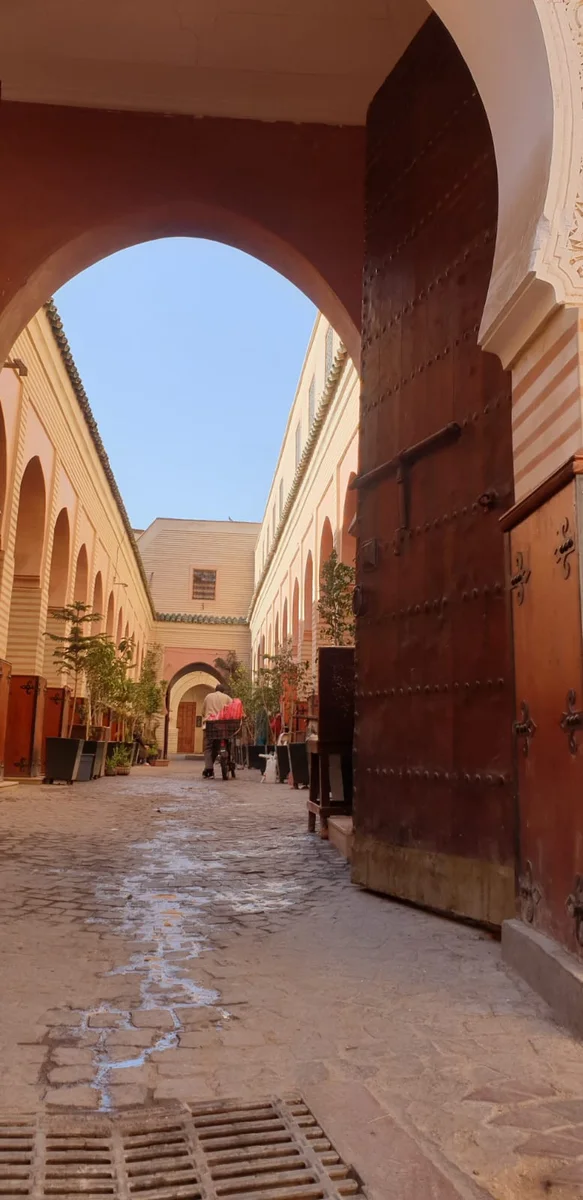
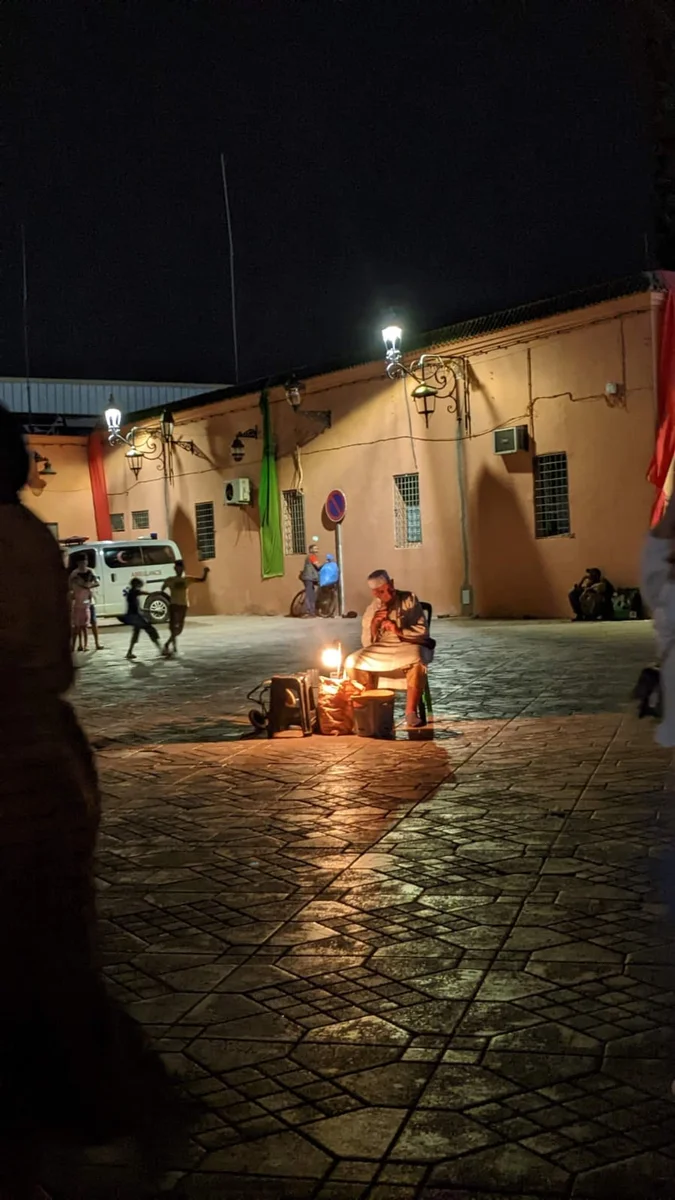
Marrakech is much more than its souks, riads and Jemaa el-Fna square.
Founded in the 11th century by the Almoravids, the city was successively shaped by several major Moroccan dynasties. Almoravids, Almohads, Saadians and later Alaouites left behind palaces, madrasas, gardens, mausoleums and monuments that today allow visitors to explore nearly a thousand years of history.
The Medina of Marrakech has been listed as a UNESCO World Heritage Site since 1985, notably for the richness of its architecture, its historic urban fabric and the continuity of its traditional craftsmanship.
To truly understand Marrakech, some monuments are particularly important.
Here are 7 must-see monuments and cultural sites to visit in Marrakech, from the rare 12th-century Almoravid Qubba to the palaces of the Saadian and Alaouite periods.
1. Bahia Palace — The Elegance of Moroccan Art
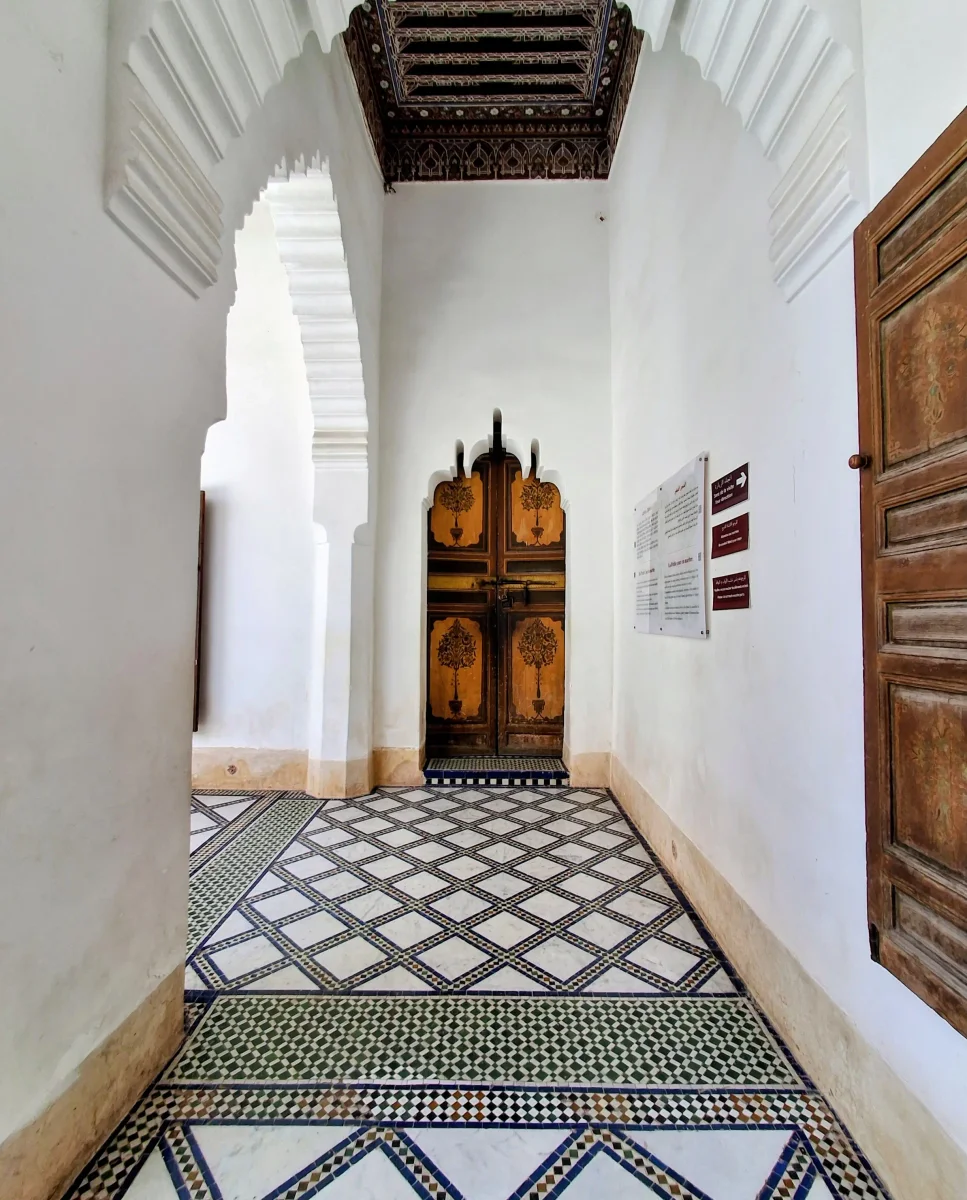
Built and expanded mainly during the second half of the 19th century, Bahia Palace is one of the great masterpieces of palatial architecture in Marrakech.
Its history is closely linked to Si Moussa, Grand Vizier under Sultan Moulay Hassan I, and later to his son Ahmed Ben Moussa, better known as Ba Hmad.
From the 1890s onward, Ba Hmad considerably expanded the family residence.
The result is not a palace organised around a single monumental building, but a vast complex made up of riads, gardens, courtyards, reception rooms and apartments connected to one another.
Why Visit Bahia Palace?
Bahia is one of the best places in Marrakech to observe the great traditions of Moroccan decorative art.
Take time to look carefully at:
- the geometric zellige;
- painted wooden ceilings;
- carved doors;
- finely worked stucco;
- interior gardens;
- the Grand Riad;
- the spectacular Grand Courtyard.
The palace also provides insight into the organisation of a major residence associated with Moroccan political power at the end of the 19th century.
MoroccoMuseum tip: do not look only at the walls and courtyards. Some of Bahia Palace’s most remarkable decoration is above you, especially in the painted wooden ceilings.
Discover Bahia Palace, practical information and tickets
2. Saadian Tombs — The Royal Necropolis of Marrakech
The Saadian Tombs are among the most refined surviving monuments from the Saadian period in Marrakech.
This royal necropolis contains the tombs of members of the Saadian dynasty, which ruled Morocco during the 16th and 17th centuries.
An early part of the funerary complex is associated with the burial of Prince Mohammed ech-Cheikh in 1557.
The complex was later considerably enriched during the reign of Sultan Ahmed al-Mansour, one of the major figures of the Saadian dynasty.
The Chamber of the Twelve Columns
The most famous part of the monument is the Chamber of the Twelve Columns.
It notably contains the tomb of Sultan Ahmed al-Mansour.
Marble, carved wood, stucco, geometric patterns and architectural decoration come together in a relatively small but richly decorated space.
It is precisely this contrast between the intimate size of the monument and the refinement of its decoration that makes the Saadian Tombs particularly impressive.
Why Visit the Saadian Tombs?
A visit allows you to discover:
- a genuine royal necropolis;
- Saadian funerary architecture;
- the Chamber of the Twelve Columns;
- carved stucco and wood decoration;
- the gardens surrounding the mausoleums;
- an essential part of Marrakech’s 16th-century history.
The Saadian Tombs are located in the historic Kasbah district.
They can easily be combined with a visit to El Badi Palace, which is nearby.
Discover the Saadian Tombs and prepare your visit
3. Ben Youssef Madrasa — Learning at the Heart of the Medina
The photograph above shows El Badi Palace, presented in the following section.
Ben Youssef Madrasa is one of the most remarkable monuments in the historic centre of Marrakech.
An educational institution existed in this area before the Saadian period, but the monument visitors admire today is mainly associated with the reconstruction carried out in the 16th century under the Saadian Sultan Abdallah al-Ghalib.
The madrasa was designed to accommodate students who came to Marrakech to pursue religious and intellectual studies.
Around its large central courtyard are a prayer hall and the spaces that once housed the students.
Spectacular Architecture
Much of the decoration is concentrated around the central courtyard.
Here you can observe:
- zellige;
- carved stucco;
- cedar wood;
- calligraphic inscriptions;
- geometric patterns;
- a central pool.
But it is also worth going upstairs to the areas once reserved for students.
The small and much simpler cells create a striking contrast with the monumental character of the courtyard.
They remind visitors that Ben Youssef Madrasa was not simply a decorative monument.
It was a genuine place of study and daily life.
Why Visit Ben Youssef Madrasa?
It provides insight into the role of education in historic Moroccan society while allowing visitors to discover one of the most refined decorative ensembles in Marrakech.
It is also located in an exceptional part of the Medina, just a short walk from the Marrakech Museum and the Almoravid Qubba.
Discover Ben Youssef Madrasa and prepare your visit
4. El Badi Palace — The Remains of a Monumental Saadian Palace
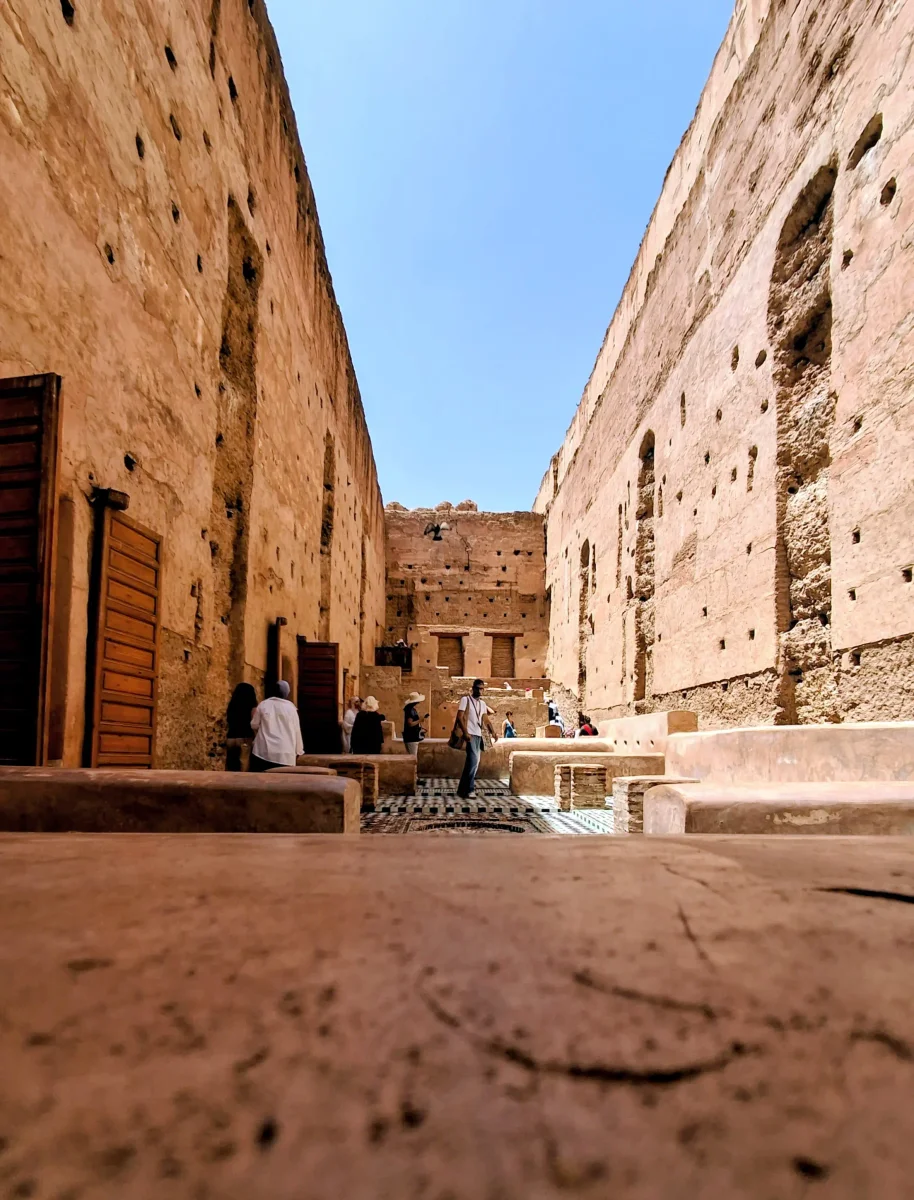
Built from the late 16th century during the reign of the Saadian Sultan Ahmed al-Mansour, El Badi Palace was intended to demonstrate the power and prestige of the Saadian dynasty.
Its name is generally associated with the idea of “the Incomparable.”
At its height, the palace used precious materials and contained vast ceremonial spaces.
Today, much of that decoration has disappeared.
But this is precisely what makes the visit particularly interesting.
Imagining a Lost Palace
Unlike Bahia Palace, where much of the architectural decoration is still visible, El Badi is explored mainly through its surviving remains.
Visitors pass through:
- an immense central courtyard;
- large pools;
- sunken gardens;
- the ruins of former pavilions;
- underground passages and additional spaces depending on the areas accessible;
- high walls now famous for the storks that nest on them.
From some elevated parts of the monument, visitors can also see the Kasbah and the rooftops of Marrakech.
Bahia or El Badi?
The two palaces are very different and both are worth visiting.
El Badi tells the story of Saadian power in the 16th century.
Bahia tells the story of the political and artistic world of the late 19th century.
Visiting both therefore allows you to compare two very different periods in the history of Marrakech.
Discover El Badi Palace and prepare your visit
5. Marrakech Museum — Art and Heritage Inside Mnebhi Palace
The Marrakech Museum is housed in Mnebhi Palace, a historic residence located just a short walk from Ben Youssef Madrasa.
The visit offers two different points of interest.
There are the collections and exhibitions, but there is also the building itself.
The palace provides an opportunity to discover the organisation and decoration of a grand Moroccan residence, with its vast interior courtyard and traditional decorative elements.
Depending on the exhibitions on display, visitors can discover different aspects of Moroccan art and heritage.
Why Visit the Marrakech Museum?
The museum combines:
- the discovery of a historic palace;
- Moroccan architecture;
- objects and heritage;
- art;
- temporary or permanent exhibitions depending on the programme.
Its location is also ideal for organising a cultural morning.
The Marrakech Museum, Ben Youssef Madrasa and the Almoravid Qubba are all located in the same area of the Medina.
6. Almoravid Qubba — A Rare Witness to 12th-Century Marrakech
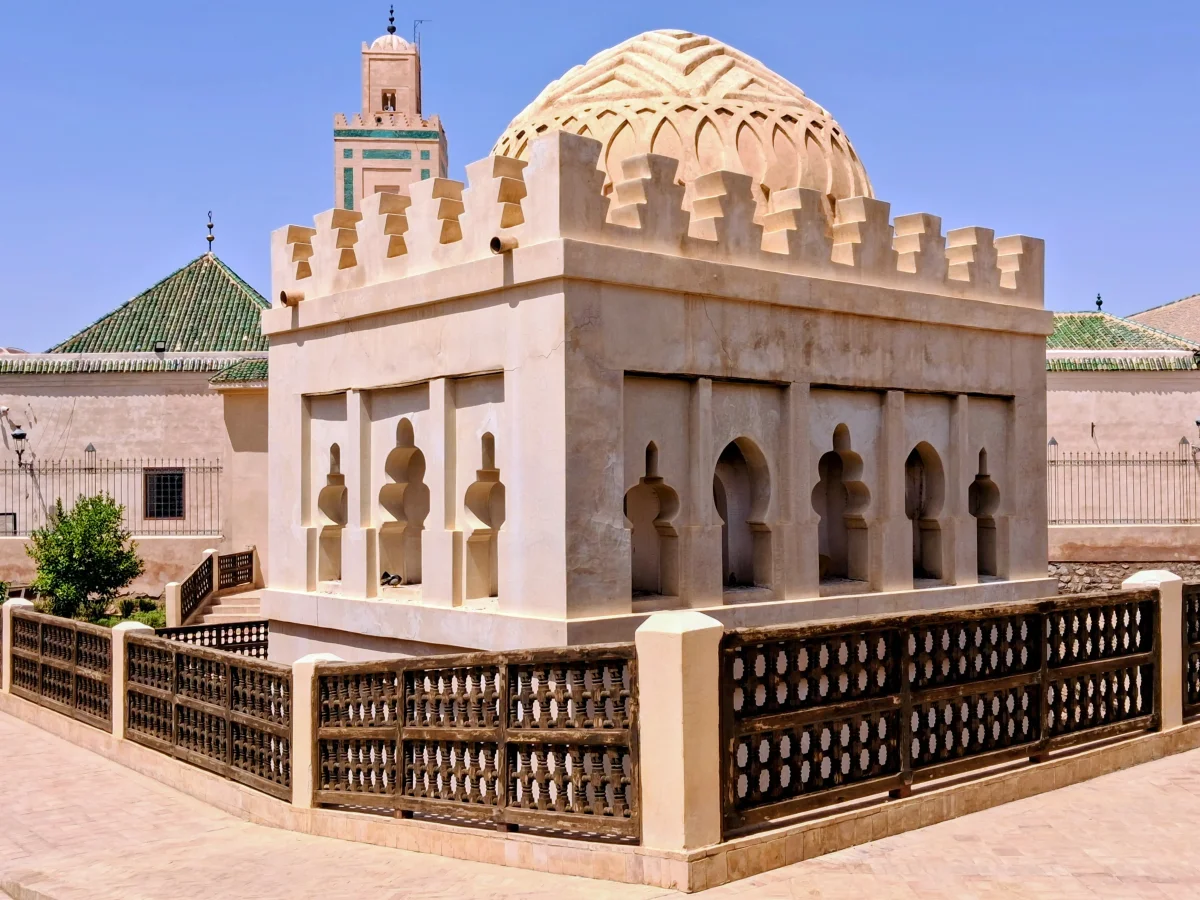
The Almoravid Qubba, also known as the Almoravid Koubba, is one of the most valuable monuments for understanding the origins of Marrakech.
The city was founded in the 11th century under the Almoravids and quickly became one of the major political capitals of the western Maghreb.
Yet very few Almoravid monuments remain visible in Marrakech today.
This is what makes the Qubba particularly important.
A Monument Connected to Water
The Qubba formed part of a religious and hydraulic complex located near the Ben Youssef Mosque.
It is generally associated with a space used for ablutions, in which water played an essential role.
The current level of the monument also allows visitors to perceive the successive transformations of the surrounding district over the centuries.
Look Inside the Dome
From the outside, the monument may appear relatively modest.
But its importance becomes much clearer when observing the interior architecture.
Arches, carved motifs, geometric and vegetal forms already reveal an architectural vocabulary that would influence later periods.
MoroccoMuseum tip: do not spend only a few minutes at the Qubba. Take time to observe the interior of the dome and the surrounding remains.
Discover the Almoravid Qubba and prepare your visit
7. Dar Bellarj — Where Heritage Continues to Live
Dar Bellarj offers a different experience from the other monuments in this selection.
It is not simply a matter of visiting a historic building.
The Dar Bellarj Foundation is a cultural space dedicated to creativity, heritage, traditions and cultural transmission.
Its name is connected to storks: the place is said to have once served as a refuge for injured storks.
Today, Dar Bellarj hosts exhibitions and various cultural projects.
Why Visit Dar Bellarj?
Because Moroccan heritage is not limited to monuments from the past.
At Dar Bellarj, heritage and contemporary creation can come together through:
- exhibitions;
- artistic projects;
- meetings;
- research;
- cultural activities;
- the transmission of traditions and know-how.
The programme changes over time, so it is particularly worth checking which exhibitions are available during your stay.
Dar Bellarj is also located close to Ben Youssef Madrasa.
Which Monument Should You Visit First in Marrakech?
It mainly depends on what you want to discover.
- For 19th-century Moroccan architecture: Bahia Palace
- For the history of the Saadian dynasty: El Badi Palace and the Saadian Tombs
- For architecture and the history of education: Ben Youssef Madrasa
- To explore the Almoravid origins of Marrakech: Almoravid Qubba
- To combine architecture and collections: Marrakech Museum
- For living and contemporary heritage: Dar Bellarj
If you have enough time, the most interesting approach is to visit several monuments from different periods.
This allows you to see how the architecture of Marrakech evolved from the 12th to the 19th century.
Can You Visit Several Marrakech Monuments in the Same Day?
Yes, but it is better to organise visits by neighbourhood rather than repeatedly crossing the Medina.
Route 1 — Ben Youssef and the Heart of the Medina
You can combine:
- Ben Youssef Madrasa
- Almoravid Qubba
- Marrakech Museum
- Dar Bellarj
These four places are located in the same area.
Then take time to explore the surrounding streets and souks rather than immediately moving on to another district.
Route 2 — Bahia and the Kasbah
Another day or half-day can include:
- Bahia Palace
- Mellah and Place des Ferblantiers
- El Badi Palace
- Saadian Tombs
This route allows you to discover several periods of Marrakech’s history while limiting unnecessary travel.
How Many Days Should You Allow to Discover Marrakech’s Heritage?
If you simply want to see a few major monuments, two days can be enough.
But to discover the Medina without turning your stay into a succession of rushed visits, it is better to allow more time.
Much of Marrakech’s appeal can also be found between its monuments:
- in the souks;
- the funduqs;
- ancient gates;
- artisans’ workshops;
- historic districts;
- gardens;
- small squares throughout the Medina.
Marrakech’s heritage is therefore not discovered only behind an entrance gate.
The city itself is part of the visit.
Tips for Visiting Marrakech’s Monuments
- Start your visits early whenever possible.
- Group monuments located in the same neighbourhood.
- Check opening hours and access conditions before visiting.
- Wear comfortable shoes for walking through the Medina.
- Take time to observe ceilings, doors and decorative details.
- Alternate monuments with gardens, souks and breaks.
- Respect religious spaces and areas with restricted access.
- Buy your tickets through reliable channels and check exactly what is included.
- Do not focus only on the most photographed places: some smaller monuments tell an essential part of Marrakech’s history.
Understanding Marrakech Through Its Monuments
These seven places actually tell the story of several different Marrakechs.
The Almoravid Qubba takes us back to the city’s earliest major periods.
Ben Youssef Madrasa, El Badi Palace and the Saadian Tombs notably reflect the importance of Marrakech during the Saadian era.
Bahia Palace reveals another period: that of Morocco’s powerful dignitaries at the end of the 19th century.
The Marrakech Museum offers a way to explore heritage through a historic residence and its collections.
Finally, Dar Bellarj reminds us that Moroccan culture did not stop with the construction of its monuments.
It continues to live, to be passed on and to evolve.
This succession of periods, architecture and traditions is what makes Marrakech much more than simply a tourist destination.
Prepare Your Cultural Visit to Marrakech
With MoroccoMuseum, you can prepare your discovery of Moroccan heritage before your arrival.
You can:
- discover the history of the monuments;
- check practical visitor information;
- identify places to visit nearby;
- organise your cultural itinerary;
- access ticketing options when available;
- discover other museums and monuments across Morocco.
For monuments offering this service through MoroccoMuseum, you can also check the available options before your visit.
Discover tickets for Morocco’s monuments
Sources and References
- UNESCO — Medina of Marrakesh
- Visit Marrakech — Ben Youssef Madrasa
- Visit Marrakech — Saadian Tombs
- Visit Marrakech — Dar Bellarj
- Visit Marrakech — Monuments, Parks and Museums
MoroccoMuseum tip: do not simply try to tick monuments off a list. Choose a few places from different periods and leave time to walk between them. A large part of Marrakech’s heritage is discovered in the streets connecting its monuments.