Al Batha Museum in Fez: From Royal Palace to Museum of Islamic Arts
Near Bab Boujloud, between Fez el-Bali and Fez Jdid, stands one of Fez's historic palaces: Dar Al Batha, now home to the Al Batha Museum of Islamic Arts.
Long known as the Batha Museum or the Museum of Arts and Traditions of Fez, the monument has a dual importance.
First, it is a remarkable example of Moroccan palatial architecture from the late 19th century.
It has also become an important place for understanding the artistic and cultural history of Fez and, more broadly, the development of Islamic arts in Morocco.
After several years of restoration, the palace reopened to the public on 26 February 2025 with a new museum experience devoted to Islamic arts.
This transformation offers another reason to discover a monument that is sometimes less well known than the Al-Attarine Madrasa, the Bou Inania Madrasa, Al Quaraouiyine or the Nejjarine Museum, but is deeply connected to the cultural history of Fez.
Dar Al Batha: A Late 19th-Century Palace
Unlike many of the famous monuments of Fez el-Bali, Dar Al Batha is not a medieval building.
Its history begins in the late 19th century under the Alaouite dynasty.
Construction of the palace began during the reign of Sultan Moulay Hassan I, who ruled Morocco from 1873 to 1894.
It was subsequently completed under his successor, Sultan Moulay Abdelaziz.
Heritage sources date its completion to 1897.
A Palace Designed for Receptions
Dar Al Batha was not originally intended to be a museum.
The palace served several functions associated with the royal court.
It was notably used for private receptions, meetings and ceremonies, and could also serve as a summer residence.
Its architecture reflects this original purpose: a prestigious setting organised around reception spaces and a large interior garden.
A Palace Between Fez el-Bali and Fez Jdid
The location of Dar Al Batha is particularly interesting for understanding the urban history of Fez.
The palace stands close to the transition between Fez el-Bali, the old city, and Fez Jdid, the new city founded by the Marinids in the 13th century.
Fez el-Bali
Fez el-Bali forms the oldest historic core of the city.
Its streets contain some of the most famous monuments in Fez:
- Al Quaraouiyine
- the Al-Attarine Madrasa
- the Bou Inania Madrasa
- the Chouara Tanneries
- the Nejjarine Museum of Wooden Arts and Crafts
The old city is also home to thousands of workshops, shops, funduqs, mosques and historic houses.
Fez Jdid
To the west of Fez el-Bali lies Fez Jdid.
This new city was founded in 1276 by the Marinids.
It included the royal palace, military facilities, fortifications and residential districts.
Over the centuries, Fez el-Bali and Fez Jdid developed together to form the vast historic urban ensemble visible today.
The Medina of Fez has been a UNESCO World Heritage Site since 1981.
The Architecture of Dar Al Batha
Even before exploring the museum collections, the building itself deserves to be considered as a heritage site.
Dar Al Batha belongs to the tradition of large Moroccan residences and palaces organised around interior spaces.
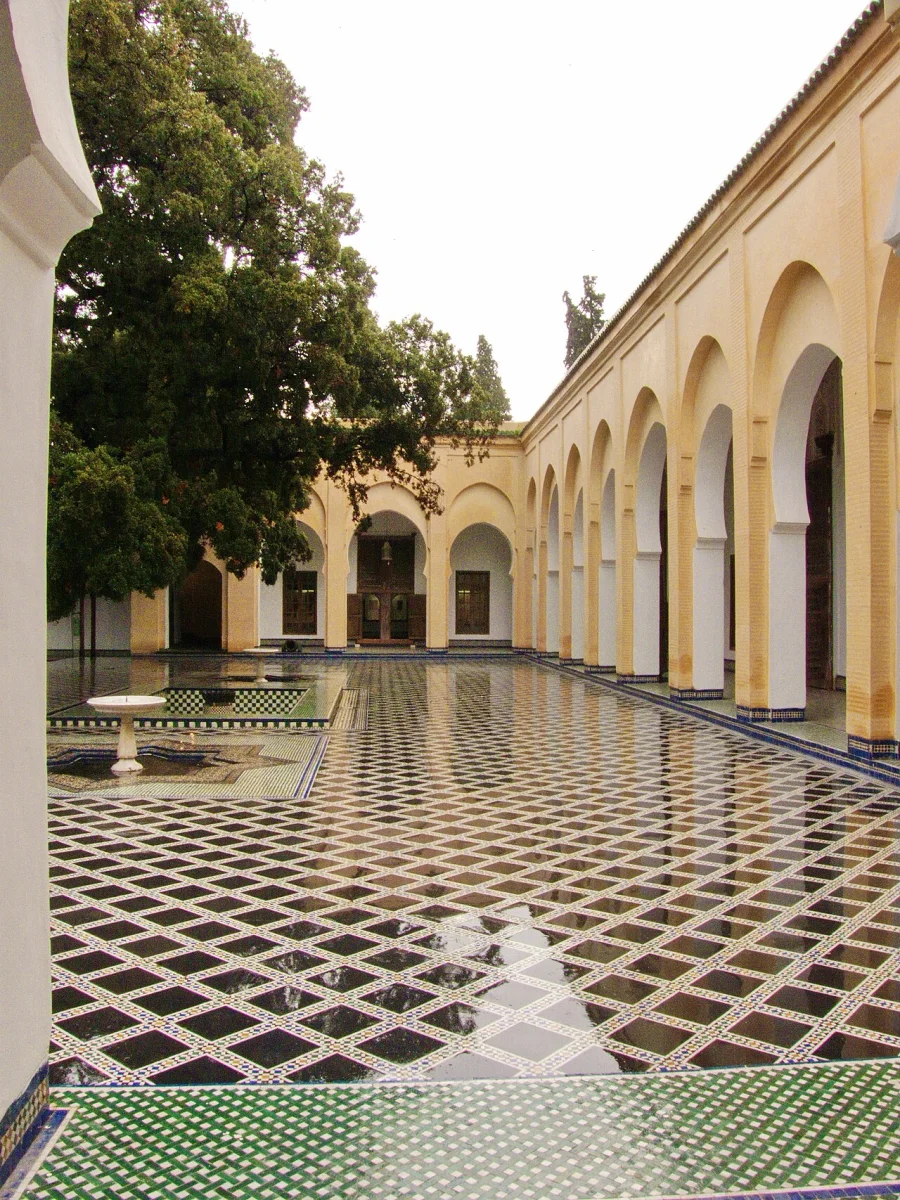
The palace includes two main wings and several residential areas arranged around a central garden.
The Moroccan-Andalusian Garden
One of the most remarkable features of Dar Al Batha is its Moroccan-Andalusian garden.
It forms the true heart of the palace.
This organisation around an interior garden belongs to a long architectural tradition found in major Moroccan residences.
The garden is not simply decorative.
It contributes to the organisation of the palace and creates a transition between its different rooms and galleries.
A Palace Facing Inward
As in many traditional Moroccan palaces and riads, the relatively discreet exterior contrasts with the richness of the interior spaces.
The main rooms open onto galleries and the garden.
This architectural approach favours privacy, shade, air circulation and the relationship between architecture and vegetation.
Dar Al Batha therefore reveals another side of Fez's architectural heritage.
After the spectacular decoration of the Al-Attarine Madrasa or the Bou Inania Madrasa, visitors can discover here the organisation of a large Alaouite palatial residence.
From Royal Palace to Museum in 1915
The history of Dar Al Batha changed significantly in the early 20th century.
In 1915, the palace became a museum devoted to the arts and traditions of Fez and its surrounding region.
This transformation gave the building a new heritage function.
Archaeological, architectural and ethnographic collections were progressively assembled there.
The museum thus became a place for preserving important examples of Fez's artistic and artisanal heritage.
A Protected Historic Monument
The heritage value of the building itself was also officially recognised.
In 1924, Dar Al Batha was classified as a historic monument.
The palace therefore became both a monument to be preserved and a place dedicated to preserving other elements of Moroccan heritage.
The Former Collections of the Batha Museum
For much of the 20th century, the Batha Museum was particularly known for collections devoted to Fez and its surrounding region.
These collections included archaeological objects, architectural elements and ethnographic works.
Woodwork occupied an important place.
Friezes, panels, lintels and other architectural elements offered an opportunity to observe the development of decorative techniques and the craftsmanship of Fez across different dynastic periods.
The museum also preserved manuscripts and various objects connected with the intellectual, scientific and artistic history of the city.
2019: A Major Restoration of Dar Al Batha
After more than a century as a museum, Dar Al Batha underwent a major restoration programme.
The project was launched in 2019.
Its purpose was not simply to restore the palace.
The museum's role and visitor experience were also completely reconsidered.
After several years of work, the monument finally reopened to the public on 26 February 2025.
The Al Batha Museum of Islamic Arts
Since its reopening, inaugurated on 26 February 2025 by King Mohammed VI as part of the rehabilitation programme for the Fez medina, Dar Al Batha has taken on a new identity: the Al Batha Museum of Islamic Arts.
This transformation considerably broadens the interpretation of the monument.
The museum is no longer limited to presenting the traditions of Fez.
It now offers a journey through the development of Morocco across different dynasties and civilisations.
A Journey Through Moroccan History
The permanent exhibition presents works and objects that illustrate several major historical periods.
The visitor route covers a broad chronology, from pre-Islamic civilisations to the modern era.
One of its aims is to show how Islamic arts developed in Morocco over the centuries.
Each dynasty contributed to this history.
The Idrisids played a fundamental role in the early development of Fez.
The Almoravids and Almohads integrated the city into vast political networks linking different regions of the Maghreb and al-Andalus.
The Marinids profoundly shaped the architecture of Fez.
The Saadians and later the Alaouites continued this artistic and cultural evolution.
Fez, a City of Art and Knowledge
The choice of Fez as the location for a major museum devoted to Islamic arts makes particular sense when considering the city's history.
For more than a thousand years, Fez has been an important religious, intellectual, commercial and artisanal centre.
Al Quaraouiyine
At the heart of Fez el-Bali stands Al Quaraouiyine, one of the major religious and intellectual centres in the history of the city.
Places of learning, libraries, workshops, souks and funduqs developed around this important institution.
This concentration of activities helped make Fez a major centre for the transmission of knowledge.
The Marinid Madrasas of Fez
The Marinid period, between the 13th and 15th centuries, represents one of the great chapters in the monumental history of Fez.
Several madrasas were built to accommodate students who came to study in the city.
Al-Attarine Madrasa
The Al-Attarine Madrasa, built between 1323 and 1325, is one of the most refined examples of this architecture.
Zellige, carved wood, finely sculpted stucco, calligraphy and marble combine to create decoration of extraordinary precision.
A visit to the Al Batha Museum helps place these techniques within the broader history of Moroccan arts.
Bou Inania Madrasa
The Bou Inania Madrasa is another essential monument in Fez.
Built in the 14th century, it combines educational, religious and architectural functions.
Visiting Dar Al Batha after the madrasas allows visitors to move from observing historic monuments to gaining a broader understanding of the objects, techniques and artistic traditions that shaped them.
Nejjarine: Understanding the Art of Woodworking
The Nejjarine Museum of Wooden Arts and Crafts is an excellent complement to a visit to the Al Batha Museum.
Housed in a historic funduq, Nejjarine is devoted to woodworking and the craftsmanship associated with this material.
Wood plays an essential role in the traditional architecture of Fez.
It can be found in doors, ceilings, beams, screens, furniture and decorative elements in houses, palaces, mosques and madrasas.
Combining Al Batha and Nejjarine therefore provides two complementary perspectives on the heritage of Fez.
Chouara Tanneries: A Living Heritage
The heritage of Fez is not limited to objects preserved inside museums.
It also continues to live in the workshops of the Medina.
The Chouara Tanneries are one of the most spectacular examples.
Artisans there continue a long tradition of preparing, tanning and dyeing leather.
After discovering historic objects at the Al Batha Museum, observing the artisans of Chouara helps visitors understand that many traditional skills of Fez continue to be practised today.
Zellige and Ceramics in Fez
Among the arts traditionally associated with Fez, ceramics also occupy an important place.
The city is particularly renowned for its zellige, created from small pieces of glazed ceramic that are cut and assembled into complex geometric patterns.
These compositions can be seen throughout many historic monuments.
The Al-Attarine Madrasa offers a particularly spectacular example.
Dar Al Batha helps place these decorative arts within a broader historical context.
Dar Al Batha and the History of Morocco's Dynasties
One of the strengths of the new museum is its ability to show that Moroccan art does not belong to a single period.
It is the result of a long history shaped by successive dynasties and multiple cultural exchanges.
Fez is particularly well suited to telling this story.
The city preserves traces of several major historical periods.
The Idrisid era is linked to its origins.
The Almoravids and Almohads contributed to its development.
The Marinids left an exceptional monumental legacy.
The Alaouites contributed significantly to the development of Fez Jdid and were responsible for the creation of Dar Al Batha itself.
The museum therefore becomes a gateway to more than a thousand years of Moroccan history.
Architecture Shaped by Multiple Influences
UNESCO notes that the historic architecture of Fez developed over more than ten centuries.
Local craftsmanship interacted with different influences, including Andalusian, eastern and African traditions.
The encounter between these traditions is one of the great strengths of the city's heritage.
It can be seen in its architecture, decoration, objects, artisanal techniques and even in the organisation of the Medina itself.
Dar Al Batha now provides a space in which these influences can be placed into perspective.
What to Visit Around the Al Batha Museum
The museum's location makes it easy to include in a day exploring Fez.
Bab Boujloud
The famous Bab Boujloud, one of the main gateways into Fez el-Bali, is nearby.
It is an excellent starting point for entering the Medina.
Bou Inania Madrasa
Not far from Bab Boujloud, the Bou Inania Madrasa offers the opportunity to discover one of the great Marinid monuments of Fez.
Al Quaraouiyine
Continuing deeper into the Medina leads to the area around Al Quaraouiyine, the historic religious and intellectual heart of the city.
Al-Attarine Madrasa
Close to Al Quaraouiyine stands the Al-Attarine Madrasa, one of the masterpieces of Marinid architecture.
Nejjarine Museum
The Nejjarine Museum of Wooden Arts and Crafts provides a deeper insight into traditional craftsmanship.
Chouara Tanneries
Finally, the Chouara Tanneries offer the opportunity to observe one of the most famous historic crafts of Fez still being practised.
An Itinerary for Understanding Fez
These monuments should not be considered as completely separate attractions.
Together, they reveal different dimensions of the same city.
Dar Al Batha tells the story of Moroccan arts and dynasties.
Bou Inania and Al-Attarine illustrate the Marinid golden age.
Al Quaraouiyine recalls the intellectual and religious importance of Fez.
Nejjarine preserves the history of woodworking traditions.
Chouara reveals a craft that remains alive today.
Exploring these places together helps explain why Fez remains one of Morocco's most important heritage cities.
From Fez to Meknes
A visit to Dar Al Batha can also form part of a wider journey between Fez and Meknes.
The two cities provide insights into different periods of Moroccan history.
Fez is deeply associated with the Idrisids and Marinids, while Meknes is particularly marked by the reign of Sultan Moulay Ismail during the 17th and 18th centuries.
Meknes also has its own Bou Inania Madrasa, which should not be confused with the monument of the same name in Fez.
Combining the two destinations therefore offers a broader understanding of the diverse heritage of Morocco's imperial cities.
Why Visit the Al Batha Museum?
The Al Batha Museum has a rare quality.
The building is almost as important as the collections it contains.
Before becoming a museum, Dar Al Batha was a historic palace.
Its Moroccan-Andalusian garden, rooms, galleries and architectural organisation provide evidence of an important period in the history of Fez.
Inside, the new museum route devoted to Islamic arts expands this experience across several centuries of Moroccan history.
The museum therefore creates a link between architecture, history, religion, craftsmanship and the transmission of knowledge.
Dar Al Batha: A New Chapter for a Historic Palace
The history of Dar Al Batha reflects several transformations in the history of Fez.
A royal palace at the end of the 19th century, a museum of arts and traditions from 1915, a protected historic monument since 1924, and then comprehensively restored in the 21st century, the building entered a new chapter in 2025 with the opening of the Al Batha Museum of Islamic Arts.
This evolution does not break with its past.
Instead, it gives the palace a renewed purpose: explaining and transmitting a heritage of which Fez has long been one of the principal historic centres.
Just a short distance from Bab Boujloud, the Bou Inania Madrasa and the streets of Fez el-Bali, Dar Al Batha now provides an excellent introduction to the city.
The journey can then continue towards Al-Attarine, Al Quaraouiyine, Nejjarine and the Chouara Tanneries.
Because understanding Fez requires more than simply admiring its monuments.
It also means understanding the arts, skills and civilisations that shaped them.
That is precisely what the Al Batha Museum allows visitors to discover today.
Read Also
- Discover the Al-Attarine Madrasa
- Bou Inania Madrasa in Fez: History and Architecture
- Al Quaraouiyine: History of the Intellectual Heart of Fez
- Nejjarine Museum: The Art of Woodworking in a Historic Funduq
- Chouara Tanneries: History and Leather Craftsmanship in Fez
- Discover Fez: Heritage, Culture and Monuments
- Discover Meknes: History and Heritage of the Imperial City