Salat Al Azama Synagogue in Marrakech: History and Jewish Heritage
In the heart of the Mellah of Marrakech, behind a relatively discreet entrance, stands one of the city's most important witnesses to its Jewish history: Salat Al Azama Synagogue, also known as Slat Al Azama or Lazama.
Associated with Sephardic Jews who arrived in Morocco following their expulsion from the Iberian Peninsula at the end of the 15th century, the synagogue reflects several centuries of religious, cultural and social history.
Still connected to Marrakech's Jewish community, Salat Al Azama also offers visitors an opportunity to discover an essential dimension of Moroccan heritage, sometimes less familiar than the palaces, madrasas and monuments of the Medina.
Discover Salat Al Azama Synagogue and practical visitor information
A Synagogue Associated with Jews Expelled from Spain
The history of Salat Al Azama is traditionally associated with 1492.
That year marked a major turning point in the history of the Jewish communities of the Iberian Peninsula.
Following the Alhambra Decree issued by the Catholic Monarchs, Jews who refused to convert to Christianity were forced to leave the Spanish kingdoms.
Some of these Sephardic communities found refuge in North Africa, particularly in Morocco.
These newcomers are often referred to in Jewish historical sources as the Megorashim, meaning "the expelled".
They joined Jewish communities that had already been established in Morocco for centuries.
Was Salat Al Azama Really Founded in 1492?
Jewish tradition in Marrakech directly associates Salat Al Azama with Jews who arrived from Spain following the expulsions of 1492.
Some traditions attribute its foundation to Rabbi Yitzhak Delouya, who is associated with the Sephardic community that settled in Marrakech.
However, it is important to distinguish between community tradition and facts that can be established with certainty through historical documentation.
The exact year in which the synagogue was founded is not definitively documented.
It is therefore more accurate to consider 1492 as the date traditionally associated with its origins, rather than an unquestionably established construction date.
This distinction is particularly important because the present-day Mellah of Marrakech was established several decades later, during the 16th century.
What Does "Salat Al Azama" Mean?
The synagogue's name appears in several transliterations, including Salat Al Azama, Slat Al Azama, Lazama and Al Azama.
It is generally associated with the community of Jews expelled from the Iberian Peninsula.
The synagogue is consequently sometimes described as the "Synagogue of the Expelled".
Its history reflects the encounter between two important components of Moroccan Judaism: Jewish communities established in Morocco before the Iberian migrations and Sephardic populations who arrived mainly from the late 15th century onward.
The Creation of the Mellah of Marrakech
The synagogue is now located within the Mellah of Marrakech, the historic Jewish quarter in the southern part of the Medina.
The establishment of the Mellah dates to the Saadian period.
Historical sources generally place its creation around 1557–1558, during the reign of the Saadian Sultan Abdallah al-Ghalib.
Research by historian Emily Gottreich, however, suggests that the formation of the quarter should probably not be understood as a single event occurring on one specific date.
Instead, the creation of the Mellah appears to have been a gradual process during the 1550s and early 1560s.
The quarter developed close to the Kasbah and the Saadian royal complex.
This location placed the Jewish community near the seat of political power while creating a distinct urban space within Marrakech.
A District at the Heart of Marrakech's Commercial Life
The Mellah gradually became an important commercial area of the city.
Members of Marrakech's Jewish community participated in trading networks connecting Morocco with Saharan regions, Atlantic ports and international markets.
Artisans, merchants and intermediaries played significant roles in the economic life of the city.
Jewellery and metalworking are particularly associated with the commercial history of the neighborhood.
Part of this commercial heritage can still be perceived today around the Mellah and Place des Ferblantiers.
Architecture Hidden Behind a Discreet Entrance
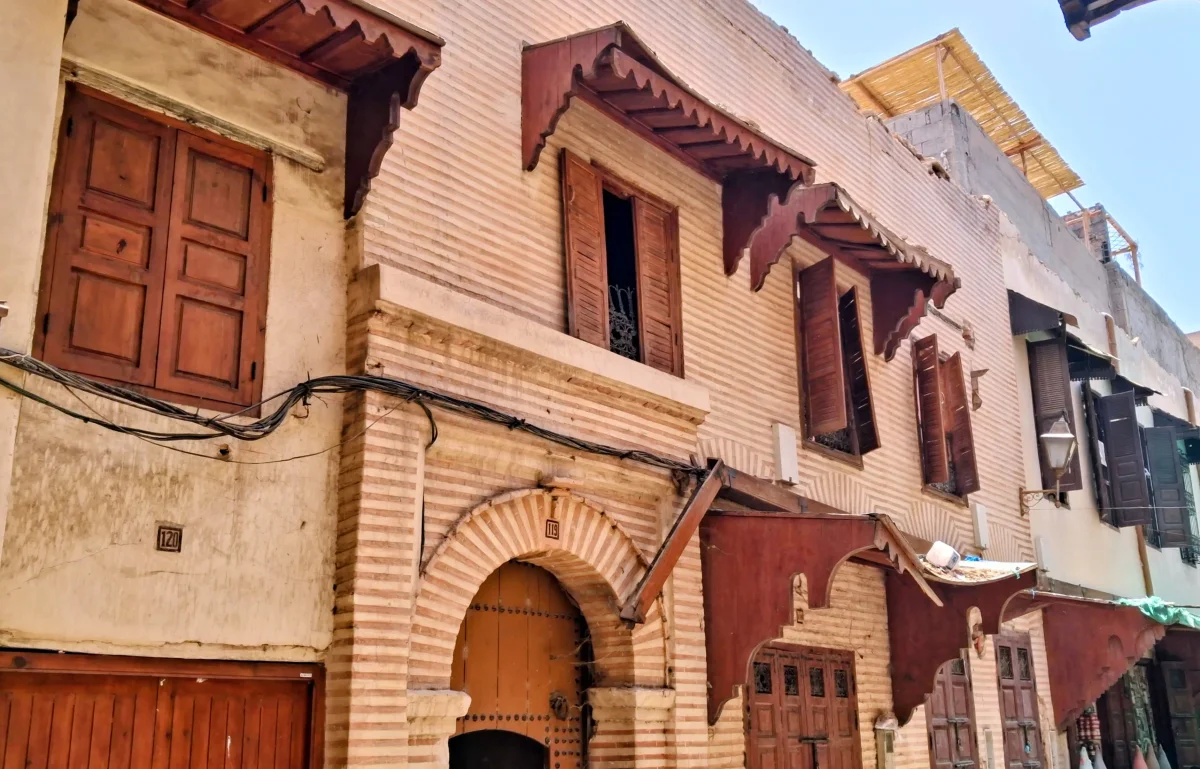
Like many traditional buildings within the Medina, Salat Al Azama reveals relatively little from the street.
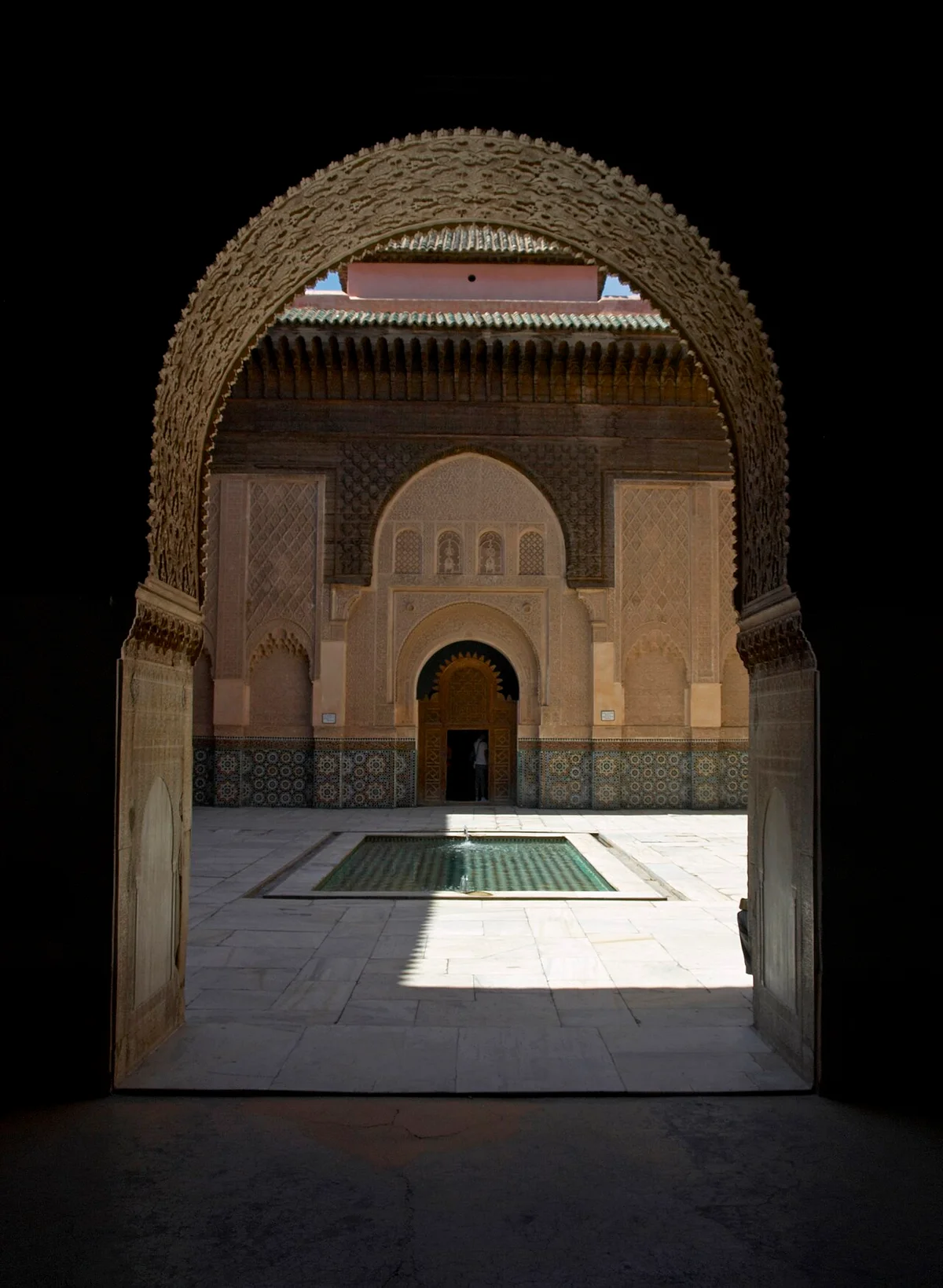
Its interior is organized around a central courtyard.
This layout recalls traditional Moroccan domestic architecture, where rooms are often arranged around an interior courtyard rather than opening directly onto the street.
From the outside, the synagogue can therefore resemble a traditional residence more than a monumental religious building.
The Courtyard of Salat Al Azama
The courtyard is one of the synagogue's most recognizable spaces today.
Its white and blue tones, decorative tiles and rooms opening onto the courtyard create an atmosphere very different from Marrakech's monumental palaces.
Historically, different spaces associated with community life were organized around this central area.
Salat Al Azama was therefore not simply a place where people came to pray.
It formed part of a broader religious, educational and community environment.
A Synagogue and a Place of Learning
Moroccan synagogues could also play an important role in religious education.
Salat Al Azama included spaces dedicated to study.
Historical accounts of Marrakech's Jewish community mention a yeshiva, an institution devoted to Jewish religious learning.
Rooms around the courtyard were once associated with students from the Mellah and, according to community tradition, young people arriving from other regions of Morocco, including areas around the Atlas Mountains.
This educational dimension helps us understand how the synagogue once functioned as a genuine community center, extending well beyond its role as a place of worship.
The Prayer Hall
The prayer hall remains the religious heart of Salat Al Azama.
Its organization reflects Moroccan Jewish and Sephardic traditions.
The synagogue, however, has evolved over time.
Its present appearance is the result of several transformations and restorations.
Research into the building indicates that parts of the synagogue were altered during the 20th century.
The original wooden Torah ark is reported to have been replaced by a marble structure, while a section for women was also incorporated during later modifications.
These changes remind visitors that a living religious monument is rarely preserved in exactly the same form throughout its history.
The Jewish Heritage of Marrakech
Salat Al Azama also provides an opportunity to place the history of the Mellah within the much broader story of Jewish communities in Morocco.
Jewish presence in Morocco is ancient and predates the arrival of Sephardic populations expelled from the Iberian Peninsula.
Over the centuries, communities developed in imperial cities, Atlantic and Mediterranean ports, the Atlas Mountains and southern Morocco.
Fez, Essaouira, Meknes, Rabat, Tetouan and Marrakech were all home to significant Jewish communities during different historical periods.
The arrival of Sephardic Jews from the late 15th century onward added new religious, linguistic and cultural traditions to this already diverse history.
An Important Community Until the 20th Century
Marrakech gradually became one of the major centers of Moroccan Jewish life.
The Mellah once contained numerous synagogues, places of study and community institutions.
From the middle of the 20th century, its demographic situation changed dramatically.
As in other Moroccan cities, much of Marrakech's Jewish population gradually left the city, particularly for Israel, France, Canada and other destinations.
The Mellah consequently lost much of its historic Jewish population.
However, many elements of the neighborhood continue to preserve the memory of this presence, including its architecture, places of worship, cemetery, restored street names and the memory of former commercial activities.
Salat Al Azama Today
Unlike many historic places of worship that have disappeared or been converted to other uses, Salat Al Azama remains connected to the Jewish religious life of Marrakech.
The synagogue continues to be associated with prayer and religious celebrations when community life and circumstances allow.
It also welcomes visitors interested in discovering the Jewish history of Marrakech.
Some spaces contain photographs, documents and objects that help explain the history of the community and the evolution of the Mellah.
Salat Al Azama therefore serves simultaneously as a place of worship, a place of memory and a heritage site.
Why Visit Salat Al Azama?
A visit offers a perspective on Marrakech that is very different from the one revealed by its great palaces.
Several major monuments connected with the Saadian period and the broader history of Marrakech are located nearby.
You can easily combine the synagogue with a visit to Bahia Palace, El Badi Palace and the Saadian Tombs.
This proximity makes it possible to create an especially interesting itinerary exploring several dimensions of Marrakech's history: royal power, palace architecture, the Saadian dynasty, urban communities and Jewish heritage.
Explore the Mellah Around the Synagogue
Do not limit your visit to the interior of Salat Al Azama.
Take time to explore the streets of the Mellah of Marrakech as well.
The street layout, some balcony-fronted houses, markets and historic commercial spaces still reveal elements of the neighborhood's distinctive past.
Place des Ferblantiers also provides a natural transition between the Mellah, Bahia Palace and the area surrounding El Badi Palace.
Exploring the neighborhood on foot therefore allows you to understand the synagogue within its historical environment rather than viewing it as an isolated monument.
A Moroccan Heritage Worth Preserving
The history of Salat Al Azama demonstrates that Moroccan heritage is the result of multiple communities, traditions and cultural influences.
Moroccan Judaism is an integral part of that history.
Preserving a synagogue, cemetery, Mellah or community archive therefore means more than protecting the heritage of a particular community.
It also means preserving part of the historical memory of Morocco.
Salat Al Azama remains one of the most accessible examples of this heritage in the heart of Marrakech.
Plan Your Visit
Before visiting, check the latest information concerning opening hours, access conditions and admission.
View the Salat Al Azama Synagogue page
For more detailed information:
- Salat Al Azama Synagogue: Access, Opening Hours and Prices
- Salat Al Azama Synagogue: Practical Visitor Guide
References and Sources
- Emily Gottreich, On the Origins of the Mellah of Marrakesh, International Journal of Middle East Studies, Cambridge University Press, 2003.
- Barry L. Stiefel, Jews and the Renaissance of Synagogue Architecture, 1450–1730, Routledge.
- Gaston Deverdun, Marrakech : des origines à 1912.
- Diarna — The Geo-Museum of North African and Middle Eastern Jewish Life, archival material concerning Slat al-Azama and Jewish heritage in Marrakech.
- Jewish Community of Marrakech, historical documentation concerning Al Azama Synagogue and the Jewish history of Marrakech.