Chouara Tanneries in Fez: History, Leather and Centuries-Old Craftsmanship
In the heart of Fez el-Bali, among the narrow streets of the Medina, souks and artisan workshops, lies one of Morocco's most iconic sights: the Chouara Tanneries.
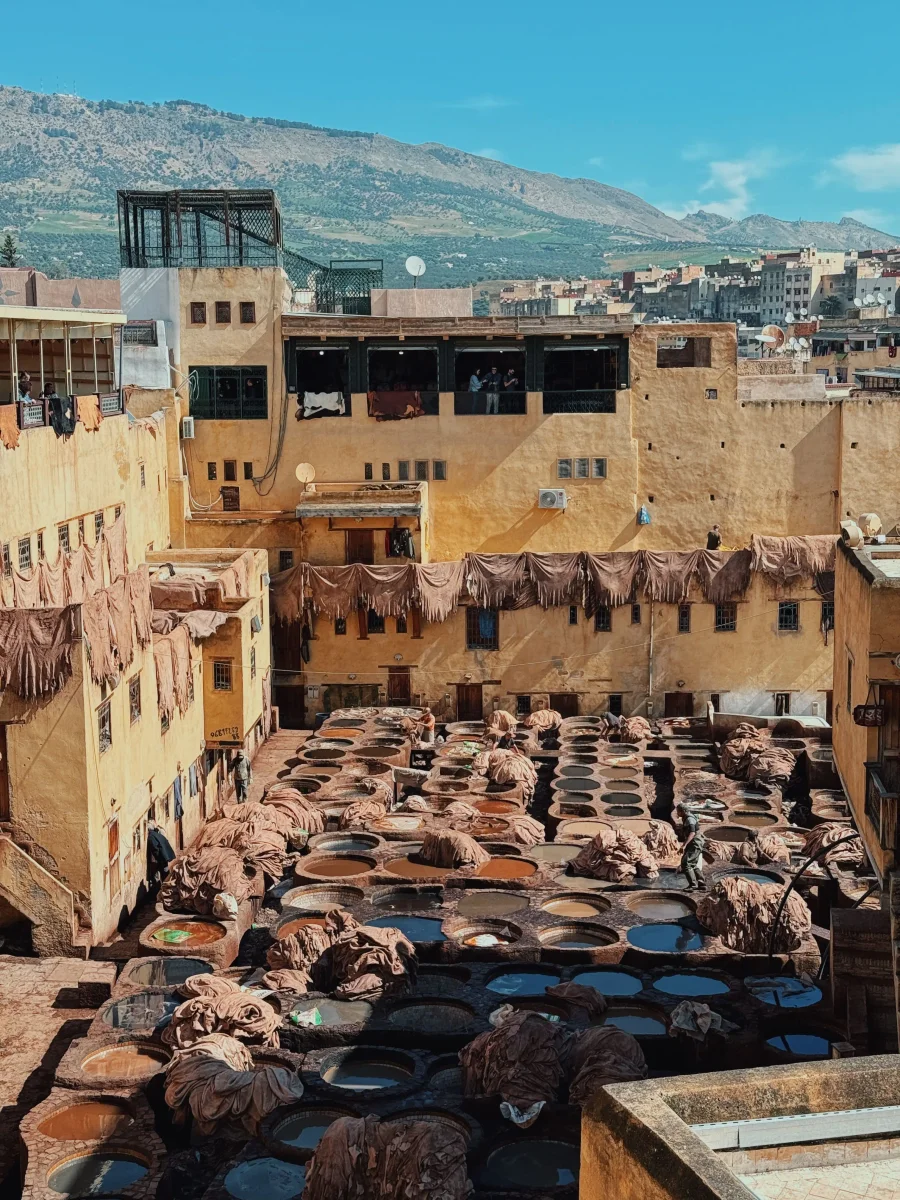
From the terraces overlooking the site, visitors can see a spectacular collection of stone vats used during the different stages of preparing, tanning and dyeing hides.
But Chouara is much more than a famous image of Fez.
The tannery belongs to a very old tradition of leatherworking, an activity that has played an important role in the city's economy for centuries. Historical sources attest to the importance of tanners in medieval Fez, although the exact date when the Chouara Tanneries themselves were established remains uncertain.
Visiting Chouara therefore offers an opportunity to experience a special kind of heritage: not a monument frozen in time, but a working craft site that remains active today.
The Chouara Tanneries in the Heart of Fez el-Bali
The Chouara Tanneries are located in Fez el-Bali, the oldest part of the Medina of Fez.
The Medina has been listed as a UNESCO World Heritage Site since 1981 and is considered one of the most important historic urban centres in the Arab-Muslim world.
Fez developed from the Idrisid period onwards and continued to expand under the major dynasties that successively ruled Morocco.
Over the centuries, the city became an important religious, intellectual, commercial and craft centre.
This historic organisation can still be seen today.
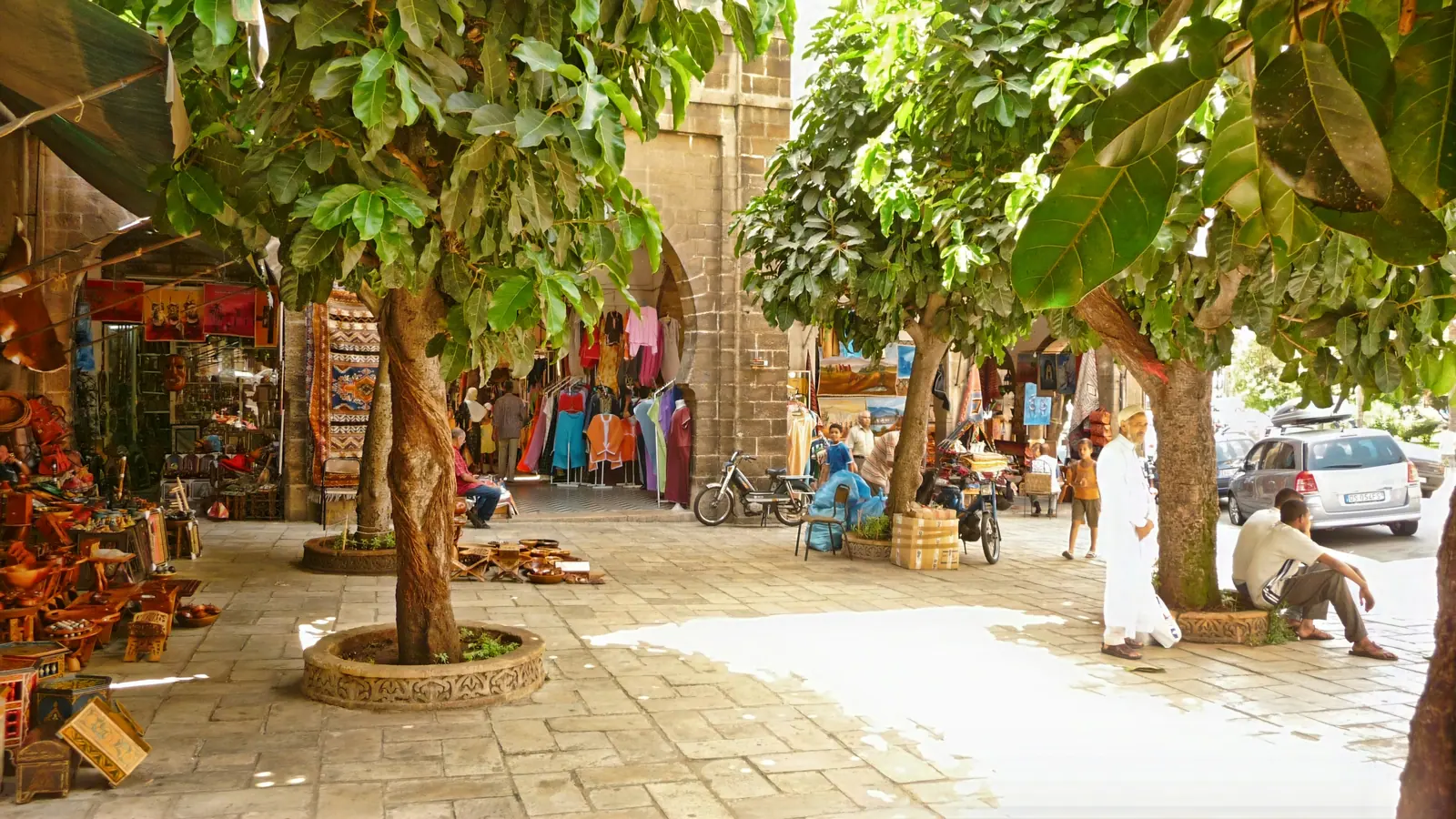
Souks, mosques, madrasas, funduqs and workshops are intertwined within a dense network of streets where traditional crafts continue to occupy an important place.
Why Were Tanneries Built Near Water?
Processing hides requires large quantities of water.
Historic tanneries were therefore generally established close to rivers, streams or water sources that could supply the different stages of production.
Chouara is located close to the Oued Fez, in the eastern part of the Medina.
This location was not simply practical.
It also illustrates how the urban organisation of Fez el-Bali was closely connected to the economic activities that sustained the city.
What Is the History of the Chouara Tanneries?
It is common to read that the Chouara Tanneries date directly from the foundation of Fez in the 9th century or that they were established in the 11th century.
The historical reality requires more caution.
Local tradition associates the old tanneries of Fez with the city's early development, but the precise date when Chouara itself was established has not been conclusively determined by the available historical evidence.
What is much better documented is the considerable age of Fez's leather industry.
A Major Industry in Medieval Fez
Tanning already occupied an important position in the medieval economy of the city.
Historical accounts indicate that leather products from Fez gained a reputation that extended far beyond the surrounding region.
During the Almohad period, between the 12th and 13th centuries, historical sources mention numerous tanning workshops operating in the city.
Under the Marinids, when Fez experienced one of the most brilliant periods in its history, leatherworking remained closely connected to the commercial and craft activities of the Medina.
Chouara therefore belongs to a leatherworking tradition stretching back many centuries, even though this broader history should not be confused with a precise foundation date for the present tannery.
How Does a Traditional Tannery Work?
Seen from above, the Chouara Tanneries can resemble an enormous painter's palette.
But each group of vats has a practical function.
Transforming animal hide into usable leather requires several successive operations.
1. Preparing the Hides
Hides from animals including sheep, goats and cattle must first be cleaned and prepared.
They pass through different solutions designed to remove unwanted material and prepare the fibres for tanning.
The pale or whitish vats visible at Chouara are associated with some of these initial stages.
Lime is among the substances traditionally used during the preparation of hides.
2. Softening the Hides
Another stage involves working and softening the hides before further processing.
Chouara is particularly known for the traditional use of mixtures containing pigeon droppings, whose action is associated with their ammonia-rich compounds.
This process helps soften the hides and prepare their fibres for subsequent treatment.
The work remains physically demanding.
Artisans handle the hides directly and move them between different vats during the production process.
3. Tanning the Leather
Tanning is the essential process that transforms animal hide into durable leather.
Traditional techniques have historically made use of plant-based tannins.
These substances help stabilise the fibres and prevent the hide from decomposing.
The process requires time as well as specialist knowledge passed down among generations of craftsmen.
4. Dyeing the Leather
Once prepared and tanned, the leather can be dyed.
This is the stage responsible for the spectacular appearance of the Chouara Tanneries when viewed from the surrounding terraces.
The colours visible in the vats vary according to the work being carried out.
Plant materials have historically been used to produce different shades.
However, it would be misleading to assume that every colour visible at Chouara today necessarily comes exclusively from natural pigments.
Like many traditional crafts, tanning has evolved over time and can combine historic practices with more contemporary products and methods.
From Raw Leather to Fez Babouches
The work performed by the tanners is only one stage in a much larger craft production chain.
Once the hides have been tanned, coloured and dried, they leave the tannery and are taken to other workshops.
Fez's Leather Craftsmen
The leather can then be cut, sewn, decorated and assembled.
It is used to produce items such as:
- babouches
- bags
- belts
- wallets
- poufs
- accessories
- decorative objects
This specialisation of different trades is characteristic of the traditional organisation of Moroccan medinas.
A single artisan does not necessarily create an entire finished product.
Several different crafts may intervene between the raw hide and the object eventually sold in the souk.
Chouara and the Traditional Crafts of Fez
The Chouara Tanneries become even more interesting when considered as part of the wider craft heritage of Fez.
Historically, the Medina functioned as an enormous economic network.
Artisans were often grouped in different neighbourhoods and souks according to their trades.
Tanners prepared hides.
Other craftsmen transformed the finished leather.
Carpenters and woodcarvers worked with wood.
Metalworkers shaped metal.
Weavers produced textiles.
Zellige craftsmen created the geometric compositions decorating palaces, mosques and madrasas.
This diversity helps explain why Fez remains one of Morocco's great centres of traditional craftsmanship.
Nejjarine: Discover Another Historic Craft of Fez
To continue exploring the city's traditional crafts, the Nejjarine Museum of Wooden Arts and Crafts is particularly interesting.
Located inside a historic funduq, the museum is dedicated to woodworking and the craftsmanship associated with it.
The building itself also provides an opportunity to understand the role of funduqs in the economy of the Medina.
These establishments were historically used to accommodate merchants and store merchandise.
Chouara and Nejjarine therefore reveal two complementary dimensions of Fez: craft production and commerce.
From the Tanneries to the Madrasas: Understanding the Medina of Fez
Only a short walk from the souks and craft districts are some of the city's most important religious and intellectual monuments.
Among them is Al Quaraouiyine, which occupies a central place in the religious and intellectual history of Fez.
Several madrasas were built around this major centre of learning.
The Al-Attarine Madrasa, built between 1323 and 1325 during the reign of the Marinid Sultan Abu Sa'id Uthman II, is one of the finest examples.
Nearby, the Bou Inania Madrasa also illustrates the intellectual and architectural development of Fez during the Marinid period.
A City Where Everything Was Connected
These monuments may appear very different from the Chouara Tanneries.
Yet they belonged to the same urban system.
Madrasas accommodated students.
Mosques structured religious life.
Funduqs supported commerce.
Souks organised trade.
Workshops housed craftsmen.
Tanneries produced leather.
It is this combination that makes Fez el-Bali such an exceptional historic city.
How to See the Chouara Tanneries
Chouara has an unusual layout.
The artisans work at the level of the vats, while visitors generally observe the tannery from terraces located inside the surrounding buildings.
Several leather shops have terraces overlooking the vats.
Panoramic Terraces
From the upper floors, it is much easier to understand the organisation of the tannery.
Visitors can see the different groups of vats, hides arranged around the site and artisans moving through the working area.
Most of the famous photographs of the Chouara Tanneries are taken from these terraces.
Do You Have to Pay to See Chouara?
There is no single admission system comparable to the ticket office of a conventional museum for the various privately operated viewpoints.
Some terraces belong to leather shops and other businesses.
Access arrangements can therefore vary.
It is advisable to ask clearly about any conditions or charges before going up to a terrace and not to assume that a service offered in the street is automatically free.
Why Are Visitors Given Mint?
One of Chouara's most famous characteristics is its smell.
It comes from some of the materials used during the treatment of the hides and can be particularly strong.
Visitors are therefore sometimes offered a few leaves of fresh mint to hold near their nose while looking over the tannery.
Mint obviously has no role in the leather-production process.
It has simply become a familiar part of the visitor experience on some of Chouara's terraces.
When Is the Best Time to Visit the Chouara Tanneries?
Activity at the tanneries varies depending on the day, season and production currently underway.
It is therefore impossible to guarantee that every vat will be filled with bright colours at the exact moment of a visit.
Visit During the Day
Daylight generally makes it easier to observe the artisans at work and distinguish the different shades in the vats.
Natural light also makes the overall organisation of the site easier to understand.
Allow Time to Explore the Neighbourhood
Chouara should not be treated as an isolated tourist attraction.
The surrounding neighbourhood is part of the experience.
Walking through its streets helps visitors understand how leather moves from the tanning process towards workshops and commercial spaces.
Respecting the Artisans
The Chouara Tanneries have become one of the most photographed attractions in Fez.
But it is important to remember something essential:
the people visible among the vats are working.
Chouara is not a set created for visitors.
It is a real production environment.
Observing the work from the surrounding terraces provides a remarkable opportunity to discover traditional craftsmanship, but the experience should always respect the artisans and their workplace.
What to Visit Around the Chouara Tanneries
Chouara's location in the heart of Fez el-Bali makes it easy to combine the tanneries with several important historic monuments.
Al Quaraouiyine
Al Quaraouiyine is one of the great historic religious and intellectual centres of Fez.
Its history helps explain why the city attracted students, scholars and travellers for centuries.
Al-Attarine Madrasa
Located close to Al Quaraouiyine, the Al-Attarine Madrasa is one of the great masterpieces of Marinid architecture in Fez.
Its zellige, carved stucco and decorated woodwork reveal another dimension of the extraordinary skills of the city's craftsmen.
Bou Inania Madrasa
The Bou Inania Madrasa offers another opportunity to explore Marinid architecture and the history of education in Fez.
Nejjarine Museum
The Nejjarine Museum of Wooden Arts and Crafts is an excellent complement to a visit to Chouara.
After observing leatherworking at the tanneries, visitors can discover the importance of wood in Moroccan craftsmanship and traditional architecture.
From Fez to Meknes: Continue Exploring Morocco's Heritage
A stay in Fez can easily be combined with a visit to Meknes, another of Morocco's historic imperial cities.
While Fez offers an opportunity to explore the Idrisid and Marinid periods, historic centres of learning and traditional crafts, Meknes is deeply associated with Sultan Moulay Ismail and his ambitious imperial capital.
Meknes also has its own Bou Inania Madrasa, which should not be confused with the monument of the same name in Fez.
Combining Fez and Meknes therefore provides a fascinating introduction to several major periods in Moroccan history.
Chouara: A Living Heritage
The Chouara Tanneries are neither a palace nor a museum.
That is precisely what makes them so remarkable.
They offer a rare opportunity to observe a craft that has contributed to the economy and identity of Fez for centuries.
The vats, hides, movements of the artisans and surrounding workshops tell a different story from the city's monumental architecture.
Only a short distance from Al Quaraouiyine, the Al-Attarine Madrasa, Bou Inania and the Nejjarine Museum, Chouara reminds us that the heritage of Fez is not limited to historic buildings.
It also survives through crafts, gestures and skills transmitted from one generation to another.
Visiting the Chouara Tanneries means discovering a living part of the heritage of Fez.