Traditional Moroccan Architecture: Understanding Zellige, Carved Stucco, Cedarwood and Muqarnas
Entering a Moroccan palace, madrasa or riad means stepping into an architecture that does not reveal all its secrets at first glance.
At first, the eye is drawn to the colours of zellige, the delicacy of carved stucco, the painted wooden ceilings, or the play of light and shadow created by arches and galleries.
But behind this decorative richness lies a true architectural language, developed, refined and passed down by generations of Moroccan craftsmen.
In Marrakech, this language can be discovered notably at the Bahia Palace, the Ben Youssef Madrasa, the Saadian Tombs and El Badi Palace.
These monuments belong to different periods, yet they share a common vocabulary: geometry, light, water, calligraphy, zellige, carved gebs plaster and finely worked wood.
Understanding these elements allows you to look at Moroccan architecture differently and, above all, notice details during a visit that can easily be missed.
An Architecture Shaped by Centuries of History
Traditional Moroccan architecture does not belong to a single period or dynasty.
It is the result of centuries of evolution and exchanges between Morocco, Al-Andalus, the Maghreb and different regions of the Islamic world.
Marrakech is an exceptional place to observe this history.
Founded in the 11th century by the Almoravids, the city quickly became a major political and cultural capital.
The Almohads then profoundly transformed Marrakech during the 12th century.
Several centuries later, the Saadians made the city one of Morocco's major political centres and developed a particularly refined architectural style.
El Badi Palace and the Saadian Tombs still bear witness to this period today.
In the 19th century, the Bahia Palace shows how Moroccan architectural traditions continued to evolve while preserving techniques inherited from much earlier periods.
This continuity explains why visitors can find similar decorative principles in monuments built centuries apart.
Zellige: Geometry Transformed into Architecture
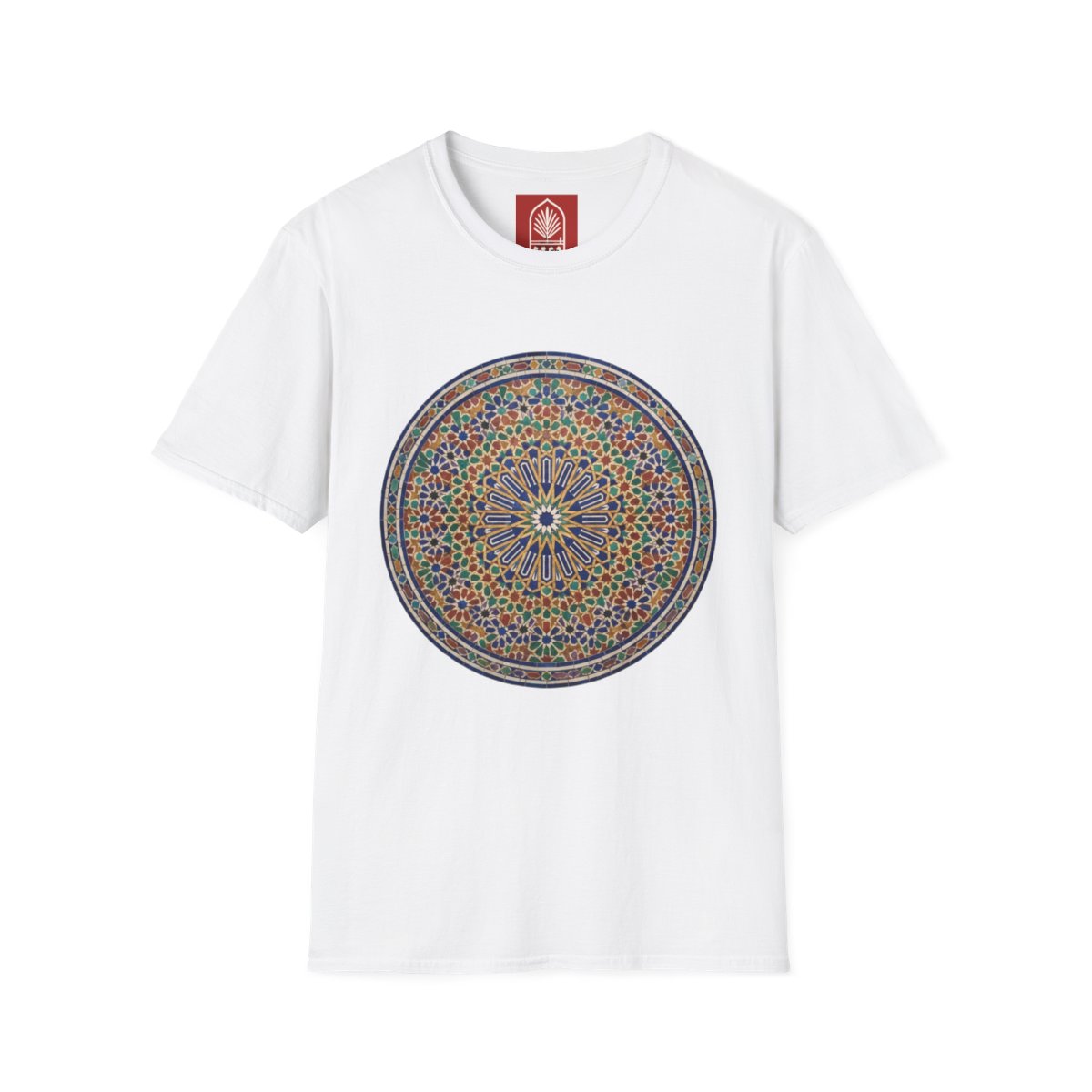
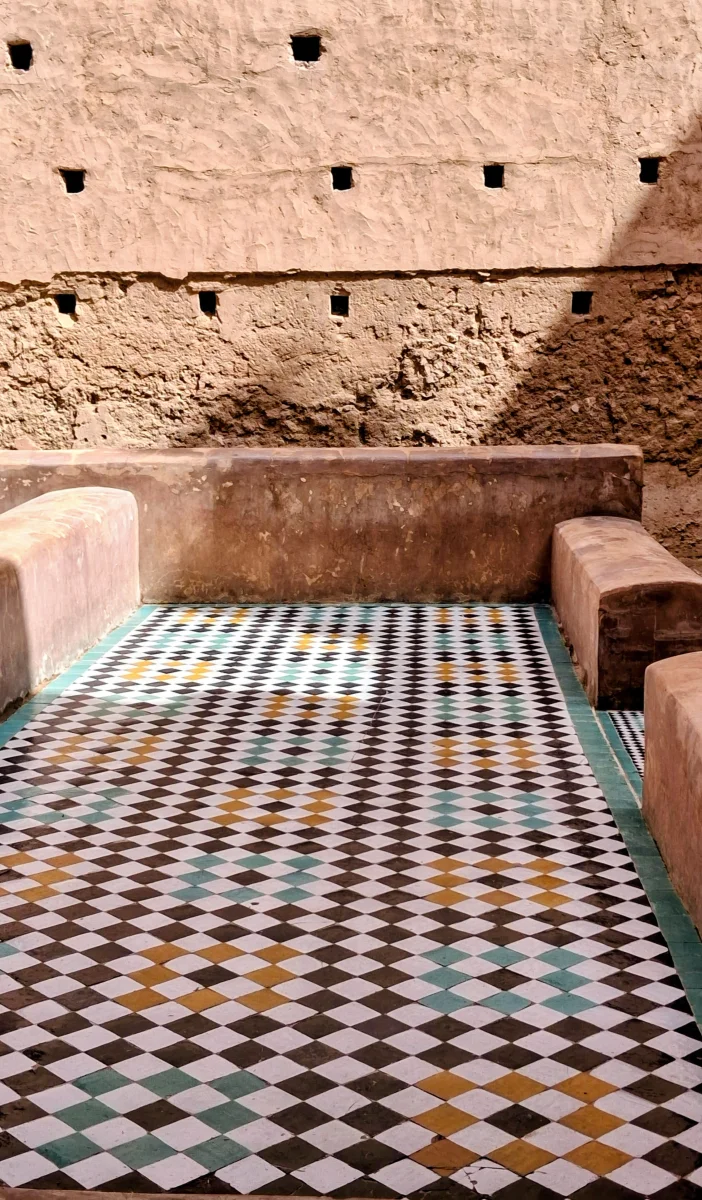
Zellige is probably one of the most recognisable elements of Moroccan architecture.
It consists of small pieces of glazed terracotta, cut and assembled by hand to create complex geometric compositions.
Unlike industrial tiles on which a pattern is simply printed, a zellige design is genuinely constructed piece by piece.
Triangles, stars, diamonds, polygons and interlacing lines are assembled according to highly precise geometric rules.
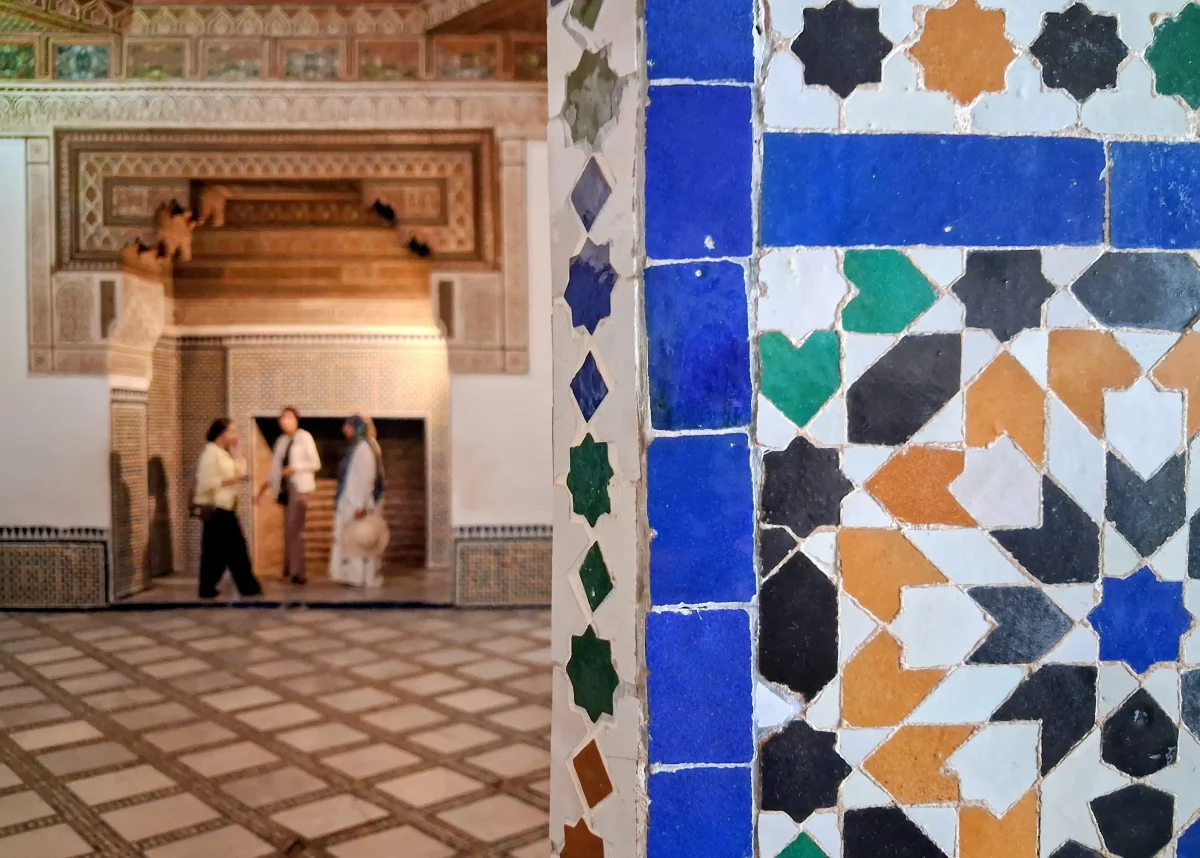
Some compositions create the impression that the pattern could continue endlessly beyond the wall.
This repetition is one of the important characteristics of geometric decoration developed in western Islamic architecture.
In Marrakech, pay particular attention to the zellige at the Bahia Palace and the Ben Youssef Madrasa.
In Fez, this tradition also reaches an exceptional level in several major historic madrasas, including the Al-Attarine Madrasa.
How Is Zellige Made?
Traditional zellige production involves several stages and requires great technical skill.
The clay is shaped and fired before being covered with glaze.
The tiles are then cut by hand into different geometric forms.
Each small piece must correspond exactly to the planned composition.
The craftsman must therefore master the material, the gesture and the geometry.
The different pieces are then assembled according to the final design before being fixed together.
Visitors only see the completed surface, but behind just a few square metres of zellige there may be hundreds or even thousands of individually worked pieces.
The Colours of Zellige
Blue, green, white, black, yellow, ochre and many other shades appear depending on the period, workshop and monument.
Specific symbolic meanings are sometimes attributed to each of these colours.
Such interpretations should, however, be treated with caution.
Colours may have cultural or religious associations, but their use also depends on the historical period, available materials, local traditions and the composition sought by the craftsmen.
The true language of zellige therefore lies as much in its geometry, rhythm and repetition as in its colours.
Gebs and Carved Stucco: Mineral Lacework
Above panels of zellige, another much finer form of decoration often appears: carved plaster, commonly associated with gebs in Moroccan craftsmanship.
From a distance, it can resemble delicate mineral lace.
Up close, it reveals a remarkable variety of motifs.
These include vegetal arabesques, geometric compositions, interlacing patterns, rosettes and calligraphic inscriptions.
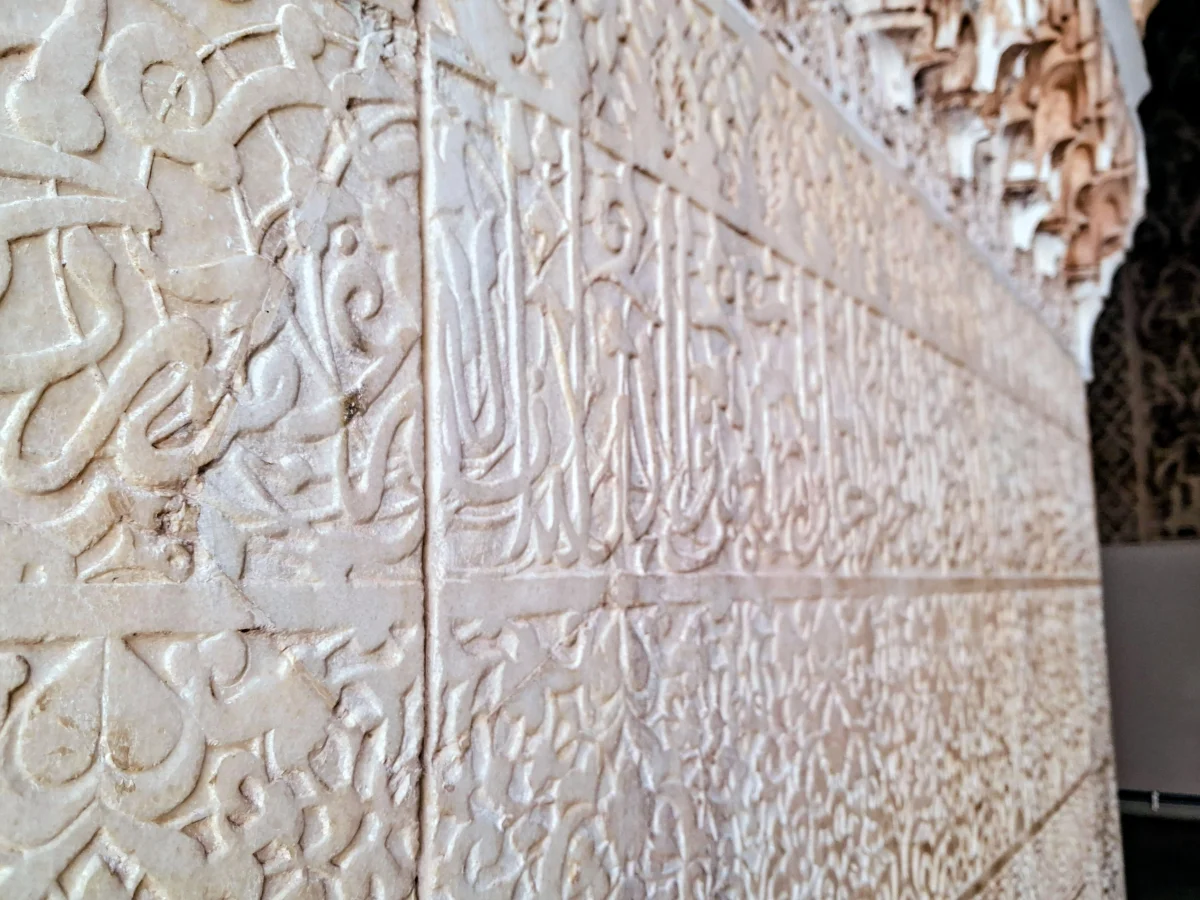
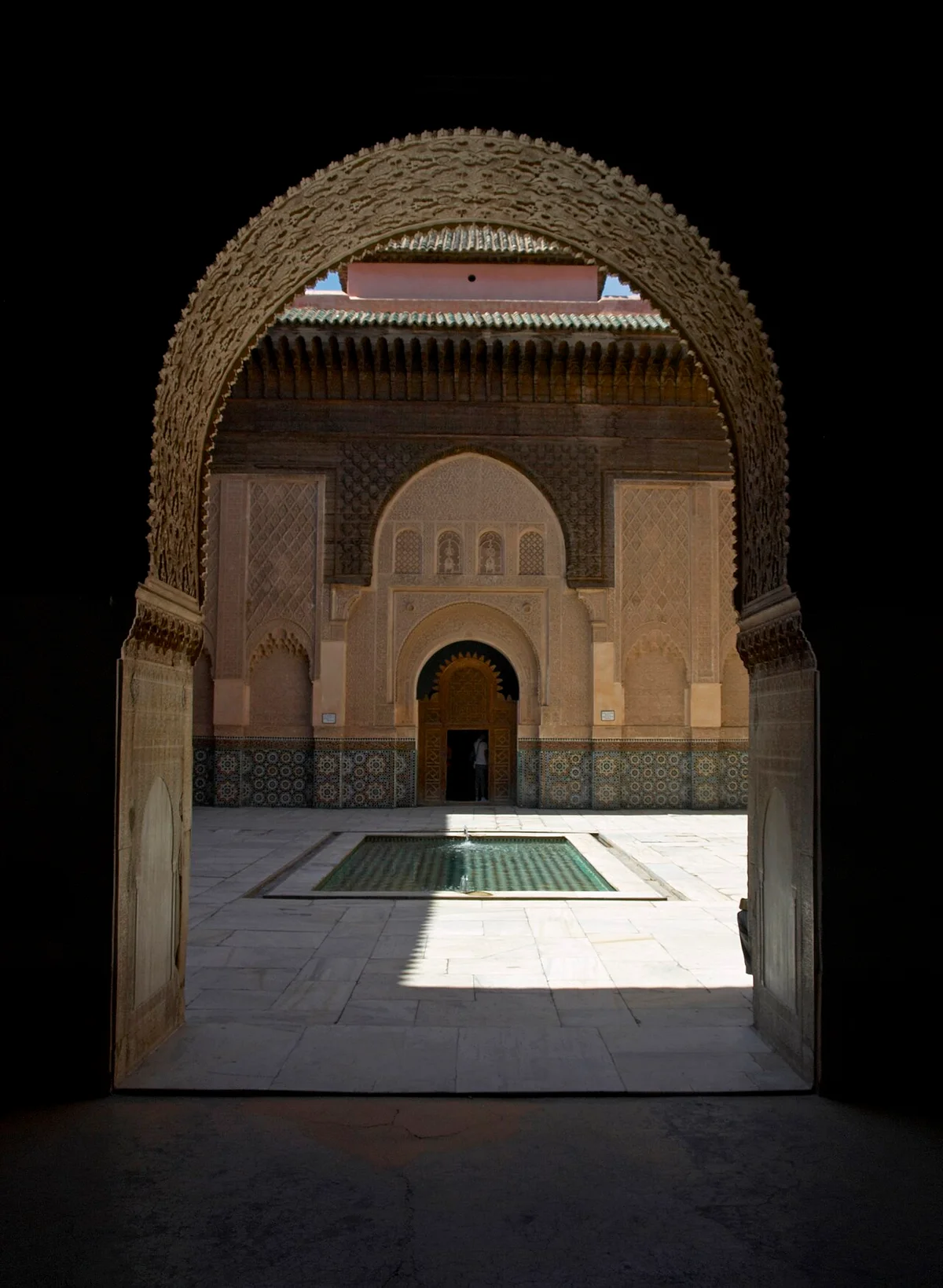
The Ben Youssef Madrasa is one of the best places in Marrakech to observe this combination of zellige, carved plaster and wood.
Do not only look at the courtyard as a whole.
Move closer to the walls.
At just a few centimetres away, surfaces that initially appear simply decorative reveal an extraordinary density of detail.
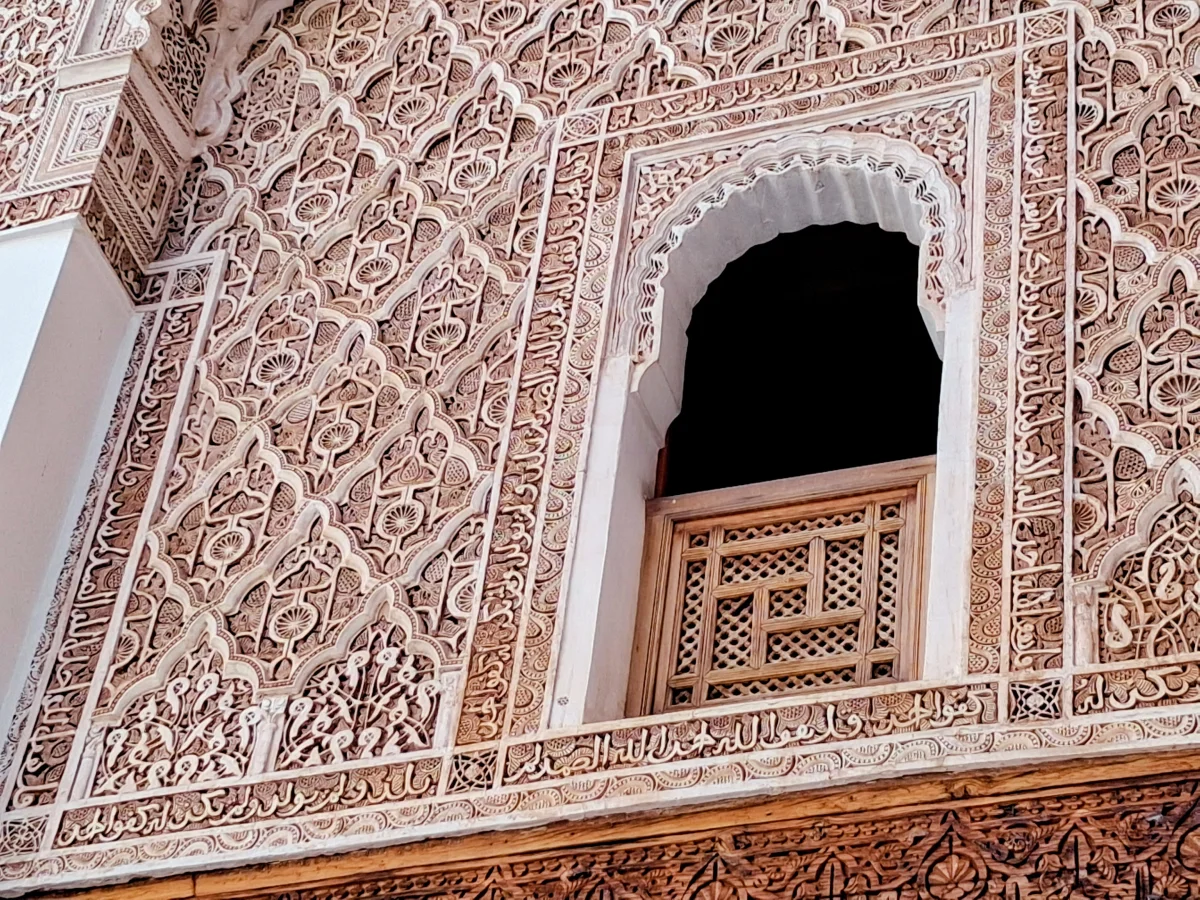
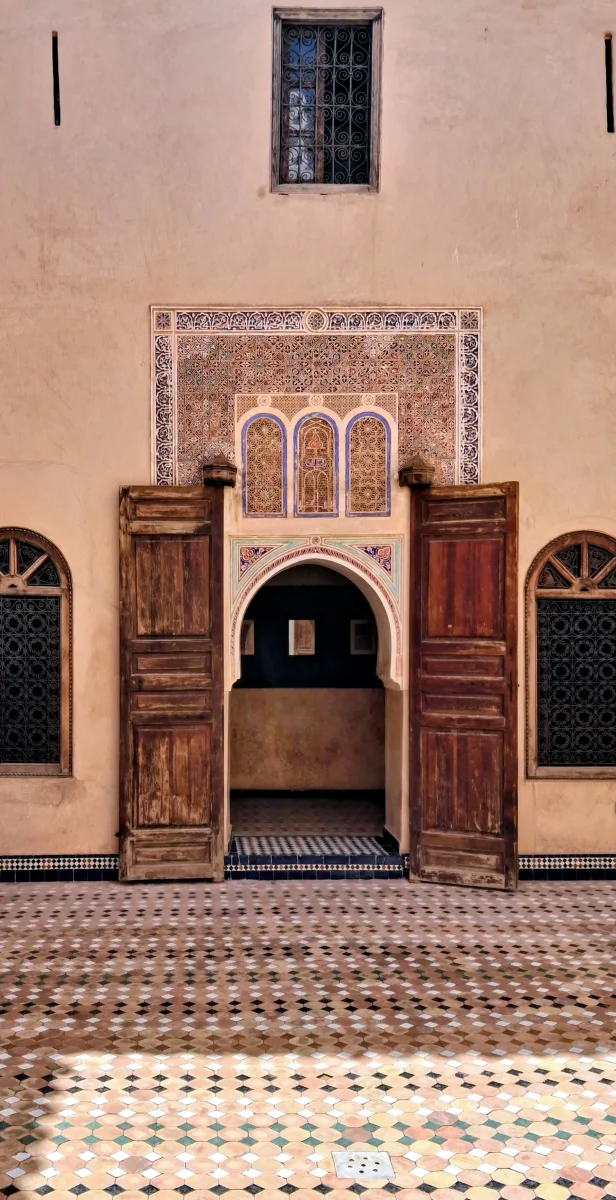
This photograph shows particularly well how several traditional crafts can meet on the same interior façade.
The carved plaster interacts with the woodwork and openings, creating several levels of depth.
The decoration is therefore not simply applied to the building.
It is part of the architecture itself.
Calligraphy: When Writing Becomes Architecture
In madrasas, religious monuments and certain prestigious buildings, Arabic calligraphy forms an integral part of architectural decoration.
Inscriptions are not simply added to the walls.
They become friezes, lines, rhythms and decorative compositions in their own right.
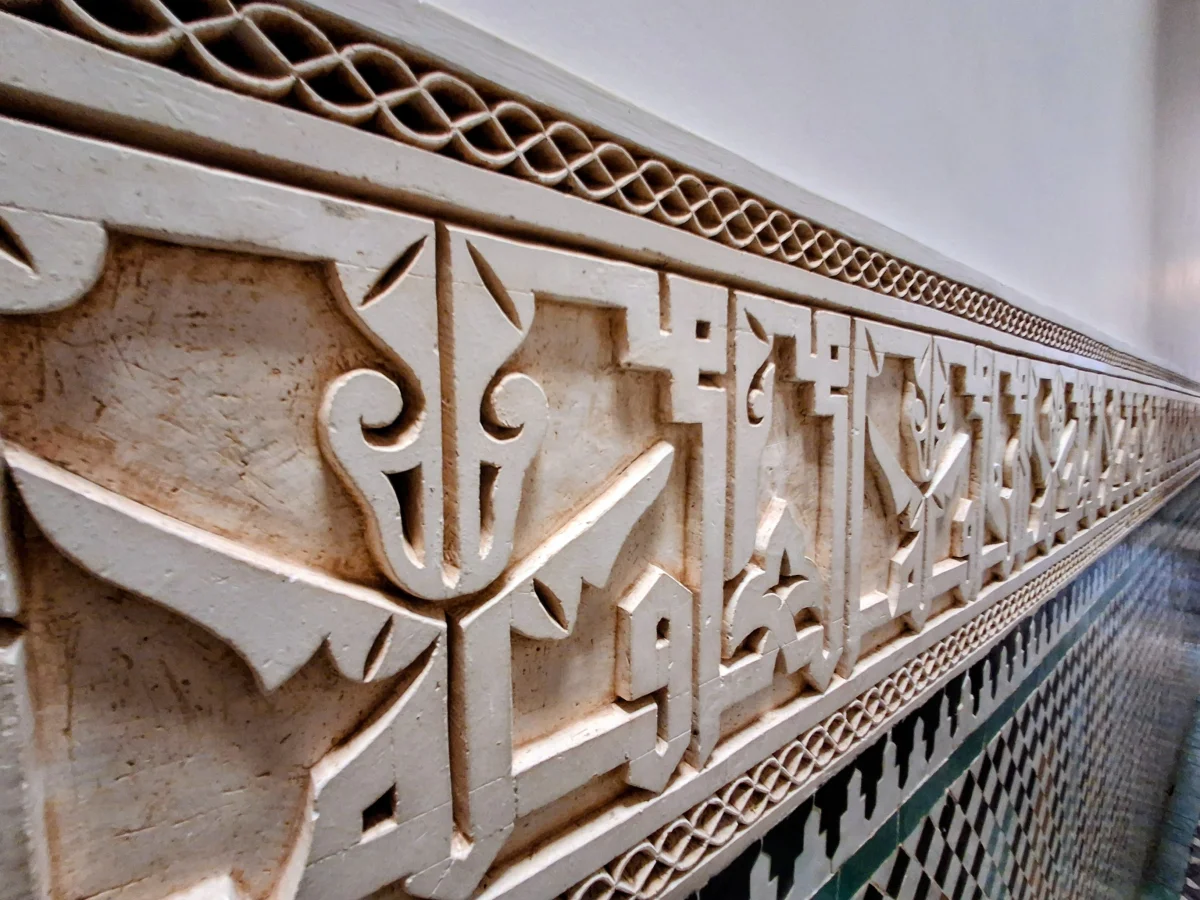
Some inscriptions are carved into plaster, while others may appear in wood, stone or decorative panels.
At the Ben Youssef Madrasa, observe how inscriptions are integrated into arabesques and geometric forms.
From a few metres away, an inscription may look like a simple decorative pattern.
Move closer and you discover that the writing itself forms part of the ornament.
Woodwork: Doors, Windows, Friezes and Ceilings
In Moroccan architecture, wood is not limited to ceilings.
It also appears in monumental doors, windows, moucharabiehs, lintels, friezes, balustrades and galleries.
Woodwork creates a particularly interesting contrast with carved plaster.
The Ben Youssef Madrasa offers many examples of this combination.
On a single wall, visitors can observe the transition between an intricately worked mineral surface and a wooden opening crafted with the same degree of precision.
This combination helps give interior façades their depth and rhythm.
Cedarwood: Architecture That Makes You Look Up
Inside a Moroccan monument, never forget to look at the ceiling.
Cedarwood, highly valued in Moroccan monumental architecture, can be carved, painted, assembled or combined with other decorative techniques.
It appears in ceilings, lintels, doors, galleries and grand reception rooms.
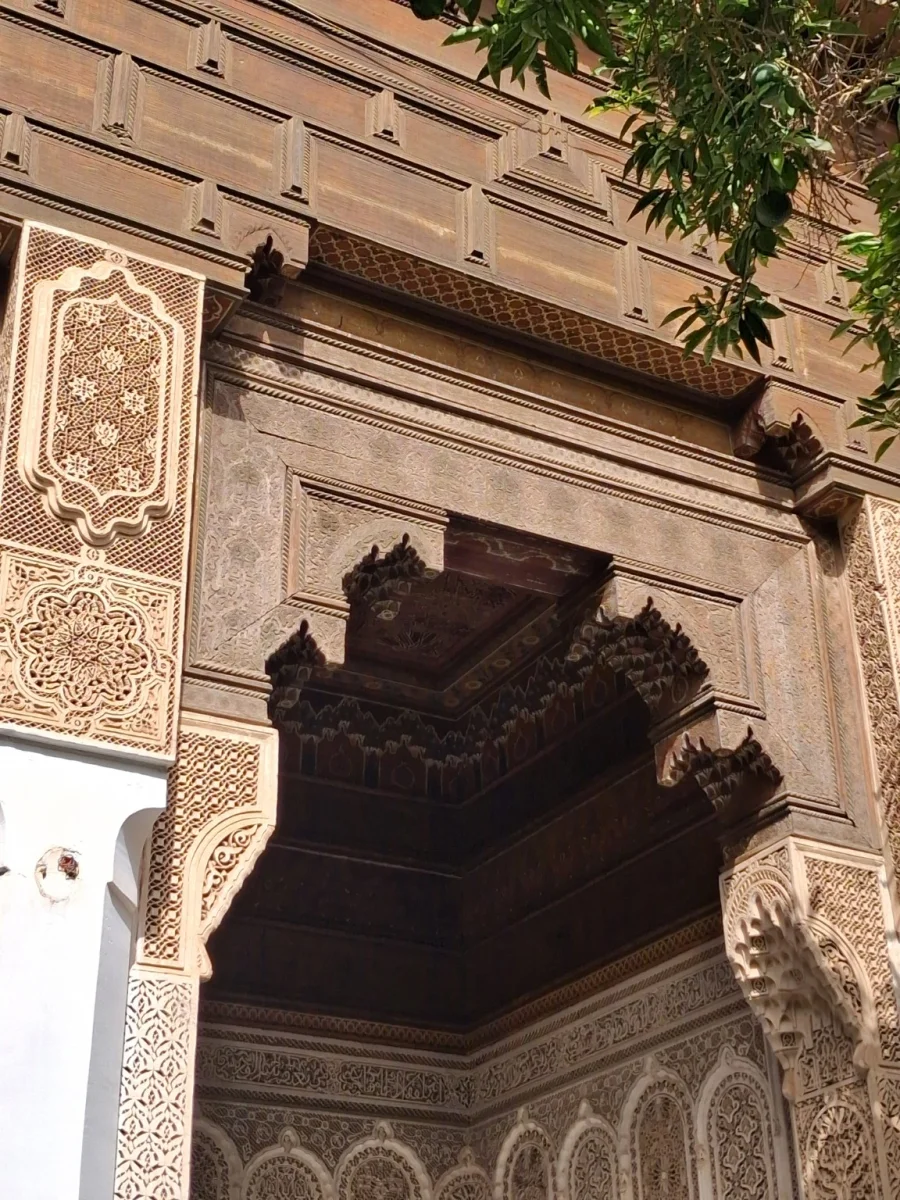
At the Bahia Palace, the ceilings are an essential part of the visit.
Some display extremely elaborate geometric and vegetal compositions.
Wood also creates a visual contrast with the materials used lower down on the walls.
The glossy, mineral surface of zellige responds to the delicacy of carved plaster and then to the visual warmth of wood.
The Gayza: A Detail Many Visitors Miss
Among the details worth observing in Moroccan palaces are the carved wooden cornices and friezes, sometimes locally known as gayza.
They create a visual transition between walls, doors and ceilings.
At the Bahia Palace, these elements help reveal how Moroccan architectural decoration works as a complete composition.
A spectacular ceiling should therefore not be viewed in isolation.
It interacts with the doors, friezes, stucco and zellige panels beneath it.
Muqarnas: Geometry Becomes Three-Dimensional
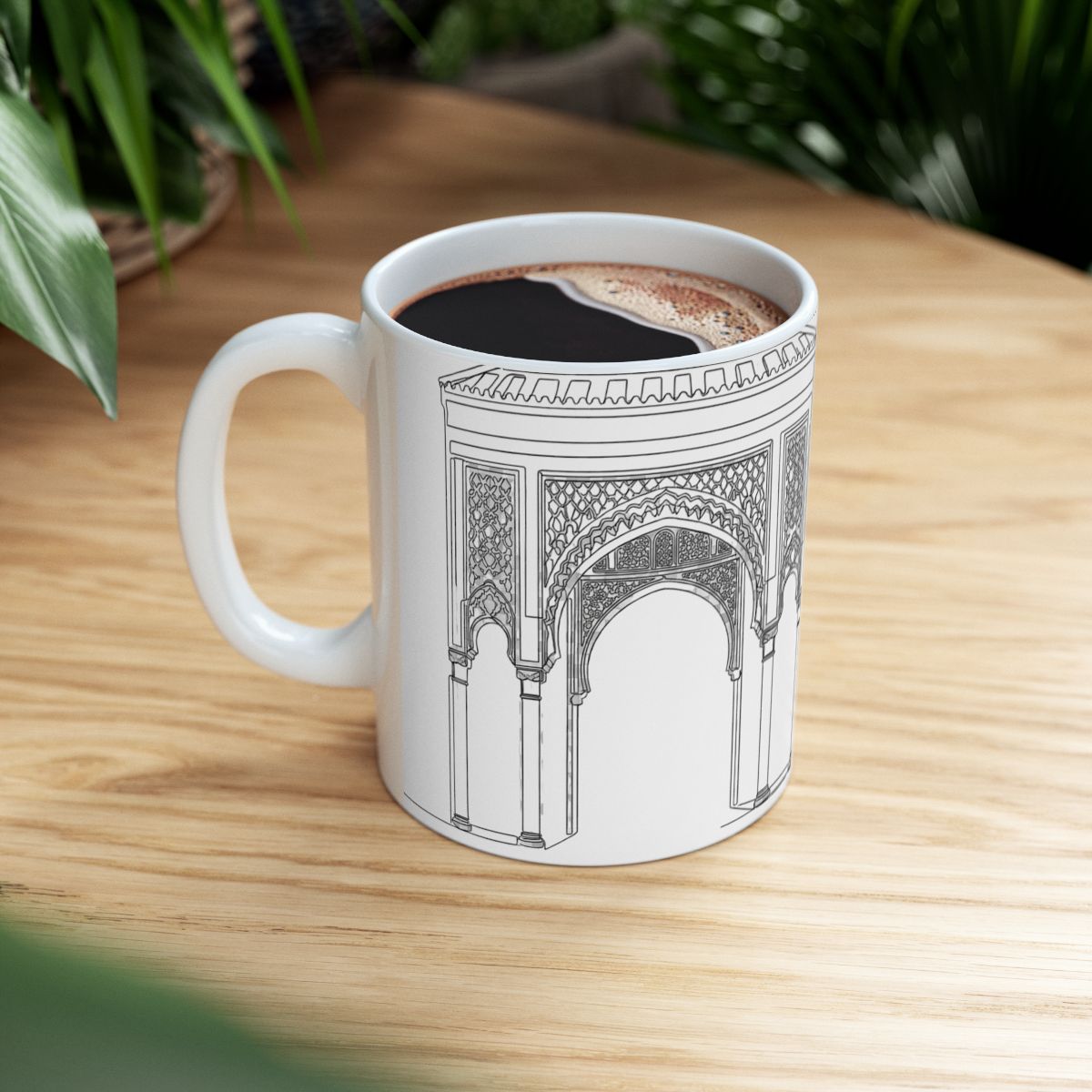
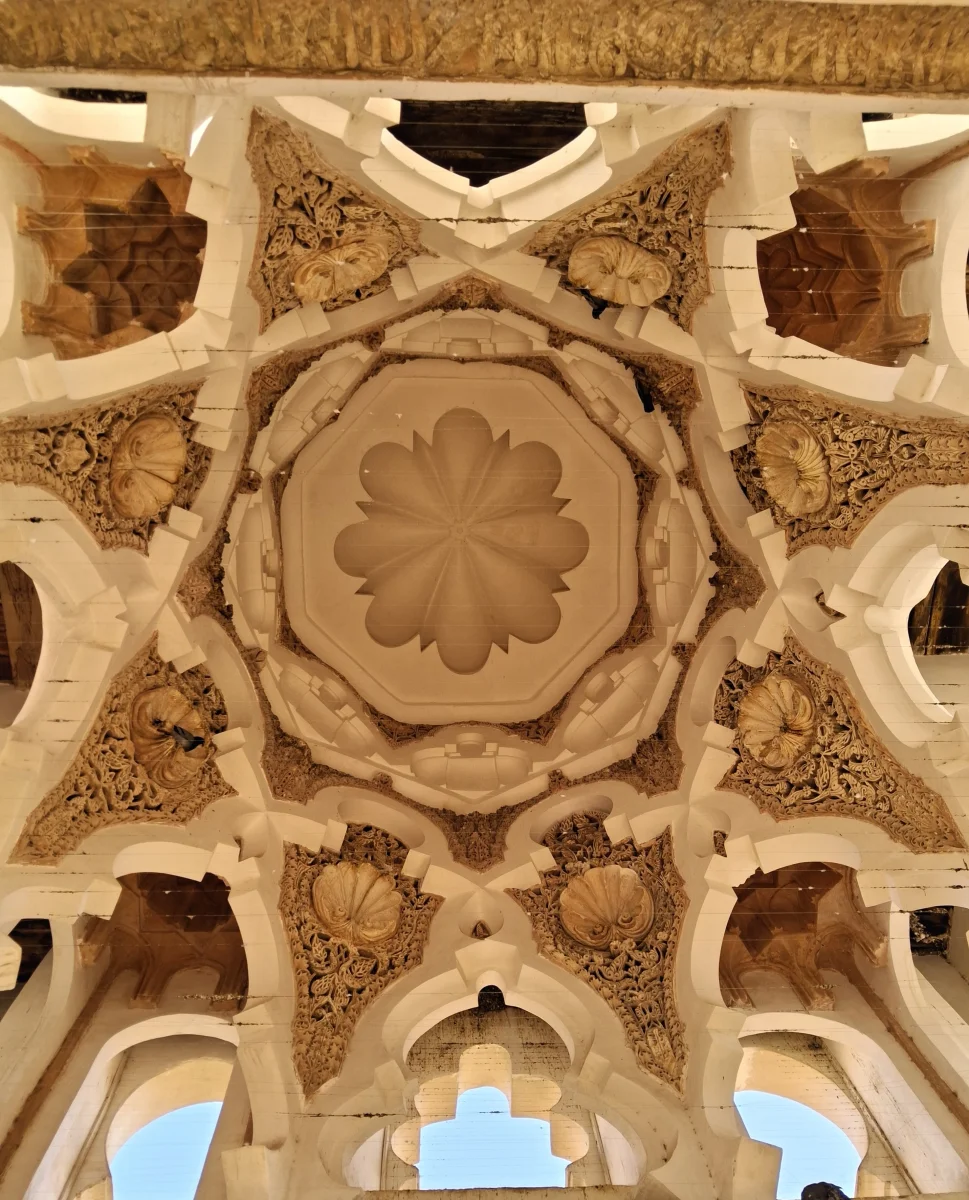
Muqarnas are among the most spectacular elements of Islamic architecture.
They take the form of a succession of small interlocking geometric niches or cells.
They may appear beneath domes, arches, cornices or in transitional areas between different parts of a building.
Their appearance is sometimes compared to stalactites.
But their interest lies not only in their geometric complexity.
Muqarnas also transform light.
Each small surface receives the light differently, creating a succession of shadows and reliefs that evolve throughout the day.
The Saadian Tombs: The Refinement of Royal Architecture
To observe one of the most refined expressions of Saadian art in Marrakech, visit the Saadian Tombs.
This royal necropolis brings together several decorative techniques characteristic of Moroccan architecture: carved stucco, calligraphy, woodwork, marble, arches and geometric compositions.
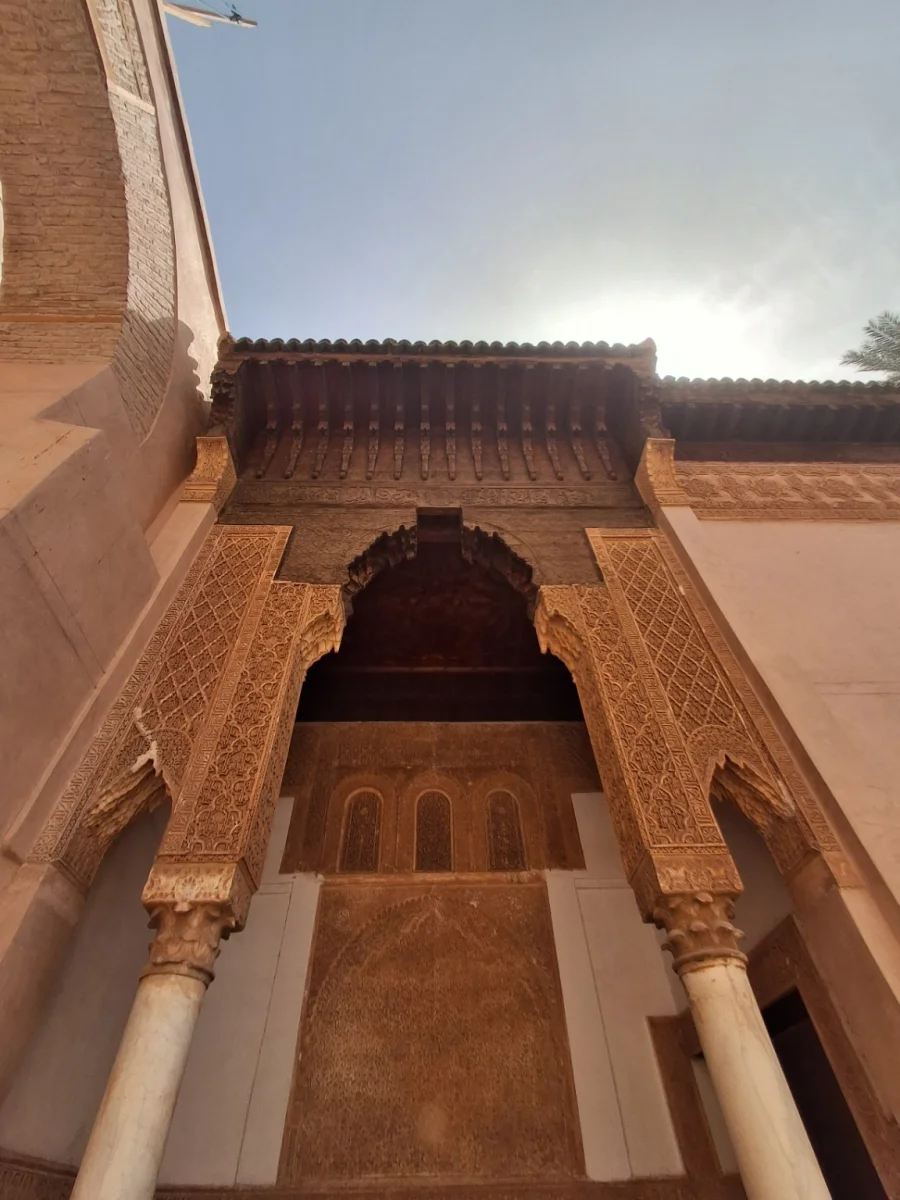
The famous Chamber of the Twelve Columns, associated with the mausoleum of Sultan Ahmad al-Mansur, is one of the most remarkable spaces in the complex.
But during your visit, it is worth looking beyond the most famous features.
The arches, friezes, passageways and carved details show how Saadian architecture combined several techniques at once to create a coherent composition.
The Almoravid Qubba: Returning to the Origins of Marrakech
To understand the evolution of Marrakech's architecture, it is also necessary to go back several centuries before the great Saadian and Alaouite palaces.
The Almoravid Qubba is one of the rare surviving monumental remains of Almoravid Marrakech.
Its architecture allows visitors to observe early decorative forms that contributed to the architectural history of the city.
Its dome, arches, vegetal motifs, calligraphy and relief work already reveal an architecture in which structure and decoration are deeply interconnected.
The Qubba therefore provides valuable perspective when compared with monuments built several centuries later.
Tadelakt: The Elegance of a Continuous Surface
Moroccan architecture does not rely only on highly detailed ornament.
It also masters the art of simplicity.
Tadelakt is a traditional lime-based plaster that is worked and polished until it develops a smooth, slightly glossy surface.
Its aesthetic is almost the opposite of zellige.
While zellige multiplies lines, colours and forms, tadelakt creates a continuous, soft and relatively uniform surface.
This alternation between highly decorated surfaces and more restrained spaces contributes to the balance of many Moroccan interiors.
Rammed Earth: Behind the Decoration, There Is Earth
Moroccan palaces and monuments are not made only from decorative materials.
Behind the zellige, stucco and decorated ceilings are often much simpler construction techniques.
Rammed earth, formed primarily from compacted earth, has played a major role in Moroccan architecture.
The walls of Marrakech are one of its most visible examples.
At El Badi Palace, the monumental scale of the ruins also helps visitors understand the contrast between the massive structures of the building and the extraordinary richness of the decoration that once covered them.
This contrast between earth, stone, plaster, ceramic and wood is one of the keys to understanding traditional Moroccan architecture.
The Courtyard: The True Heart of Moroccan Architecture
To understand a palace, madrasa or riad, studying decoration alone is not enough.
You also need to understand how the building is organised.
In many traditional Moroccan homes, architecture is oriented inward.
From the street, the exterior façade may appear relatively simple.
Once the door is crossed, however, a courtyard, galleries, gardens, fountains and sometimes richly decorated salons are revealed.
The courtyard becomes the heart of the building.
It distributes access to the surrounding rooms, brings in light and contributes to natural ventilation.
At the Bahia Palace, this succession of courtyards, gardens and reception rooms is one of the great highlights of the visit.
Water: Architecture, Coolness and Reflection
Pools and fountains are not merely decorative.
In courtyards and gardens, water contributes directly to the atmosphere of the place.
It brings freshness, reflects façades and changes the perception of space.
At the Ben Youssef Madrasa, the courtyard basin forms part of the architectural composition.
At the Bahia Palace, water interacts with gardens, courtyards and decorated surfaces.
This combination of architecture, vegetation and water is one of the major principles behind many traditional Moroccan spaces.
Light: The Invisible Material of Architecture
One of the most subtle aspects of Moroccan architecture is perhaps light itself.
It rarely enters a building uniformly.
It passes through a doorway, gallery, window or courtyard before reaching the zellige, carved stucco or woodwork.
As the day progresses, the reliefs change.
An inscription that appears discreet in the morning may become much more visible a few hours later.
Muqarnas create new shadows.
Glazed zellige reflects the light.
Pools can mirror the sky and surrounding façades.
Traditional Moroccan architecture is therefore also an architecture of time and light.
The same space can feel different depending on the moment of the day.
How to Read a Moroccan Palace During Your Visit
When you enter a palace or madrasa, try first to look at the walls vertically.
In many monuments, you can observe a characteristic organisation.
1. The Lower Section: Zellige
Mosaic panels decorate and protect the lower part of the walls.
Their geometry creates a highly structured visual base.
2. The Middle Section: Carved Stucco
Above them appear arabesques, calligraphy and geometric compositions.
The decoration gradually becomes lighter and more intricate.
3. The Upper Section: Wood
Friezes, lintels, windows, galleries and ceilings complete the composition.
The eye is naturally drawn upward.
Zellige → stucco → wood.
This sequence is an excellent key for learning how to observe Moroccan architecture.
However, it should not be considered an absolute rule.
Each monument adapts this vocabulary according to its period, function, patron and the craftsmen involved in its construction.
Marrakech and Al-Andalus: A Connected Architectural History
The similarities between certain Moroccan monuments and historic architecture in Andalusia are not accidental.
For several centuries, Morocco and Al-Andalus belonged to political, artistic and intellectual worlds that were deeply interconnected.
Craftsmen, scholars, techniques and decorative forms circulated between both sides of the Strait of Gibraltar.
This is why principles found in Marrakech or Fez can also be observed in historic monuments in Granada, Seville or Córdoba.
Interior courtyards, geometry, water, carved plaster, wood and mosaic all bear witness to this long history of shared knowledge and craftsmanship.
Where to See Traditional Architecture in Marrakech
Several monuments allow visitors to compare these techniques directly.
Ben Youssef Madrasa
The Ben Youssef Madrasa is particularly interesting for studying the combination of zellige, carved plaster, calligraphy and woodwork.
Take the time to observe the courtyard from several angles, then move closer to the walls to discover the details.
Bahia Palace
The Bahia Palace is an excellent place to understand 19th-century Moroccan palace architecture.
Its courtyards, gardens, salons, zellige and decorated ceilings show how older traditions continued to be used and renewed.
Saadian Tombs
The Saadian Tombs represent one of the most refined examples of Saadian art in Marrakech.
Marble, stucco, wood, calligraphy and geometric compositions combine to create an exceptionally elaborate royal setting.
El Badi Palace
El Badi Palace tells a different story.
Much of its original decoration has disappeared, but its scale still allows visitors to imagine the monumental ambition of the Saadian court.
Its ruins are also an excellent place to understand the structures and materials hidden behind the decoration.
A Living Craft Heritage
Zellige, carved plaster, woodwork and other traditional techniques are not merely remnants of an ancient architectural style.
Moroccan craftsmen continue to master and transmit these skills today.
They can be found in the restoration of historic monuments as well as in riads, houses, mosques, hotels and contemporary architectural projects.
This continuity is essential to understanding Moroccan heritage.
It is not simply a style preserved in monuments.
It is a collection of living skills and traditions.
Tips for Observing Architectural Details During Your Visit
During your next visit to a Moroccan monument, try not to look only at the overall impression.
Move closer to the details.
Look for the individual pieces that make up a zellige panel.
Observe the depth of the carved plaster.
Try to distinguish calligraphic inscriptions from purely geometric motifs.
Look at the windows and doors.
Then raise your eyes toward the ceilings.
Finally, step back a few metres.
You will begin to understand how hundreds or thousands of individual elements come together to form a coherent architectural composition.
Moving constantly from detail to the whole is probably one of the best ways to discover traditional Moroccan architecture.
Explore the Masterpieces of Moroccan Architecture
Marrakech is home to several essential monuments for understanding these architectural traditions.
Discover the Bahia Palace, the Ben Youssef Madrasa, the Saadian Tombs and El Badi Palace.
When online booking is available, MoroccoMuseum also allows you to prepare your visit and explore the different access options.
🎟️ Discover Moroccan heritage and monuments
Continue Exploring Morocco
Moroccan heritage is not limited to a single palace or city.
From the madrasas of Fez to the palaces of Marrakech, from museums to archaeological sites, each monument tells a different part of Morocco's history.
You can also explore the Al-Attarine Madrasa in Fez to compare the Marinid architecture of Fez with the major historic monuments of Marrakech.
🎟️ Discover Morocco's heritage
📖 Read our Guides & Inspiration