Dar El Bacha in Marrakech: The Pasha’s Palace Turned Museum of Confluences
In the heart of the Marrakech Medina, behind a relatively discreet façade on Rue Dar El Bacha, stands one of the city’s most refined palaces: Dar El Bacha.
Built in 1910, this vast palace was the residence of Thami El Glaoui, who became Pasha of Marrakech in 1912 and was one of the most powerful political figures in Morocco during the first half of the 20th century.
Today, transformed into the Museum of Confluences, Dar El Bacha offers visitors the opportunity to discover an important chapter in the history of Marrakech, a remarkable example of Moroccan palatial architecture, and exhibitions devoted to the many influences that have shaped Morocco’s cultural heritage.
But before becoming a museum, Dar El Bacha was above all a palace of power, reception and representation.
The History of Dar El Bacha
The name Dar El Bacha literally means “House of the Pasha.”
The palace was built in 1910, at a time when Marrakech still held a major political position in southern Morocco.
Two years later, in 1912, Thami El Glaoui was appointed Pasha of Marrakech by Sultan Moulay Youssef.
His residence therefore had to reflect his status.
Dar El Bacha was not simply a private residence. The palace was also a place of reception where political officials, diplomats, travellers, artists and foreign personalities visiting Marrakech would meet.
This representative function partly explains the exceptional richness of its architecture and decoration.
Who Was Thami El Glaoui?
Understanding Dar El Bacha requires knowing the figure with whom its history is closely associated.
Thami El Glaoui belonged to the powerful Glaoua family, originally from the High Atlas.
Appointed Pasha of Marrakech in 1912, he gradually became one of the most influential figures in Morocco during the French Protectorate.
His role in Moroccan political history remains complex, particularly because of his relationship with the French authorities and his opposition to Sultan Mohammed V during the final years of the Protectorate.
Dar El Bacha therefore preserves the memory of a particular period in Marrakech’s history, at the crossroads of local power, political transformation and international influence.
A Masterpiece of Moroccan Architecture
Even without knowing its history, Dar El Bacha is worth visiting for its architecture alone.
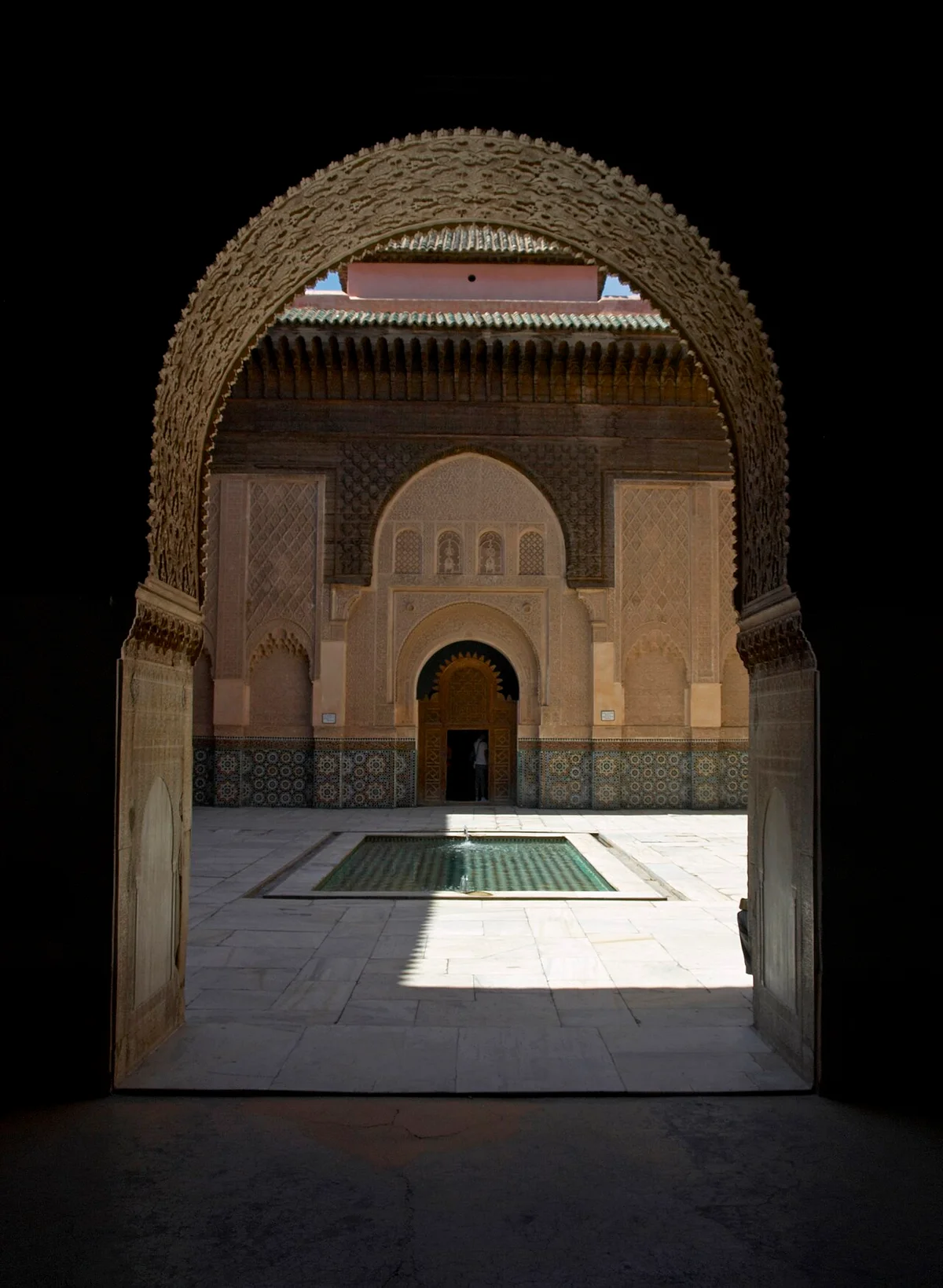
The palace is organised according to the traditional principles of the Moroccan riad, around an interior garden structured by geometric axes.
At its centre, fountains, orange trees and vegetation play an integral role in the organisation of the space.
Several richly decorated salons open onto the garden.
This layout creates a gradual transition between open spaces, galleries and interior rooms.
Zellige, Carved Wood and Stucco: The Expertise of Moroccan Artisans
Dar El Bacha is a remarkable showcase of Moroccan craftsmanship.
During your visit, take the time to observe the details.
The Zellige
The lower sections of the walls are decorated with zellige, geometric compositions made from small pieces of glazed terracotta that are cut and assembled by hand.
The patterns are based on extremely precise geometric constructions.
At Dar El Bacha, they contribute to the visual balance between floors, walls, columns and openings.
The Wooden Ceilings
Remember to look up.
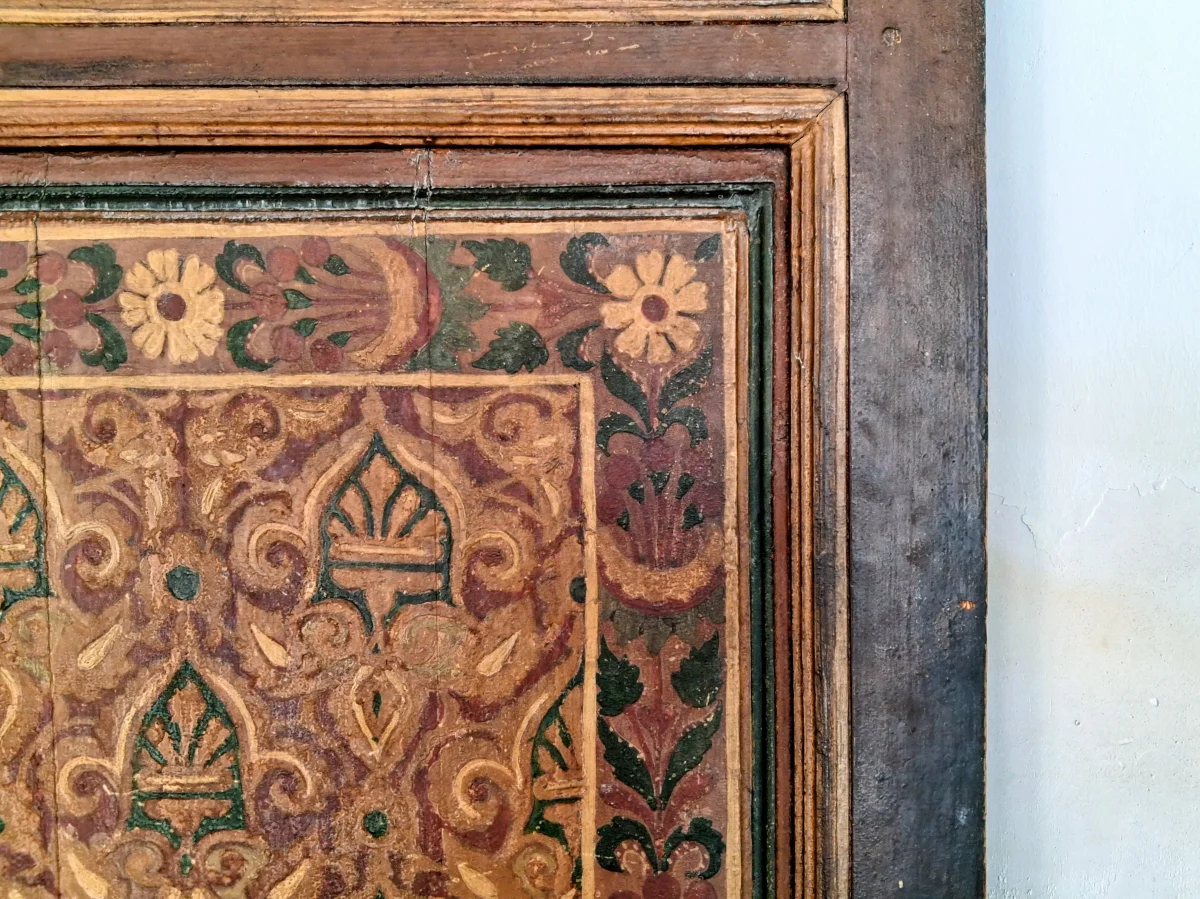
The ceilings and some of the doors feature remarkable carved and painted woodwork.
Wood has been an essential element of Moroccan architecture for centuries, particularly in palaces, madrasas and large residences.
You can find this craftsmanship in several historic monuments in Marrakech, including the Ben Youssef Madrasa.
The Carved Stucco
The plaster surfaces offer another level of detail.
Geometric patterns, arabesques and decorative compositions transform the walls into genuine works of craftsmanship.
This combination of zellige, wood, carved plaster, marble, water and vegetation is one of the defining characteristics of traditional Moroccan architecture.
The Garden at the Heart of the Palace
The central garden is one of the most pleasant spaces in Dar El Bacha.
However, it should not be considered merely a decorative feature.
In traditional riad architecture, the garden truly forms the heart of the house.
The main rooms are organised around it.
Vegetation provides shade and freshness, while fountains and water contribute to the atmosphere of the space.
The symmetry of the pathways also reinforces the impression of balance.
This relationship between architecture, light, water and vegetation largely explains the distinctive atmosphere of Dar El Bacha.
The Private Areas of the Palace
Dar El Bacha is not limited to the salons visible around the main garden.
The complex included several spaces corresponding to the different functions of a large residence.
These included:
- reception rooms;
- private apartments;
- a library;
- a douiria, traditionally associated with service areas;
- a hammam;
- various spaces reserved for the family and the daily functioning of the palace.
This organisation reminds us that Dar El Bacha was once a living residence occupied by a large household.
The Hammam of Dar El Bacha
Among the particularly interesting features of the palace is its traditional hammam.
The hammam played an important role in the daily life of large Moroccan residences.
Beyond its function related to hygiene, it was also part of a long-established social and domestic culture.
At Dar El Bacha, the historic water and heating systems also demonstrate the technical expertise required to operate a large residence.
The heritage value of the palace therefore lies not only in its decoration.
It also helps us understand how a large Moroccan residence actually functioned.
From Historic Palace to the Museum of Confluences
Following an extensive restoration carried out by the National Foundation of Museums, Dar El Bacha entered a new chapter in its history.
The palace opened to the public in 2017 under the name Dar El Bacha Museum of Confluences.
This transformation made it possible to preserve the monument while giving it a new cultural purpose.
The museum focuses particularly on the exchanges and influences that have contributed to the development of Morocco’s cultural identity.
An approach especially well suited to Marrakech.
For centuries, the city was a meeting point between the Sahara, the Atlas Mountains, major African trade routes, the Mediterranean world and the different regions of Morocco.
Why Is It Called the “Museum of Confluences”?
The term “confluences” precisely summarises the museum’s philosophy.
Morocco’s cultural history was never shaped in isolation.
It developed through multiple heritages and exchanges: Amazigh, Arab-Islamic, African, Andalusian, Mediterranean and Jewish, among others.
The exhibitions organised at Dar El Bacha therefore explore different periods, artistic traditions and cultures.
The palace itself becomes a space for dialogue.
A historic monument now houses collections and exhibitions that tell the story of encounters between cultures.
What to See at the Dar El Bacha Museum of Confluences
A visit is not limited to the collections on display.
The building itself is an essential part of the experience.
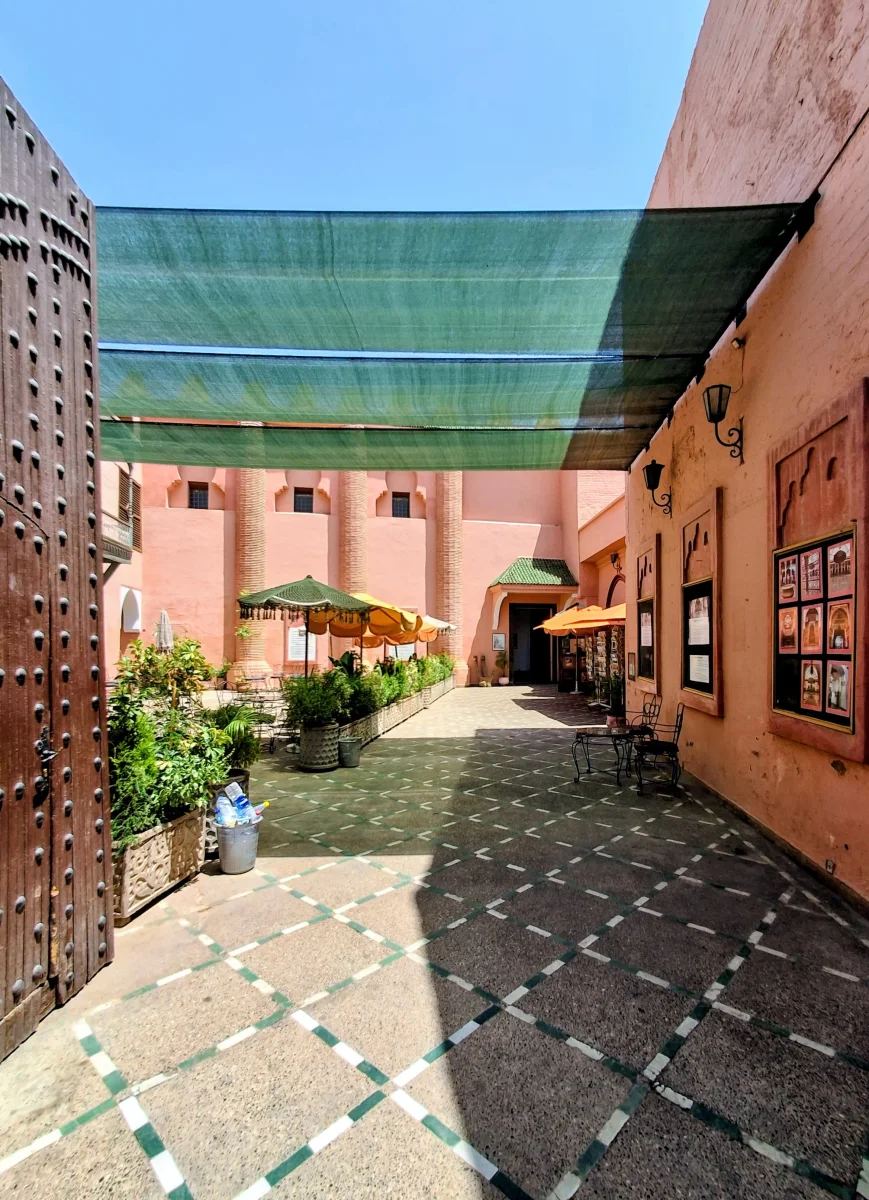
The Patio and Central Garden
This is probably the palace’s most iconic space.
Take the time to observe the symmetry of the garden, the fountains, orange trees, galleries and decorated façades.
The Historic Salons
Several salons surrounding the garden reflect the refinement of Morocco’s grand residences in the early 20th century.
Pay particular attention to the ceilings, doors, floors and decorative details.
The Exhibitions
The Museum of Confluences regularly hosts temporary exhibitions.
The content of your visit may therefore vary depending on the period.
It is worth checking the museum’s current programme before your visit.
The Architectural Details
Dar El Bacha is also particularly interesting for architecture and photography enthusiasts.
Do not focus only on the grand perspectives.
Some of the most remarkable elements can be very small: a zellige composition, a carved door, a painted ceiling motif or a detail of stucco.
How Much Time Should You Allow to Visit Dar El Bacha?
Allow approximately 1 to 1.5 hours to explore the palace comfortably.
A quick visit will allow you to see the main spaces, but Dar El Bacha deserves to be explored slowly.
Much of its appeal lies precisely in its architectural details.
If an important temporary exhibition is being presented during your visit, you may want to allow additional time.
When Is the Best Time to Visit Dar El Bacha?
Morning is generally an excellent time to discover the palace.
The light makes it easier to appreciate the patios and decoration, while visiting relatively early in the day often allows you to enjoy the spaces in a quieter atmosphere.
As opening hours and access conditions may change, it is recommended to check official information before your visit.
What to Visit Around Dar El Bacha
Dar El Bacha’s location makes it easy to include in a day dedicated to exploring the heritage of the Medina.
You can continue your visit towards:
- the Ben Youssef Madrasa;
- the Almoravid Qoubba;
- the Marrakech Museum;
- the souks of the Medina;
- Jemaa el-Fna Square.
The Almoravid Qoubba offers a particularly interesting contrast with Dar El Bacha.
Built several centuries earlier, it takes visitors back to the Almoravid period and the monumental origins of Marrakech.
By combining several monuments during the same walk, you can explore almost a thousand years of Marrakech’s history in just a few hours.
Dar El Bacha or Bahia Palace?
The two monuments are sometimes compared, but they tell different stories.
The Bahia Palace is primarily associated with the late 19th century and the grand viziers Si Moussa and Ba Ahmed.
Dar El Bacha belongs more closely to early 20th-century Marrakech and the history of Thami El Glaoui.
Visiting both therefore provides an opportunity to understand two successive periods in the city’s political and architectural history.
Bahia Palace impresses with the scale of its courtyards and apartments.
Dar El Bacha offers a more concentrated experience centred around the traditional organisation of the riad, its garden and its salons.
Dar El Bacha: Much More Than a Beautiful Setting
It would be easy to visit Dar El Bacha simply for its zellige, ceilings and garden.
But the palace tells a much broader story.
It bears witness to the transformation of Marrakech in the early 20th century, the political role of Thami El Glaoui, the expertise of Moroccan artisans and the ability of a historic monument to find a new purpose.
Once the residence of one of the most powerful figures in Marrakech, Dar El Bacha has now become a place dedicated to culture and encounters between different heritages.
It is precisely this transformation that makes a visit particularly fascinating.
Plan Your Visit to Dar El Bacha
Before heading to the museum, remember to check:
- opening hours;
- current admission prices;
- any temporary exhibitions;
- any special access conditions.
To continue exploring, you can also browse our guides to Marrakech monuments and museums and our guides and inspiration.
MoroccoMuseum helps you discover Moroccan heritage, understand the history of its monuments and prepare your visits throughout Marrakech and the rest of Morocco.
Book. Discover. Experience Morocco.