The Menara Gardens: History, Legends, and Secrets of a Jewel in Marrakech
Where Time Seems to Stand Still
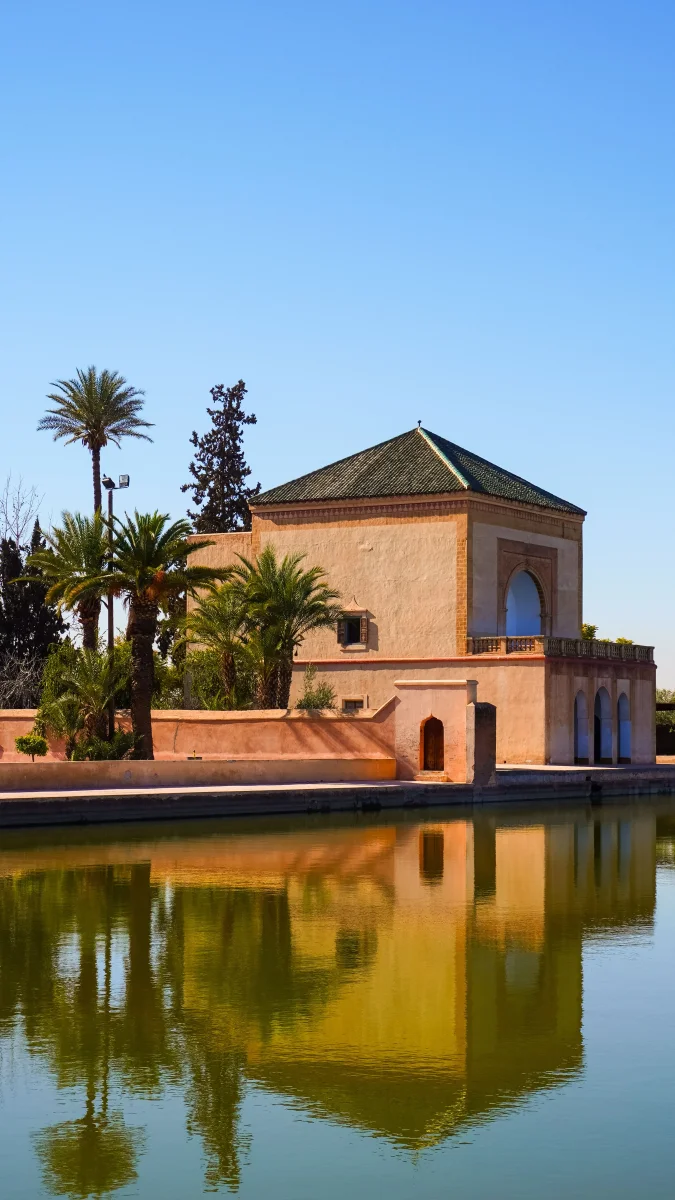
Just minutes away from the bustling medina of Marrakech, a vast mirror of water reflects a pavilion with green tiles, while the peaks of the High Atlas outline the horizon. Centuries-old olive trees rustle in the wind, storks soar above the basin, and the silence contrasts with the liveliness of the Red City.
Welcome to the Menara Gardens, one of the most emblematic landscapes in Morocco.
Every year, thousands of visitors come to photograph this site, which has become a true icon of Marrakech. Many stop for a few minutes in front of the basin, admire the famous pavilion, and then continue their visit.
Yet, behind this peaceful image lies a story nearly nine centuries old.
The Menara was not created to host strollers.
Originally, it was a vast political, agricultural, and hydraulic project conceived by the Almohad rulers to demonstrate their power, nourish the city, and control a resource as precious as it was rare: water. The large basin that attracts photographers today was not merely a decorative element; it was the heart of an irrigation system designed to supply orchards and olive groves through a remarkable hydraulic network.
Over the centuries, the dynasties that succeeded one another in Marrakech transformed this estate. The Saadians turned it into a vacation spot. The Alaouite rulers rebuilt the pavilion that now dominates the basin, giving rise to one of the most famous silhouettes in Moroccan heritage.
But the Menara is also a place of memory.
Around its olive trees, stories have been passed down for generations—popular tales of hidden treasures, stories of royal love, and sovereigns who came here to seek the coolness of summer evenings. Some of these stories belong to the oral heritage of Marrakech; others echo in ancient chronicles. Distinguishing them helps to better understand what is part of History and what belongs to the collective imagination.
Even today, the Menara Gardens hold a special place in the hearts of Marrakchis. People come at sunset to walk with family, run among the olive groves, contemplate the snow-capped mountains in winter, or simply enjoy a moment of calm away from the city's hustle and bustle.
Inscribed with the medina of Marrakech on the UNESCO World Heritage List since 1985, the Menara Gardens are not just a historical park. They represent one of the most beautiful testimonies of garden art in the Islamic West, where architecture, water, agriculture, and landscape form an inseparable whole.
In this guide, MoroccoMuseum invites you to discover the complete history of the Menara: its creation under the Almohads, the technical feats that enabled its water supply, the evolution of its famous pavilion, the accounts of travelers who admired it over the centuries, and the legends that continue to fuel the mystery of this unique place.
The Origins of the Menara: The Almohad Dream
To understand the birth of the Menara Gardens, we must go back to the 12th century, a time when Marrakech was one of the most powerful capitals in the Muslim world.
Founded in the 11th century by the Almoravids, the city experienced a profound revival after the arrival of the Almohad dynasty in 1147. Under the reign of Caliph Abd al-Mu'min, the empire extended from Tripolitania to Andalusia. Marrakech then became a vast political, military, artistic, and architectural laboratory. It was during this period that several major projects were launched that would permanently mark the city's landscape, including the Koutoubia, the Agdal Gardens... and the Menara.
Contrary to popular belief, the Menara was not designed as a pleasure garden. Its primary objective was much more ambitious: to create a vast agricultural estate capable of producing olives, fruits, and irrigated crops while demonstrating the technical mastery of the Almohad state in a semi-arid environment.
Medieval chroniclers report that around 1157, a massive enclosed orchard was established to the west of Marrakech. At its center, a gigantic basin was excavated to store the water needed for irrigation. Supplied by an ingenious network of underground pipes, this reservoir quickly became the living heart of the estate.
The Hydraulic Genius of the Menara: A Masterpiece of Medieval Engineering
While the pavilion is today the symbol of the Menara Gardens, the true miracle of this place is invisible.
It lies underground.
Beneath the vast basin that reflects the High Atlas is a hydraulic system designed nearly nine centuries ago, at a time when every drop of water represented a strategic wealth. For the Almohad rulers, ensuring the water supply for their agricultural estates was both a political and economic necessity.
The Marrakech region has a semi-arid climate. Rainfall is irregular, and summers are particularly dry. Yet, the engineers of the time succeeded in creating a vast agricultural domain capable of producing olives, fruits, and various crops through perfect water management.
At the heart of this system lies the great basin of the Menara.
Approximately 195 meters long, nearly 160 meters wide, and several meters deep, it could store tens of thousands of cubic meters of water. Far more than a decorative element, it served as a reservoir regulating the irrigation of the surrounding olive groves according to the needs of the crops.
But one question remains.
Where did this water come from, given that the Menara is several kilometers from the mountains?
The answer reflects the remarkable expertise developed in medieval Morocco.
The Khettaras: Man-Made Underground Rivers
To supply Marrakech, the Almohad engineers relied on a system already known in several arid regions: the khettaras.
These underground galleries, sometimes several kilometers long, capture water that naturally flows down from the foothills of the High Atlas. Thanks to an extremely gentle slope, water flows slowly by gravity to cultivated areas, without the need for pumps or complex mechanisms.
Today, as you travel through the Haouz plain, you can still see the alignments of small wells marking the path of these galleries. Each opening once allowed for the maintenance of the underground network and the removal of debris during its construction.
This system has a significant advantage.
Water flows underground, protected from evaporation caused by the intense Moroccan heat. In a region where summer temperatures regularly exceed 40 °C, this solution preserved a precious resource while ensuring a regular supply to the crops.
Historians today consider these structures one of the greatest successes of medieval hydraulics in North Africa.
A Basin Designed to Irrigate Thousands of Olive Trees
When the water arrived at the Menara, it was stored in the large basin before being redistributed to the various agricultural plots.
Contrary to popular belief, the famous olive trees that now surround the Menara are not just a backdrop.
They are the heirs of a vast agricultural estate created to produce an essential resource: olive oil.
In the Middle Ages, this oil was used for food, lighting, certain medicinal purposes, and was also part of trade exchanges.
The garden thus constituted a genuine agricultural operation belonging to the power.
Irrigation channels allowed for precise distribution of water according to the seasons and the needs of the plantations. Each plot received a determined amount, following established rules to avoid any waste.
This organization reflects a particularly developed administration capable of simultaneously managing hydraulic resources, crops, and infrastructure maintenance.
Did You Know?
The olive groves of the Menara still cover several dozen hectares today.
Even though their economic function is no longer that of the 12th century, they continue to shape the landscape and remind us that this place was first a vast agricultural estate before becoming a space for strolling.
A Technology That Still Inspires Admiration
Heritage specialists today consider the Menara a remarkable example of integration between architecture, landscape, and engineering.
The basin, channels, olive groves, and pavilion should not be studied separately.
They form a coherent whole designed to meet several objectives at once:
- Store water;
- Irrigate crops;
- Create an orderly landscape;
- Affirm the power of the Almohad dynasty.
This vision explains why the Menara Gardens occupy such a special place in the history of Marrakech.
They are not just a historical garden.
They embody a way of thinking about territory, where the mastery of water, agriculture, architecture, and political power converge in a single project.
It is this alliance of technical prowess and landscape harmony that continues to fascinate visitors nearly nine centuries after the estate's creation.
In the next section, we will discover how the famous pavilion of the Menara became one of the most photographed monuments in Morocco, as well as its evolution under the Saadian and Alaouite dynasties.
The Pavilion of the Menara: A Symbol of Marrakech Through the Centuries
If there is one monument that embodies Marrakech in the eyes of the world, it is undoubtedly the pavilion of the Menara.
With its pyramidal roof covered in green tiles, its elegant silhouette reflecting in the waters of the basin, and the mountains of the High Atlas in the background, it has become one of the most photographed landscapes in Morocco.
However, the building we admire today is not the one known to the early Almohad rulers.
In the 12th century, the Menara estate was primarily a vast agricultural garden. While a pavilion likely already existed, it primarily served a practical function: allowing the ruler or his representatives to oversee the crops, observe the irrigation network, and occasionally enjoy the coolness of the place.
Over the centuries, the estate evolved.
The dynasties that governed Marrakech quickly understood that the Menara was not just an agricultural success. It was also a place of representation of power.
The garden gradually became a space for strolling, receiving guests, and resting for the rulers.
The pavilion was then transformed several times.
The current building is generally attributed to a significant reconstruction carried out under the Alaouite dynasty in the 19th century, notably during the reign of Sultan Sidi Mohammed Ben Abderrahmane (1859-1873), before being restored by his successors. Historical research shows, however, that several campaigns of work have succeeded one another over the centuries, which explains some differences in interpretation among authors.
This evolution is common in Moroccan heritage.
Contrary to the fixed image we sometimes have of historical monuments, these have constantly been maintained, enlarged, or rebuilt to meet the needs of each era.
The Menara is no exception to this rule.
Why a Pavilion by a Basin?
The question seems simple.
Yet, its answer reveals the entire philosophy of Islamic gardens.
In the architectural tradition of the medieval Muslim world, water represents much more than an essential resource.
It symbolizes life, prosperity, order, and harmony.
The large basin of the Menara serves, of course, an agricultural function, but it also has a strong aesthetic dimension.
The reflection of the pavilion on the water creates an almost perfect symmetry.
When the wind dies down and the waters become perfectly calm, the building seems to float between sky and earth.
This dialogue between architecture and landscape is characteristic of the great historical gardens of Morocco.
At certain times of the year, when the snow-capped peaks of the High Atlas appear on the horizon, the basin simultaneously reflects the mountains, the sky, and the pavilion.
This natural composition explains why the Menara became, from the 19th century, a favored subject for painters, photographers, and foreign travelers.
European Travelers Discover the Menara
From the 19th century onward, Marrakech increasingly attracted explorers, diplomats, painters, and European writers.
Many mention the Menara in their accounts.
They describe a vast olive garden stretching to the horizon, interrupted only by the presence of a perfectly geometric basin.
What strikes these travelers most is the contrast.
On one side, the hustle and bustle of Marrakech and its ramparts.
On the other, a silent space dominated by water, trees, and the spectacular view of the High Atlas.
The painter Jacques Majorelle, deeply inspired by the landscapes of Marrakech, immortalizes the colors of the city and its gardens multiple times. Other Orientalist artists, fascinated by Moroccan light, find in the Menara an ideal setting where architecture and nature seem to engage in constant dialogue.
The first photographs taken in Morocco at the end of the 19th century and the beginning of the 20th century already show the pavilion as an emblem of Marrakech.
More than a century later, this image remains virtually unchanged.
Did You Know?
The name "Menara" comes from the Arabic word "menzeh" or "menara", used at different times to refer to an elevated pavilion offering a viewpoint over a garden or landscape. In Morocco, this term has gradually come to refer to the entire estate.
A Backdrop for Daily Life in Marrakech
While the Menara fascinates visitors, it also holds an important place in the lives of the residents of Marrakech.
For several generations, families have come here to stroll on weekends, picnic under the olive trees, or simply admire the sunset.
Athletes take to the long tree-lined paths.
Photographers wait for the last rays of the day when the light transforms the ochre walls of the pavilion.
In winter, when the peaks of the High Atlas are covered in snow, the view becomes spectacular.
In spring, the olive groves regain their shades of green.
In autumn, the warmer light gives the estate a peaceful atmosphere that contrasts with the bustle of the historic center.
This relationship between Marrakchis and the Menara explains why the site is not perceived as a mere monument.
It is part of the city's daily life.
For nearly nine centuries, it has accompanied its evolution without ever losing its identity.
Between History and Legends: The Stories Surrounding the Menara
For nearly nine centuries, the Menara Gardens have inspired both historians and storytellers.
In Marrakech, few places have generated as many popular tales. Over generations, locals have passed down stories of hidden treasures, loves of sovereigns, secret passages, and mysteries related to the great basin.
These tales are part of the city's intangible heritage.
They reflect the collective imagination of Marrakchis, even when they cannot be confirmed by historical sources.
Understanding the Menara thus also means accepting that it belongs as much to popular memory as to History.
The Hidden Treasure Beneath the Basin: A Legend Still Alive
Among the most famous stories is that of a vast treasure hidden beneath the great basin.
According to several versions of this oral tradition, a ruler chose to hide his riches beneath the waters of the Menara to protect them from potential invaders.
In some variations, it is said to be gold, jewels, and precious weapons.
In others, the treasure would belong to an ancient sultan who left Marrakech in haste.
Storytellers sometimes said that only a few people knew the exact location of the deposit and that the secret was passed down from generation to generation.
However, no historical text confirms the existence of such a treasure.
Historians today consider this story a popular legend, likely born from the strategic importance of the basin and the prestige attached to the royal residence.
Did Sultans Really Come Here to Rest?
This time, the answer is more nuanced.
Chronicles show that several rulers did indeed use the great gardens of Marrakech as places of relaxation or representation.
The vast olive groves, the coolness of the basin, and the shade of the trees offered a striking contrast to the palaces of the medina during the intense heat.
However, the accounts describing lavish parties regularly held at the Menara are difficult to verify.
They primarily appear in the narratives of 19th-century travelers, often fascinated by the East and sometimes inclined to embellish their descriptions.
It is therefore likely that the reality lies somewhere in between: the Menara was frequented by rulers, but some of the scenes reported belong more to travel literature than to historical testimony.
The Love Stories of the Menara
For a long time, the residents of Marrakech have recounted that certain princes or princesses would discreetly come to stroll in the gardens away from prying eyes.
These stories evoke secret meetings at sunset, promises exchanged near the basin, or tales of impossible love.
No historical document allows attributing these stories to specific characters.
They belong to local folklore.
But they show how the Menara has become, over the centuries, a place associated with beauty, calm, and poetry.
Even today, many couples choose this backdrop for their wedding photographs or strolls.
The Mirror of the High Atlas
Another popular belief states that the basin of the Menara reveals its full beauty only to patient individuals.
The ancients would say that one must wait for the moment when the wind completely dies down.
Only then does the water become a perfect mirror.
The pavilion, the snow-capped mountains, and the sky seem to merge into one landscape.
This image is indeed real.
But popular tales sometimes attribute a symbolic dimension to it: that of a place where heaven and earth meet.
These stories do not belong to official history.
They mainly reflect the emotional bond that Marrakchis have maintained with this landscape for generations.
The Accounts of European Travelers
From the 19th century onward, European travelers discovered Marrakech with often awestruck eyes.
The Menara frequently appears in their journals.
They describe the silence of the garden, the perfect geometry of the basin, and the majesty of the High Atlas.
Some see it as a paradise garden.
Others speak of an almost unreal setting.
However, it is essential to read these testimonies with caution.
Many of these authors belong to the Orientalist movement.
Their goal was not always to accurately describe Morocco but also to convey to European readers a romantic vision of the East.
Their accounts today serve as valuable sources for understanding the perception of Marrakech in the 19th century, but they should not be considered historical documents on the same level as Moroccan chronicles.
Why Are These Legends Important?
One might be tempted to dismiss these stories on the grounds that they are not always verifiable.
That would be a mistake.
Heritage is not limited to stones, dates, and monuments.
It also includes the tales that residents pass down from generation to generation.
These legends tell less about what actually happened than about how Marrakchis have imagined, loved, and interpreted the Menara over time.
They give a human depth to the monument.
And perhaps that is their greatest value.
When one contemplates the reflection of the Menara in its vast basin today, it is hard not to think of all these stories that continue to live in the collective memory of Marrakech.
Whether historical or legendary, they all contribute to the timeless charm of the Menara.
The Menara Today: A Living Heritage
Nearly nine centuries after its creation, the Menara Gardens continue to play an essential role in the life of Marrakech.
Unlike many historical gardens that have become mere places of visitation, the Menara remains a vibrant space. Marrakchis come here to walk, run, picnic with family, or simply enjoy the coolness of the olive groves when the city experiences the intense heat of summer.
In the late afternoon, the long paths gradually come alive. Children play near the olive trees, athletes traverse the paths bordering the basin, and visitors await the moment when the sun descends behind the mountains of the High Atlas.
When the sky is perfectly clear, the reflection of the pavilion in the water creates one of the most iconic images of Marrakech.
This scene, photographed for over a century, remains different each day. The light, the seasons, the water level, and the presence of the snow-capped mountains constantly alter the landscape.
This is undoubtedly one of the reasons why the Menara fascinates so many photographers, whether amateur or professional.
A Recognized World Heritage
In 1985, the medina of Marrakech was inscribed on the UNESCO World Heritage List.
This recognition does not only concern the ramparts, palaces, or religious monuments.
It also encompasses the great historical gardens that contribute to the identity of the city, notably the Menara and the Agdal.
For UNESCO, these gardens illustrate a unique way of shaping the landscape in a semi-arid environment, where water, agriculture, architecture, and nature form an inseparable whole.
The Menara thus constitutes an exceptional testimony to the expertise developed by Moroccan engineers and gardeners since the 12th century.
Even today, preserving this heritage represents a major challenge.
Climate change, urban pressure, and sustainable water resource management require constant attention to pass this site on to future generations.
Did You Know?
1. A Primarily Utility Basin
The large basin was never designed as a mere decorative element. Its primary function was to store water intended for irrigation.
2. Thousands of Olive Trees
The olive groves of the Menara still cover several dozen hectares and constitute one of the largest historical green spaces in Marrakech.
3. A Unique View of the High Atlas
In winter, when the peaks are snow-covered, the contrast between the white mountains, the palm trees, and the ochre walls of Marrakech offers one of the most famous landscapes in Morocco.
4. A Medieval Feat
The hydraulic system designed under the Almohads operates by gravity, without modern mechanisms.
5. A National Symbol
The pavilion of the Menara has long been among the most represented monuments on postcards, tourist posters, and books dedicated to Morocco.
6. A Place Appreciated by Marrakchis
Long before becoming a tourist site, the Menara was already a place for strolls for the residents of Marrakech.
7. Discreet Architecture
Unlike the richly decorated palaces of the medina, the pavilion charms with the simplicity of its lines and its perfect integration into the landscape.
8. An Artistic Inspiration
Painters, photographers, and writers have immortalized the Menara since the 19th century, captivated by the unique light of Marrakech.
9. A Landscape That Changes with the Seasons
The reflection of the pavilion is never the same. The color of the water, the vegetation, and the light transform the landscape throughout the year.
10. A Living Heritage
The Menara remains one of the few large historical gardens where residents and visitors share the same space daily.
Tips for Fully Enjoying the Menara
To appreciate the full beauty of the Menara Gardens, consider visiting in the early morning or late afternoon.
These times offer softer light, more pleasant temperatures, and generally less crowding.
Photographers will particularly enjoy winter and spring days when the snow-capped peaks of the High Atlas are clearly visible on the horizon.
A visit to the Menara can easily be combined with other iconic sites in Marrakech, such as the Majorelle Garden, the Agdal Gardens, the Bahia Palace, the El Badi Palace, or the Saadian Tombs, to discover different facets of the city's history and landscapes.
Conclusion
The Menara is much more than a garden.
It tells the story of a city that has managed to tame water to bring life to the heart of a semi-arid plain. It bears witness to the ambition of the Almohad rulers, the expertise of the engineers who designed its hydraulic network, and the artistic sensitivity that has shaped its landscapes over the centuries.
It is also a place of memory.
Popular tales, oral traditions, the memories of travelers, and the strolls of generations of Marrakchis have enriched its history as much as the stones of its pavilion.
Today, contemplating the reflection of the Menara in its vast basin is akin to observing nearly nine centuries of Moroccan history.
Few places harmoniously unite heritage, nature, engineering, agriculture, and poetry.
Taking the time to discover the Menara means understanding that the greatest treasures of Marrakech are not only found behind the walls of its palaces but also in these landscapes where water, olive trees, and mountains silently tell the story of the Red City.
At MoroccoMuseum, we believe that every monument deserves to be discovered beyond its beauty. Understanding its history, its role, and the women and men who shaped it allows for a richer and more authentic experience.
We hope this guide will accompany you on your next visit and enable you to view the Menara Gardens with fresh eyes.