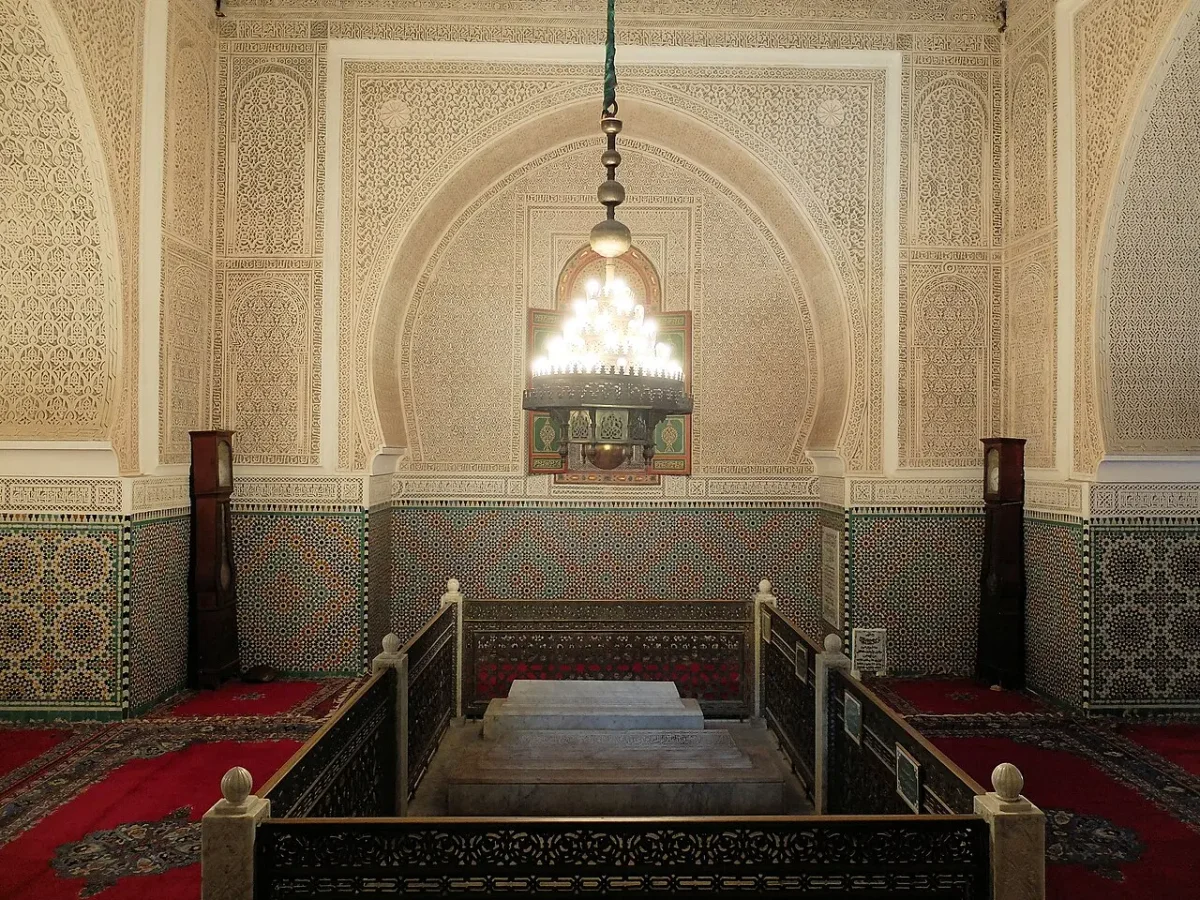
Mausoleum of Moulay Ismail in Meknes: History and Architecture in the Heart of the Imperial City
At the heart of the Imperial City of Meknes, behind the imposing walls built during the Alaouite period, stands one of the most important monuments for understanding the history of Morocco's former imperial capital: the Mausoleum of Moulay Ismail.
This is the burial place of Sultan Moulay Ismail, the Alaouite ruler who reigned from 1672 to 1727 and profoundly transformed Meknes.
Under his rule, the city became a monumental capital filled with palaces, gardens, fortifications, gates, granaries, stables and major hydraulic infrastructure.
The mausoleum should therefore not be considered an isolated monument.
It belongs to a much larger historic landscape that includes Bab Mansour, El Hedim Square, the remains of the Imperial City and Heri es-Souani.
Visiting the Mausoleum of Moulay Ismail provides an opportunity to discover a royal funerary complex, a remarkable example of Moroccan architecture and the story of the ruler who made Meknes one of Morocco's great imperial cities.
Moulay Ismail and the Transformation of Meknes
Moulay Ismail ascended the throne in 1672.
His reign, which lasted until 1727, represents one of the most important periods in the history of Meknes.
The ruler chose the city as his capital and launched an extensive architectural programme.
This was not simply a project to build a new palace.
Moulay Ismail developed an entire Imperial City beside the existing Medina.
Powerful ramparts were constructed.
Monumental gates controlled access to different areas.
Palaces, courtyards, gardens, granaries, stables and water-supply systems were integrated into an immense royal complex.
This transformation still explains the distinctive urban structure of Meknes today.
A 17th-Century Capital Listed by UNESCO
The Historic City of Meknes has been inscribed on the UNESCO World Heritage List since 1996.
UNESCO considers the city a particularly complete example of the urban and architectural structure of a 17th-century Maghreb capital.
It notably highlights the harmonious combination of elements of Islamic and European architecture and urban planning.
The Imperial City created under Moulay Ismail is one of the principal reasons for this exceptional heritage value.
The Mausoleum of Moulay Ismail should therefore be understood within this much larger historic ensemble.
The Construction of the Mausoleum of Moulay Ismail
The funerary complex is directly associated with the reign of Moulay Ismail.
Heritage sources date it to the 17th and 18th centuries, while the Meknes Prefectural Tourism Council gives 1703 as its construction date.
The monument was therefore developed during the ruler's lifetime.
Moulay Ismail died in 1727 and was subsequently buried within the complex.
The mausoleum thus became the final resting place of the ruler who had transformed Meknes into an imperial capital.
A Mausoleum Built Near an Already Venerated Site
The location of the monument also has a history predating Moulay Ismail.
According to Discover Islamic Art, the mausoleum was constructed near the tomb of Sidi Abderrahman el-Mejdoub, a 16th-century poet and mystic.
The presence of this tomb already gave the area a spiritual dimension.
Moulay Ismail therefore chose for his funerary complex a location associated with a respected religious figure.
This relationship between royal authority and sacred space contributes to the symbolic importance of the site.
A Royal Funerary Complex
The Mausoleum of Moulay Ismail is not simply a room containing a tomb.
It is a genuine architectural complex organised around several successive spaces.
Discover Islamic Art identifies three main ensembles within its layout.
Visitors therefore progress gradually from the entrance spaces towards the most important parts of the monument.
This succession of rooms, patios and courtyards creates a transition between the exterior of the Imperial City and the funerary heart of the complex.
The Great Entrance Hall
The first ensemble includes a large entrance hall and several adjoining spaces.
According to measurements published by Discover Islamic Art, this hall has a square plan and measures approximately 9.88 metres on each side.
The lower sections of the walls are covered with zellige to a height of approximately 1.60 metres.
Above them is carved plaster decoration.
A fountain occupies the centre of the space.
Its water flows into an octagonal basin.
From the entrance, the architecture therefore combines several characteristic elements of Moroccan art: geometry, water, zellige and carved stucco.
A Succession of Patios
One of the distinctive features of the mausoleum is the progression through several open spaces.
A succession of patios and passages gradually leads towards the central areas of the complex.
This arrangement creates an architectural transition.
Visitors do not move directly from the street into the burial chamber.
Instead, they cross different spaces that gradually change the atmosphere of the site.
The open courtyards bring light and tranquillity to the route.
The Ablutions Courtyard
The route notably leads towards a courtyard intended for ablutions.
It is surrounded by a colonnade.
As in many Moroccan religious monuments, water plays both a functional and architectural role.
Decorated surfaces, arches and the proportions of the courtyard help create a particularly harmonious space.
A stucco frieze also runs along the walls.
Zellige
Zellige plays an important role in the decoration of the mausoleum.
This technique consists of cutting small pieces of glazed ceramic and assembling them into precise geometric compositions.
It is one of the great traditions of Moroccan craftsmanship.
Zellige can also be seen in many monuments in Meknes and Fez.
In Meknes, it appears notably in madrasas and palaces.
In Fez, it is one of the characteristic decorative elements of monuments such as the Al-Attarine Madrasa and the Bou Inania Madrasa.
The Mausoleum of Moulay Ismail therefore forms part of a long Moroccan decorative tradition.
Carved Stucco
The walls also feature important carved stucco decoration.
Plaster allowed artisans to create particularly delicate compositions.
Geometric and vegetal patterns, as well as calligraphic elements, could be integrated directly into the architectural surfaces.
The combination of zellige and carved stucco is one of the most recognisable features of many historic Moroccan monuments.
Cedarwood
Wood is another important element of the decoration.
The Meknes Prefectural Tourism Council notably mentions a remarkable 17th-century cedarwood ceiling.
Cedar has been widely used in Moroccan monumental architecture.
It can be seen in madrasas, palaces and historic residences.
In Fez, the Nejjarine Museum of Wooden Arts and Crafts provides an excellent introduction to the importance of woodworking in Moroccan heritage.
A Marble Fountain
One of the richly decorated rooms in the complex contains a delicate marble fountain.
It occupies the centre of a basin whose shape is associated with the Seal of Solomon.
Water plays an important aesthetic role here.
It brings movement, light and freshness to the centre of the space.
Central fountains are also a recurring feature of Moroccan domestic and palatial architecture.
The Burial Chamber
The heart of the monument is naturally the funerary space.
This is where Moulay Ismail is buried.
The ruler rests alongside members of his family.
The contrast between the circulation spaces and the burial chamber reinforces the solemn character of the monument.
The architecture gradually guides visitors towards this central space.
The Royal Tombs
The tomb of Moulay Ismail is naturally the principal element of the mausoleum.
However, the ruler is not the only person buried there.
Several members of his family also rest within the complex.
The monument therefore has the character of a dynastic necropolis.
This function reinforces its importance in the history of the Alaouite dynasty.
The Four Clocks
Among the most unusual objects associated with the mausoleum are four Comtoise clocks.
The Meknes Prefectural Tourism Council presents them as gifts offered to the sultan by Louis XIV of France.
These objects recall the diplomatic relations that existed between the Morocco of Moulay Ismail and European powers.
They also create an interesting contrast with the traditional Moroccan decoration of the monument.
Moulay Ismail and Louis XIV
The reigns of Moulay Ismail and Louis XIV largely overlapped.
The two monarchies maintained complex diplomatic relations.
Embassies, negotiations and exchanges of gifts formed part of the relationship between Morocco and France.
The clocks preserved in the mausoleum are today among the material objects associated with this diplomatic history.
The Alaouite Family Tree
The monument also contains a representation of the genealogical tree of the Alaouite dynasty.
This element reminds visitors that the mausoleum is not dedicated solely to one individual.
It places Moulay Ismail within a dynastic continuity.
The Alaouite dynasty has played a central role in Moroccan history since the 17th century.
The mausoleum therefore also serves as a place of dynastic memory.
Restoration of the Mausoleum
The Mausoleum of Moulay Ismail has undergone several interventions throughout its history.
The Meknes Prefectural Tourism Council notably mentions an important restoration in 1960.
These interventions have helped preserve the decoration, courtyards and architectural spaces of the complex.
Maintaining a monument of this richness requires regular conservation of its zellige, stucco, woodwork and other decorative elements.
A Religious Monument Accessible to Visitors
The Mausoleum of Moulay Ismail is often presented as one of the relatively few Moroccan religious sanctuaries accessible to non-Muslim visitors.
This makes it a particularly interesting place for discovering Moroccan religious and funerary architecture at close range.
However, the sacred character of the monument should always be respected.
Access to certain areas may be restricted, and visiting rules can change.
It is therefore advisable to check current opening conditions and visiting hours before going.
Architecture Designed as a Progression
One of the most interesting qualities of the mausoleum lies in its spatial organisation.
Unlike a monument designed to be understood at a single glance, this complex reveals itself gradually.
Entrance.
Patios.
Ablutions courtyard.
Antechambers.
Decorated rooms.
Burial chamber.
This succession creates a genuine architectural sequence.
The further visitors progress, the more intimate and solemn the atmosphere becomes.
The Mausoleum and the Imperial City
To fully understand the monument, it is necessary to look beyond its walls.
The mausoleum belonged to the architectural world created by Moulay Ismail around his immense royal complex.
This city contained several palaces, courtyards, gardens, walls and vast infrastructure.
A visit to the mausoleum therefore becomes even more meaningful when combined with the other imperial monuments of Meknes.
Bab Mansour: The Great Gate of the Imperial City
Nearby stands Bab Mansour, one of the most famous monuments in Meknes.
Its monumental façade, zellige, geometric patterns and columns have made it one of the great symbols of the city.
Construction began under Moulay Ismail and was completed after his death.
Bab Mansour therefore illustrates the representative and monumental dimension of the Imperial City.
The mausoleum, by contrast, reveals a more intimate and dynastic aspect of the ruler's legacy.
El Hedim Square
Facing Bab Mansour lies El Hedim Square.
This historic space stands at the meeting point between the old Medina and the Imperial City.
The square therefore provides an excellent introduction to the urban organisation of Meknes.
A route combining El Hedim, Bab Mansour and the Mausoleum of Moulay Ismail already provides a strong understanding of the transformation of the city under the sultan.
Heri es-Souani
To appreciate the scale of the imperial project, it is also important to discover Heri es-Souani.
These large structures are associated with the storage and supply infrastructure of the royal city.
They remind visitors that a capital could not function through palaces and ceremonial buildings alone.
The court, soldiers and animals also needed to be supplied.
Heri es-Souani therefore reveals the logistical dimension of Moulay Ismail's immense project.
Hydraulic Infrastructure
The Imperial City also possessed important water infrastructure.
The Agdal Basin is one of the most visible elements of this system.
Water was essential for the palaces, gardens, inhabitants, animals and reserves of the royal city.
These structures demonstrate that Moulay Ismail's project involved urban planning as much as monumental architecture.
The Bou Inania Madrasa of Meknes
The history of Meknes did not begin with Moulay Ismail.
To discover an earlier period, visit the Bou Inania Madrasa of Meknes.
This monument belongs to the Marinid period.
It reminds us that Meknes already had significant urban, religious and intellectual life several centuries before its transformation into an Alaouite capital.
Comparing the madrasa with the monuments of Moulay Ismail helps trace the architectural evolution of the city.
Dar Jamaï
Close to El Hedim Square also stands Dar Jamaï.
This 19th-century palace belongs to a much later period.
Nevertheless, it provides another opportunity to explore the architecture and cultural heritage of Meknes.
A route linking the Bou Inania Madrasa, El Hedim, Bab Mansour, the mausoleum and Dar Jamaï therefore crosses several centuries of history.
From Meknes to Volubilis
The Meknes region contains an even older heritage.
North of the city lies Volubilis, one of Morocco's most important ancient archaeological sites.
The city preserves:
- mosaics
- houses
- temples
- columns
- public buildings
- a monumental arch
Combining Meknes and Volubilis makes it possible to travel from Antiquity to the great Moroccan dynasties within the same region.
Moulay Idriss Zerhoun
Near Volubilis lies Moulay Idriss Zerhoun.
The town is closely associated with Moulay Idriss I and the beginnings of the Idrisid dynasty.
A Meknes – Moulay Idriss Zerhoun – Volubilis itinerary therefore provides an opportunity to explore several major periods of Moroccan history.
Meknes and Fez: Two Complementary Imperial Cities
Meknes is also located close to Fez.
The two cities possess very different but complementary forms of heritage.
In Meknes, the legacy of Moulay Ismail dominates much of the monumental landscape.
In Fez, religious, intellectual, commercial and artisanal history occupies a particularly important place.
Al Quaraouiyine
At the heart of Fez el-Bali stands Al Quaraouiyine, one of the city's great historic religious and intellectual centres.
Its development profoundly influenced the organisation of the Medina.
Numerous monuments associated with education, commerce and religious life developed around this centre.
Al-Attarine Madrasa
The Al-Attarine Madrasa is one of the masterpieces of Marinid architecture in Fez.
Built in the 14th century near Al Quaraouiyine, it combines zellige, carved stucco, cedarwood and calligraphy.
Comparing it with the Mausoleum of Moulay Ismail helps show how major Moroccan decorative traditions continued while evolving from one dynasty to another.
Bou Inania Madrasa of Fez
Fez also has its own Bou Inania Madrasa.
It should not be confused with the one in Meknes.
Both monuments nevertheless belong to the Marinid heritage and illustrate the development of educational institutions in Morocco's great medieval cities.
Nejjarine Museum
The Nejjarine Museum of Wooden Arts and Crafts explores the importance of woodworking in Moroccan craftsmanship.
Housed in a historic funduq, it provides particularly useful context for understanding the wooden ceilings, doors and architectural elements found in historic monuments.
The cedar ceiling of the Mausoleum of Moulay Ismail takes on another dimension when considered within this long craft tradition.
Chouara Tanneries
The Chouara Tanneries represent the living artisanal heritage of Fez.
Traditional leatherworking has been one of the emblematic activities of the Medina for centuries.
The tanneries complement an exploration of Moroccan heritage that extends beyond palaces and religious monuments.
Dar Al Batha
Dar Al Batha is another important site for understanding the cultural history of Fez.
Its palatial architecture and heritage role complement a journey through the city's historic monuments.
Meknes and Fez therefore offer two different but complementary perspectives on Moroccan history.
What to See Around the Mausoleum of Moulay Ismail
The mausoleum can be incorporated into a coherent route through the Imperial City.
El Hedim Square
Begin at El Hedim Square, the great historic space between the Medina and the Imperial City.
Bab Mansour
Then admire Bab Mansour, the monumental gate that has become one of the symbols of Meknes.
Mausoleum of Moulay Ismail
Continue to the Mausoleum of Moulay Ismail to discover the ruler's history and Alaouite funerary architecture.
Heri es-Souani
Continue towards Heri es-Souani to understand the scale of the Imperial City's infrastructure.
Bou Inania Madrasa
Return towards the Medina to discover the Bou Inania Madrasa of Meknes and explore the earlier Marinid period.
Dar Jamaï
Complete the route around El Hedim with Dar Jamaï, a monument representing a later period of Moroccan palatial architecture.
An Itinerary for Understanding Meknes
Each of these monuments tells a different part of the city's history.
The Bou Inania Madrasa recalls Marinid Meknes.
El Hedim Square marks the meeting point between the Medina and the Imperial City.
Bab Mansour symbolises the monumental power of the royal project.
The Mausoleum of Moulay Ismail tells the story of the ruler.
Heri es-Souani reveals the infrastructure required to operate the capital.
Dar Jamaï opens a window onto 19th-century Meknes.
Discovering them together makes it much easier to understand why Meknes occupies such a distinctive place among Morocco's imperial cities.
Why Visit the Mausoleum of Moulay Ismail?
Because few monuments connect a historical figure so directly with the city he profoundly transformed.
Moulay Ismail made Meknes his capital.
He developed an immense Imperial City.
He commissioned palaces, walls, gates and infrastructure.
And he was ultimately buried at the heart of this architectural world.
The mausoleum therefore represents far more than a royal tomb.
It is one of the best places to begin understanding the history of imperial Meknes.
Mausoleum of Moulay Ismail: Memory of the Imperial City
More than three centuries after Moulay Ismail's death, his influence remains visible throughout Meknes.
Bab Mansour still dominates El Hedim.
The ramparts continue to shape part of the urban landscape.
The remains of the Imperial City still demonstrate the extraordinary scale of the royal project.
And at the heart of this historic ensemble rests the ruler who transformed Meknes.
The Mausoleum of Moulay Ismail is therefore simultaneously a religious monument, an architectural work and an essential place of historical memory in Meknes.
To understand the Imperial City, a visit to the mausoleum naturally complements Bab Mansour, El Hedim and Heri es-Souani.
Read Also
- Bab Mansour in Meknes: History and Architecture of the Imperial Gate
- El Hedim Square in Meknes: History at the Heart of the Imperial City
- Meknes: History and Heritage of the Imperial City
- Bou Inania Madrasa of Meknes: History and Architecture
- Heri es-Souani: Granaries and Infrastructure of Moulay Ismail
- Dar Jamaï in Meknes: History of a Moroccan Palace
- Volubilis: Discover Morocco's Ancient City
- Moulay Idriss Zerhoun: History and Heritage
- Fez: Heritage and Monuments of the Medina
- Al Quaraouiyine in Fez: History of a Great Intellectual Centre
- Al-Attarine Madrasa: A Marinid Masterpiece in Fez
- Bou Inania Madrasa of Fez: History and Architecture
- Nejjarine Museum: Wooden Arts and Crafts in Fez
- Chouara Tanneries: The History of Leatherworking in Fez
- Dar Al Batha in Fez: Palace and Heritage