Moulay Idriss Zerhoun: Sacred Town, Idrisid History and Moroccan Heritage
Set on the slopes of the Zerhoun massif, near Meknes and the archaeological site of Volubilis, Moulay Idriss Zerhoun occupies a special place in Morocco's religious and historical heritage.
The town is closely associated with Idris I, founder of the Idrisid dynasty at the end of the 8th century and a fundamental figure in Morocco's political and religious history.
His tomb stands at the heart of Moulay Idriss Zerhoun and has been an important pilgrimage destination for centuries.
But the town is much more than its sanctuary.
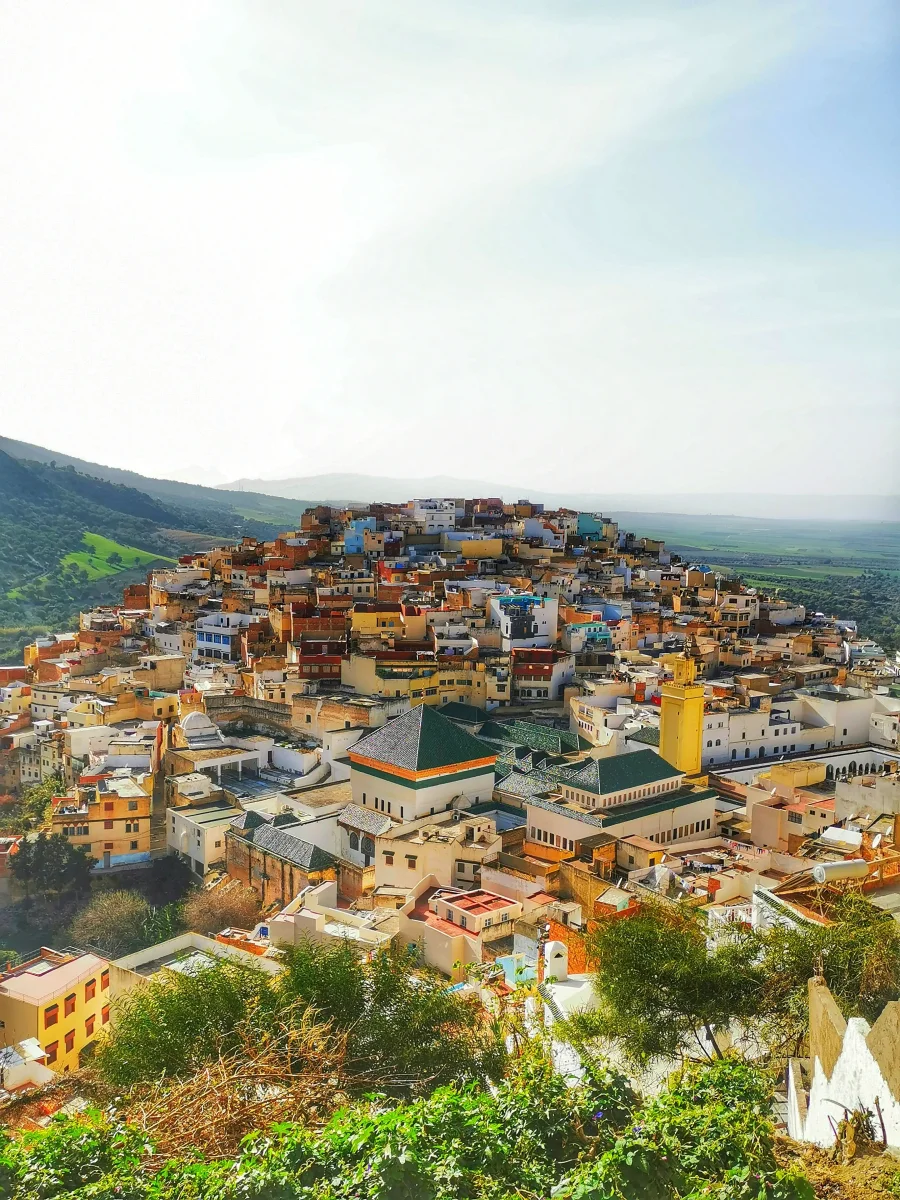
Its whitewashed houses built across the slopes of Zerhoun, narrow streets, terraces, covered passages and urban layout adapted to the mountainous terrain form a historic landscape closely connected to its natural environment.
Only a few kilometres away lies Volubilis, an ancient Mauretanian and later Roman city that briefly became a centre of power associated with Idris I.
Exploring Moulay Idriss Zerhoun therefore provides an opportunity to discover an essential period in Moroccan history, connecting Volubilis, the Idrisids, Moulay Idriss Zerhoun and the rise of Fez.
Who Was Idris I?
The history of Moulay Idriss Zerhoun is inseparable from that of Idris ibn Abdallah, generally known as Idris I.
A descendant of Hasan, grandson of the Prophet Muhammad, Idris escaped Abbasid authority in the Middle East after the Battle of Fakhkh in 786.
He travelled west and reached the Maghreb al-Aqsa towards the end of the 8th century.
He settled in the region of Walili, ancient Volubilis, where his authority was recognised with the support of local Amazigh populations.
This settlement would lead to the emergence of the Idrisid dynasty.
Idris I and the Rise of Idrisid Power
The arrival of Idris I marked an important stage in the political history of medieval Morocco.
From his base in the Volubilis region, his authority gradually expanded across several territories.
The dynasty that bears his name, the Idrisids, is generally regarded as the first Muslim dynasty to establish lasting independent political power over a significant part of Morocco.
This period was also important in the development of Islam across the territory.
The history of Moulay Idriss Zerhoun is therefore closely connected to the emergence of the first Islamic political powers in Morocco.
Volubilis Before Moulay Idriss Zerhoun
To understand this history, it is necessary to go back long before the arrival of Idris I.
Approximately 3 kilometres from Moulay Idriss Zerhoun lies the archaeological site of Volubilis.
The city existed for centuries before the Islamic period.
It was an important settlement of the Kingdom of Mauretania before developing further under Roman rule.
The remains visible today reflect this long history.
They include:
- houses decorated with mosaics
- baths
- olive presses
- public buildings
- a basilica
- a capitol
- a monumental arch
- ancient streets and neighbourhoods
The archaeological site covers approximately 42 hectares.
Volubilis and the Roman Empire
Under Roman rule, Volubilis became an important centre of the province of Mauretania Tingitana.
Its position at the foot of the Zerhoun massif and near fertile agricultural land supported its development.
Agriculture, particularly olive oil production, played an important role in the local economy.
However, the archaeological remains reveal a history far more complex than that of a purely Roman city.
The site preserves evidence of several cultures and periods: Mauretanian, Roman, Christian and later Islamic.
This succession is one of the main reasons for its exceptional historical importance.
Volubilis and Idris I
Volubilis continued to be inhabited after the Roman period.
At the end of the 8th century, Idris I established himself in the Volubilis region.
UNESCO notes that Volubilis briefly became a centre of the Idrisid dynasty.
This period forms a crucial historical link between the ancient city and Moulay Idriss Zerhoun.
The history of the region therefore reveals a remarkable transition:
Ancient Volubilis → Islamic period → Idris I → Idrisid dynasty → development of Fez.
The Death of Idris I
Idris I died in 791.
His death came only a few years after his establishment in the region.
His tomb gradually became a place of remembrance and veneration.
The town now known as Moulay Idriss Zerhoun developed around this spiritual and historical presence.
The town's name therefore directly recalls both its founder and the mountainous Zerhoun region in which it stands.
The Mausoleum of Moulay Idriss I
At the heart of the town stands the Mausoleum of Moulay Idriss I.
It is the principal sanctuary of Moulay Idriss Zerhoun.
The religious complex has developed and changed over the centuries.
It includes the ruler's tomb and various religious spaces organised around the sanctuary.
The site has major spiritual significance in Morocco.
It also forms the symbolic centre around which much of the historic town is organised.
An Important Pilgrimage Destination
Moulay Idriss Zerhoun has long been a destination for pilgrimage.
UNESCO explicitly mentions the tomb of Idris I and the annual pilgrimage associated with the site.
This religious dimension distinguishes Moulay Idriss Zerhoun from many other historic destinations in Morocco.
The town is not simply a collection of old buildings.
It remains a living religious centre.
Visitors should keep this in mind, particularly around the mausoleum and during religious celebrations.
The Moussem of Moulay Idriss
The pilgrimage tradition is expressed notably through the Moussem of Moulay Idriss Zerhoun.
This religious gathering is dedicated to the memory of Moulay Idriss I.
It traditionally attracts pilgrims and visitors from different regions of Morocco.
The moussem demonstrates that the heritage of Moulay Idriss Zerhoun is simultaneously historical, architectural and intangible.
Religious and social traditions therefore remain an integral part of the town's identity.
A Town Built on the Zerhoun Massif
One of the most remarkable aspects of Moulay Idriss Zerhoun is its location.
The town spreads across the slopes of Jbel Zerhoun.
Its houses appear to cling to the hillsides.
This topography has profoundly influenced the urban layout.
Streets naturally follow the terrain.
Visitors will encounter:
- narrow lanes
- stairways
- covered passages
- interconnected houses
- terraces
- viewpoints overlooking the surrounding valleys
The town therefore forms an urban ensemble particularly well integrated into its landscape.
Architecture Adapted to the Terrain
Unlike medinas built on relatively flat ground, Moulay Idriss Zerhoun developed in a mountainous environment.
This constraint created a more vertical form of architecture.
Houses rise above one another along the slopes.
Terraces play an important role in the urban landscape.
The narrow streets regularly change elevation.
This layout gives the town an immediately recognisable visual identity.
It also explains why some viewpoints provide panoramas across much of the settlement.
The Houses of Moulay Idriss Zerhoun
Light-coloured façades dominate the urban landscape.
From the surrounding heights, the town appears as a dense cluster of houses organised around the sanctuary.
The relative simplicity of the exterior façades contrasts with the complexity of the streets.
As in many historic Moroccan towns, traditional architecture often places greater emphasis on interior spaces than on exterior façades.
Courtyards, patios and terraces contribute to this domestic organisation.
The Streets of the Medina
One of the best ways to discover Moulay Idriss Zerhoun is simply to explore its streets.
The historic urban fabric is particularly dense.
Streets sometimes narrow into simple passages.
Some become stairways.
Others pass beneath houses.
This organisation reflects a town that developed gradually while adapting to the natural constraints of the terrain.
It also gives Moulay Idriss Zerhoun an atmosphere very different from Meknes or Fez.
Viewpoints Over the Town
The higher areas of Moulay Idriss Zerhoun offer several remarkable perspectives.
From certain viewpoints, visitors can observe the organisation of the town around the sanctuary.
The different levels of housing and the integration of the settlement into the Zerhoun massif become particularly clear.
These panoramas also help explain the geographical relationship between the town, the surrounding agricultural land and the Volubilis region.
Moulay Idriss Zerhoun and UNESCO
One important point should be clarified.
Moulay Idriss Zerhoun is not currently inscribed on the UNESCO World Heritage List.
The town has, however, appeared on Morocco's Tentative List since 1995.
A Tentative List contains sites that a country may consider nominating for World Heritage status in the future.
The Moulay Idriss Zerhoun proposal notably highlights:
- its association with Idris I
- its spiritual importance
- its religious monuments and sanctuaries
- its Islamic architecture
- its integration into the cultural landscape of Zerhoun
This status should therefore not be confused with that of Volubilis.
Volubilis: A UNESCO World Heritage Site
Volubilis has been inscribed on the UNESCO World Heritage List since 1997.
UNESCO recognises the site's importance as evidence of several civilisations and cultures.
The archaeological remains illustrate influences including:
- Libyco-Berber and Mauretanian
- Punic
- Roman
- African
- Christian
- Arab-Islamic
This exceptional succession helps explain why Volubilis is one of Morocco's most important archaeological sites.
A Protected Landscape Connection
The relationship between Volubilis and Moulay Idriss Zerhoun is not only historical.
It is also visual and geographical.
UNESCO documents concerning the protection of Volubilis emphasise the importance of preserving views between the archaeological site, the agricultural plain and the Zerhoun massif.
The proximity of Moulay Idriss Zerhoun therefore forms part of the wider cultural and visual context of Volubilis.
The two destinations are much easier to understand when explored together.
Idris II and the Rise of Fez
Idrisid history continued with Idris II, son of Idris I.
Under his rule, the centre of political power progressively shifted towards Fez.
The city became one of Morocco's major political, religious and intellectual centres.
This development creates a direct historical connection between Moulay Idriss Zerhoun and Fez.
Understanding Idris I and the Zerhoun region therefore provides valuable context for exploring the origins and development of Fez.
From Moulay Idriss Zerhoun to Fez
Over the centuries, Fez developed into a much larger urban centre.
Its Medina became home to mosques, funduqs, madrasas, workshops and markets.
Important monuments and heritage sites to discover today include:
- Al Quaraouiyine
- the Al-Attarine Madrasa
- the Bou Inania Madrasa
- the Nejjarine Museum
- Dar Al Batha
- the Chouara Tanneries
These sites belong to different periods, but together they help explain the historical and cultural development of a city whose early growth was closely connected to the Idrisid period.
Al Quaraouiyine
Al Quaraouiyine is one of the great historic religious and intellectual centres of Fez.
Founded in the 9th century, it developed over time into a central institution in the religious and scholarly life of the Medina.
Its importance reflects the role acquired by Fez after the period of the first Idrisids.
It therefore represents a logical continuation of a journey beginning in Moulay Idriss Zerhoun.
Al-Attarine Madrasa
The Al-Attarine Madrasa, built in the 14th century during the Marinid period, belongs to a much later era.
However, it demonstrates how Fez retained its role as a major centre of learning centuries after the Idrisids.
Its architecture combines zellige, carved stucco, cedarwood and calligraphy.
The madrasa stands close to Al Quaraouiyine.
Bou Inania Madrasa of Fez
The Bou Inania Madrasa of Fez is another masterpiece of Marinid architecture.
It reflects the development of religious and educational institutions within the city.
A visit helps continue a historical journey that begins with the Idrisids and develops through Morocco's later dynasties.
Nejjarine Museum
The Nejjarine Museum of Wooden Arts and Crafts reveals another dimension of Fez's heritage: its artisans.
Housed in a historic funduq, the museum explores traditional woodworking skills.
This craft tradition forms an integral part of the historic identity of the Medina.
Chouara Tanneries
The Chouara Tanneries illustrate the continuity of traditional crafts in Fez el-Bali.
Leatherworking has been one of the city's emblematic activities for centuries.
The tanneries demonstrate that Moroccan heritage is not limited to monuments.
It also includes techniques, trades and skills transmitted from one generation to another.
Moulay Idriss Zerhoun and Meknes
Moulay Idriss Zerhoun is also located near Meknes.
This proximity makes it possible to create a particularly rich historical itinerary.
Moulay Idriss Zerhoun mainly tells the story of the beginnings of the Idrisid period.
Meknes provides an opportunity to explore the era of Moulay Ismail, many centuries later.
The two destinations therefore offer very different perspectives on Morocco's dynastic history.
Meknes, an Imperial City
Meknes underwent a spectacular transformation during the reign of Moulay Ismail between 1672 and 1727.
The sultan made the city his capital and developed an immense Imperial City.
Several monuments still help visitors understand this period.
They include Bab Mansour, El Hedim Square, the Mausoleum of Moulay Ismail and the remains of the Imperial City.
Bab Mansour
Bab Mansour is one of Morocco's most famous monumental gates.
It marks one of the major entrances to the former Imperial City.
Its monumental façade reflects the architectural ambitions of Meknes during the era of Moulay Ismail.
It provides an excellent complement to a visit to Moulay Idriss Zerhoun.
El Hedim Square
Facing Bab Mansour lies El Hedim Square.
It stands at the meeting point between the Medina and the former Imperial City.
Its position makes it a natural starting point for exploring the historic heritage of Meknes.
The Mausoleum of Moulay Ismail
The Mausoleum of Moulay Ismail introduces visitors to another fundamental ruler in Moroccan history.
Several centuries separate Moulay Ismail from Idris I.
Visiting sites associated with both rulers therefore provides insight into two major periods of Morocco's dynastic history.
In Moulay Idriss Zerhoun, visitors discover the origins of Idrisid power.
In Meknes, they encounter the imperial ambitions of 17th-century Alaouite Morocco.
An Excursion Between Meknes, Moulay Idriss and Volubilis
The proximity of these three destinations makes it possible to create a particularly coherent itinerary.
Meknes
Begin by exploring the Imperial City:
- El Hedim Square
- Bab Mansour
- Mausoleum of Moulay Ismail
- Bou Inania Madrasa of Meknes
- remains of the Imperial City
Moulay Idriss Zerhoun
Continue to the sacred town.
Take time to explore its streets, observe the landscape and understand the history of Idris I.
Volubilis
Finish at the archaeological site of Volubilis.
This itinerary allows visitors to explore almost two millennia of history within a relatively compact area.
Why Combine Moulay Idriss Zerhoun and Volubilis?
Because the two sites tell successive chapters of a connected history.
Volubilis reveals the Mauretanian and Roman periods of Antiquity.
Moulay Idriss Zerhoun helps explain the rise of Idrisid power and the spiritual importance acquired by the region following the arrival of Idris I.
Together, they illustrate one of the most fascinating historical transitions in Moroccan heritage.
Why Visit Moulay Idriss Zerhoun?
Moulay Idriss Zerhoun offers an experience very different from Morocco's larger imperial cities.
Visitors come to understand the history of Idris I.
To discover an important spiritual centre.
To explore a town built across the slopes of Zerhoun.
To observe its architecture and landscape.
And above all, to place Volubilis, the Idrisids, Fez and Meknes within a connected historical narrative.
The town is therefore particularly rewarding for travellers who want to go beyond Morocco's best-known monuments and understand the different periods that shaped the country.
Moulay Idriss Zerhoun: At the Origins of a Major Chapter in Moroccan History
Few areas of Morocco bring together so many historical periods within just a few kilometres.
At Volubilis, the ruins tell the story of the Mauretanian and Roman worlds and the transformations that followed.
At Moulay Idriss Zerhoun, the memory of Idris I recalls the beginnings of the Idrisid dynasty.
In Fez, the story continues with the development of a major religious, intellectual and commercial centre.
In Meknes, centuries later, Moulay Ismail created a new imperial capital.
Discovering Moulay Idriss Zerhoun therefore means understanding far more than a single town.
It is a gateway to the history of Morocco's early Islamic dynasties and to one of the country's richest historic landscapes.
Read Also
- Volubilis: History and Visit of the Ancient City
- Meknes: History and Heritage of the Imperial City
- Bab Mansour in Meknes: History and Architecture
- El Hedim Square in Meknes: History of the Imperial Square
- Mausoleum of Moulay Ismail in Meknes: History and Architecture
- Bou Inania Madrasa of Meknes: History and Heritage
- Fez: Discover the Medina and Its Heritage
- Al Quaraouiyine in Fez: History of a Great Religious and Intellectual Centre
- Al-Attarine Madrasa: A Marinid Masterpiece in Fez
- Bou Inania Madrasa of Fez: History and Architecture
- Nejjarine Museum: Wooden Arts and Crafts in Fez
- Chouara Tanneries: The History of Leatherworking in Fez
- Dar Al Batha in Fez: Palace and Heritage