El Hedim Square in Meknes: History of the Great Square of the Imperial City
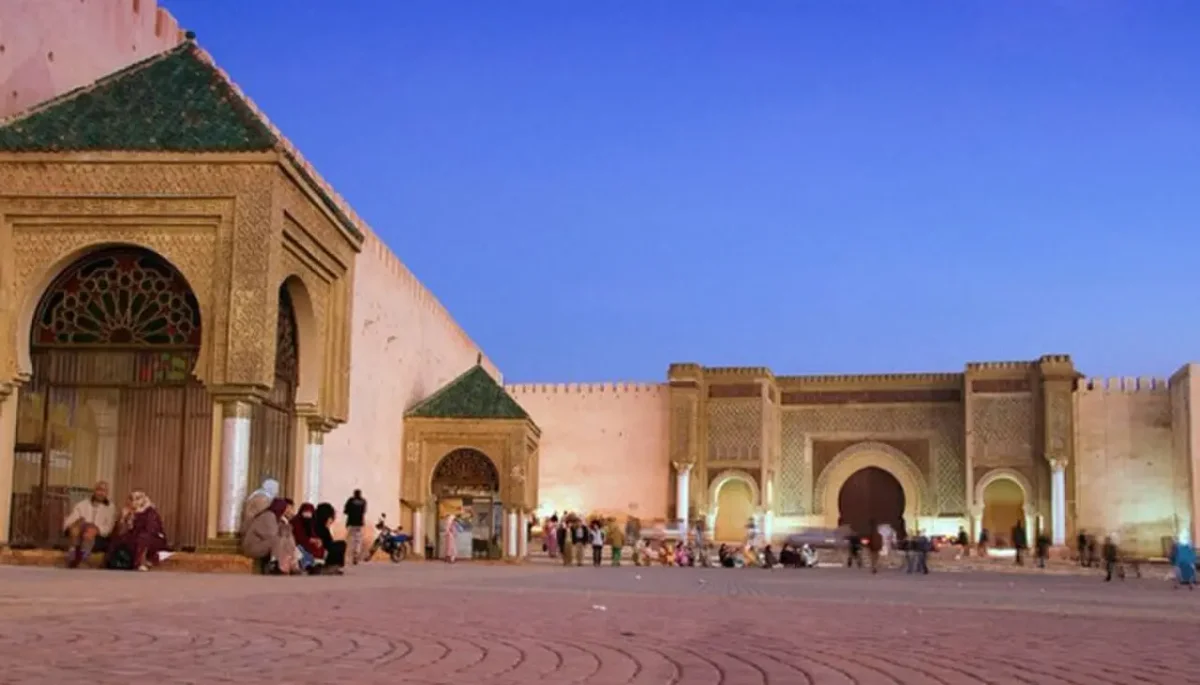
At the heart of historic Meknes, facing the monumental Bab Mansour, lies one of the city's most emblematic public spaces: El Hedim Square, also known as Lahdim or El Hédim.
Today, the square is animated by local residents, visitors, shops and cafés. But above all, it is closely connected to the profound transformation of Meknes undertaken in the late 17th century by Sultan Moulay Ismail.
Its history is directly linked to that of the Imperial City of Meknes.
When Moulay Ismail chose Meknes as his capital, he launched an immense construction programme that included palaces, ramparts, monumental gates, granaries, stables, gardens and hydraulic infrastructure.
El Hedim Square became a strategic space between the old Medina and the new imperial city.
To understand Meknes, it is therefore essential to understand El Hedim.
Meknes Before Moulay Ismail
The history of Meknes began long before its imperial period.
According to UNESCO, the city was founded in the 11th century by the Almoravids as a military settlement.
Its name is associated with the Meknassa, an Amazigh tribe established in this part of Morocco.
Over the centuries, Meknes developed under several dynasties.
The Marinid period notably left important monuments, including the Bou Inania Madrasa of Meknes.
However, the city's most spectacular transformation began in the second half of the 17th century.
Moulay Ismail Makes Meknes an Imperial Capital
In 1672, Moulay Ismail ascended the throne.
His reign, which lasted until 1727, was a decisive period in the history of Meknes.
The sultan chose the city as his capital and began creating an immense royal complex.
UNESCO describes Meknes today as the first great architectural achievement of the Alaouite dynasty.
A New City Beside the Old Medina
Moulay Ismail did not simply build a few palaces.
He developed an entire imperial city beside the existing Medina.
High defensive walls were erected.
Monumental gates controlled access between the different sections of the complex.
Palaces, gardens, granaries, stables and extensive facilities for the royal court and military were constructed behind these walls.
El Hedim Square emerged within the context of this major urban transformation.
Why Is It Called El Hedim?
The name El Hedim, also written Lahdim or El Hédim, is generally associated with an Arabic word referring to demolition or rubble.
The name is linked to the transformations undertaken during the construction of the new imperial city.
Buildings were demolished and spaces cleared to make way for the new royal complex.
The large square created near the Medina preserved the memory of these transformations in its name.
A Square Between Two Cities
One of the most interesting aspects of El Hedim is its location.
On one side lies the old Medina of Meknes.
On the other stood the vast royal city developed by Moulay Ismail.
The square therefore formed a transition zone between two urban worlds.
The Medina
The Medina concentrated much of the city's commercial, artisanal, religious and residential activity.
Its streets contained souks, mosques, funduqs, workshops and houses.
Several historic monuments can still be seen there today.
The Imperial City
Facing this older urban fabric, Moulay Ismail developed a royal complex on an entirely different scale.
Palaces, courtyards, gardens, food reserves, stables and fortifications formed an ensemble designed to express the power of the ruler.
El Hedim stood precisely at the meeting point of these two worlds.
Bab Mansour: The Monumental Façade of El Hedim
It is impossible to discuss El Hedim Square without mentioning Bab Mansour Laalej.
The gate dominates one side of the square and is today one of the most famous monuments in Meknes.
It marked one of the principal monumental entrances to the imperial city.
A Gate Begun Under Moulay Ismail
Bab Mansour was part of the vast architectural programme undertaken during the reign of Moulay Ismail.
Construction began during his reign.
However, the sultan died in 1727 before the gate was completed.
It was finished under his son, Sultan Moulay Abdallah, in 1732.
Monumental Architecture
Bab Mansour is remarkable for both its proportions and its rich decoration.
Its central opening reaches approximately 8 metres in height.
The façade notably combines:
- geometric compositions
- polychrome zellige mosaics
- vegetal motifs
- a large calligraphic inscription
- marble columns
- capitals inspired by classical forms
Together, these elements illustrate the refinement of monumental architecture developed in Meknes under the early Alaouite rulers.
Bab Mansour and the Architecture of Meknes
The monumentality of Bab Mansour should not be considered in isolation.
It belongs to a much larger urban programme.
UNESCO highlights that the imperial city of Meknes presents a remarkable combination of elements derived from Islamic and European architecture and urban planning.
This encounter between different architectural traditions is one of the reasons for the exceptional heritage value of Meknes.
Its high walls, monumental gates and immense palatial complex give the city a character distinct from Morocco's other historic capitals.
El Hedim and the Imperial Palace
Bab Mansour marked the ceremonial entrance to the palatial complex of Moulay Ismail.
Behind the walls extended an entire royal city.
The palace was not a single building.
It was an immense complex comprising several residences, courtyards, gardens and infrastructure.
This organisation explains why the monuments of the imperial city are today spread across such a large area.
Heri es-Souani: The Reserves of the Imperial City
Among the monuments associated with the imperial city are the buildings generally known as Heri es-Souani.
These vast structures illustrate the scale of the logistics required to operate Moulay Ismail's capital.
The royal complex needed to supply a large court, soldiers and the animals housed in its stables.
Large storage areas were therefore integrated into the palatial system.
Visiting El Hedim and then Heri es-Souani allows visitors to move from the ceremonial façade of the imperial city to its practical infrastructure.
The Great Stables of Moulay Ismail
The imperial city of Meknes was also renowned for its extensive equestrian facilities.
Horses played a central role in both the military organisation and symbolism of royal power.
Structures associated with the stables demonstrate the considerable scale of Moulay Ismail's project.
UNESCO explicitly mentions the large stables, granaries and cisterns among the characteristic features of the imperial city.
The Agdal Basin
The vast Agdal Basin also forms part of the monumental landscape developed around the royal complex.
This large hydraulic infrastructure reminds visitors that an imperial capital required considerable water resources.
In Meknes, monumental architecture and hydraulic engineering formed part of the same urban project.
The Mausoleum of Moulay Ismail
Close to the imperial city stands the Mausoleum of Moulay Ismail.
The monument preserves the memory of the ruler who profoundly transformed Meknes.
Moulay Ismail ruled for more than half a century, from 1672 to 1727.
His architectural programme permanently changed the organisation of the city.
Even today, much of Meknes's heritage identity is directly connected to his reign.
The Bou Inania Madrasa of Meknes
To understand the history of Meknes before Moulay Ismail, it is also important to discover the Bou Inania Madrasa.
Unlike the Alaouite imperial city, this madrasa belongs to the Marinid period.
It demonstrates that Meknes already possessed an important urban, religious and intellectual history before becoming an imperial capital.
There is also a Bou Inania Madrasa in Fez.
The two monuments should not be confused.
However, both testify to the importance placed on religious education and architecture under the Marinids.
Dar Jamaï: A Palace Turned Museum
Not far from El Hedim stands Dar Jamaï, a palace built in the 19th century.
Its architecture therefore belongs to a period much later than that of Moulay Ismail.
The building offers an opportunity to discover another period of Moroccan residential architecture.
Today associated with the presentation of Morocco's musical heritage, Dar Jamaï complements a historical exploration of the square and Medina particularly well.
A Commercial Square
El Hedim was not exclusively connected to imperial power.
Its proximity to the Medina also made it a space directly connected with commercial activity.
City gates in Morocco often formed strategic areas for trade and movement.
Merchants, artisans, travellers and residents passed through these areas every day.
Funduqs within the city provided accommodation and storage facilities for merchants and their goods.
UNESCO still highlights the remains of funduqs in Meknes as evidence of the city's historic socio-economic fabric.
El Hedim Today
The function of the square has evolved, but El Hedim remains an important public space in Meknes.
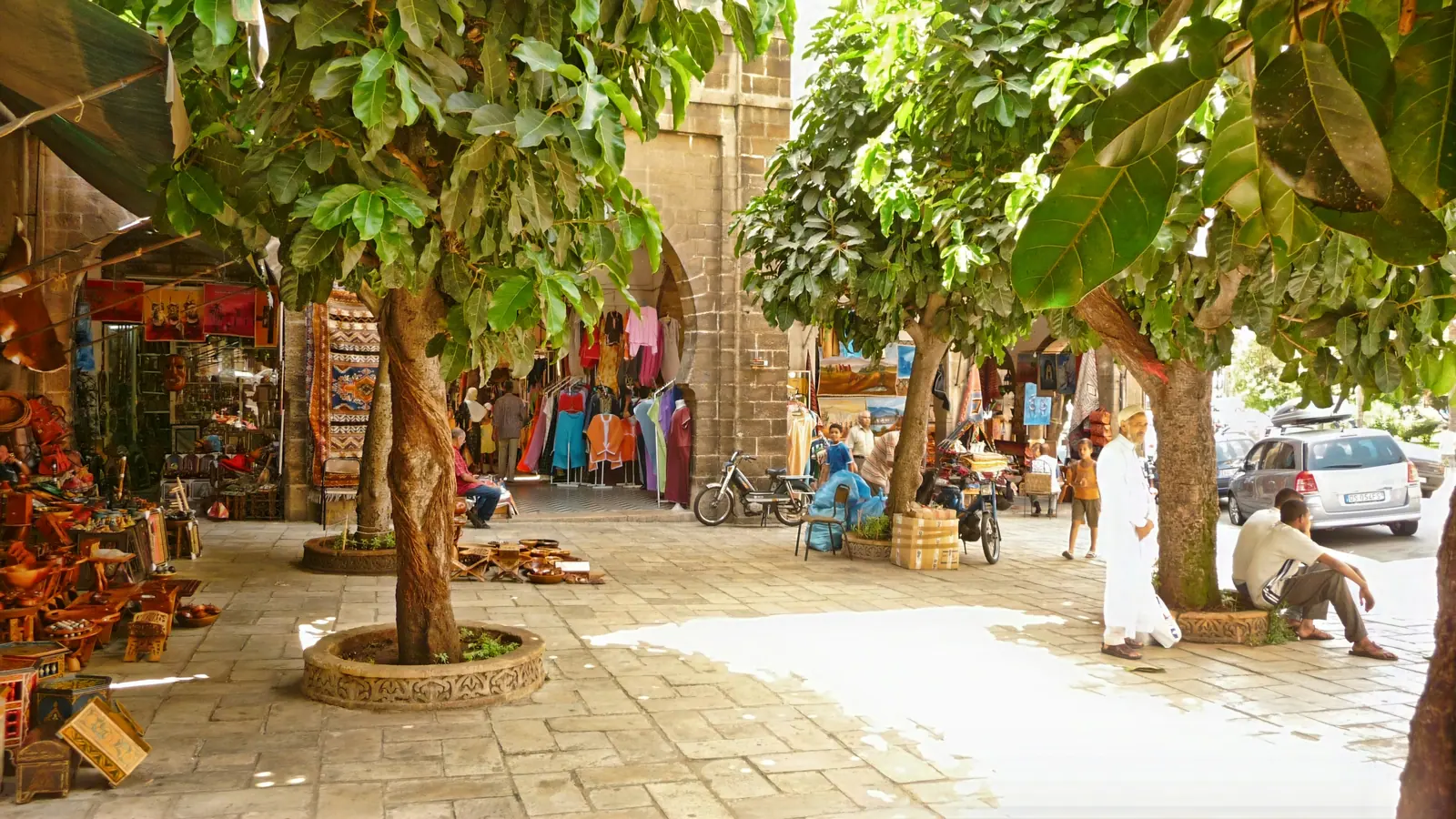
During the day, it is a natural point of passage between the souks, the Medina and the monuments of the imperial city.
In the evening, the atmosphere changes.
The square becomes a place for walking, meeting and socialising for residents and visitors.
This continuity is important.
El Hedim is not simply a historic setting.
It remains a living public space at the heart of Meknes.
El Hedim and Jemaa el-Fna: Two Squares with Different Histories
El Hedim Square is sometimes compared with Jemaa el-Fna in Marrakech because both are major historic public spaces.
The comparison can help illustrate its urban importance, but the two squares have different histories.
Jemaa el-Fna developed at the heart of Marrakech and has long served as an important commercial and cultural space.
El Hedim is deeply connected to the imperial transformation of Meknes under Moulay Ismail.
Its relationship with Bab Mansour and the royal city is therefore one of its defining historical characteristics.
Meknes and UNESCO World Heritage
The Historic City of Meknes has been inscribed on the UNESCO World Heritage List since 1996.
UNESCO considers Meknes a particularly complete example of a 17th-century Maghreb capital.
The city is distinguished by:
- its imposing ramparts
- monumental gates
- historic Medina
- imperial city
- palaces
- granaries
- stables
- mosques
- madrasas
- historic funduqs
The heritage value of Meknes also lies in the coexistence of the old Medina and the imperial city created by Moulay Ismail.
El Hedim Square stands precisely at the junction between these two urban ensembles.
From Meknes to Volubilis
A visit to Meknes can easily be combined with a trip to Volubilis, located north of the city.
The archaeological site preserves the remains of one of the most important ancient cities in Morocco.
Temples, houses, mosaics, a monumental arch and public buildings reveal a very different period in the region's history.
Combining Meknes and Volubilis therefore makes it possible to explore several centuries of history within the same destination.
Moulay Idriss Zerhoun
Near Volubilis is Moulay Idriss Zerhoun.
The town is closely associated with the memory of Moulay Idriss I and the origins of the Idrisid dynasty.
An itinerary combining Meknes, Volubilis and Moulay Idriss Zerhoun therefore offers an opportunity to explore three very different periods of Moroccan history:
- Antiquity at Volubilis
- the beginnings of Idrisid history at Moulay Idriss Zerhoun
- the Alaouite imperial capital at Meknes
From Meknes to Fez
Meknes can also naturally be combined with a visit to Fez.
Both are former imperial capitals, but their heritage tells different stories.
In Fez, monuments such as Al Quaraouiyine, the Al-Attarine Madrasa, the Bou Inania Madrasa, the Nejjarine Museum and the Chouara Tanneries notably illustrate the city's intellectual, religious and artisanal importance.
In Meknes, the monumentality of Moulay Ismail's imperial city has a stronger presence in the historic landscape.
Exploring both destinations therefore provides a better understanding of the diversity of Morocco's imperial cities.
What to Visit Around El Hedim Square
The square is an excellent starting point for exploring Meknes on foot.
Bab Mansour
Begin by observing Bab Mansour, directly facing the square.
Take time to examine its decoration, zellige, geometric patterns and inscriptions.
The Medina of Meknes
From El Hedim, continue into the streets of the Medina.
Souks, workshops, mosques and historic houses reveal the traditional urban fabric of the city.
Bou Inania Madrasa
The Bou Inania Madrasa of Meknes offers an opportunity to return to the Marinid period and discover another chapter in the city's history.
Dar Jamaï
Dar Jamaï provides an insight into 19th-century Moroccan palatial architecture and is a natural stop near El Hedim.
Mausoleum of Moulay Ismail
Continue towards the Mausoleum of Moulay Ismail to learn more about the ruler who made Meknes his capital.
Heri es-Souani
Complete your exploration of the imperial city with the large structures associated with Heri es-Souani and the infrastructure developed under Moulay Ismail.
An Itinerary for Understanding Meknes
El Hedim should not be visited as simply another square.
It provides an excellent introduction to the history of Meknes.
El Hedim helps explain the city's urban transformation.
Bab Mansour represents the monumentality of imperial power.
The Bou Inania Madrasa recalls the Marinid heritage.
The Mausoleum of Moulay Ismail tells the story of the ruler who transformed Meknes.
Heri es-Souani reveals the immense infrastructure required to support the imperial city.
Dar Jamaï represents a later period of Moroccan palatial architecture.
Together, these monuments form a route through several centuries of Meknes's history.
Why Visit El Hedim Square?
Because it helps visitors understand the city before they even enter its monuments.
On one side are the streets of the old Medina.
On the other are Bab Mansour and the former imperial city.
Between them lies a vast square created during the transformations undertaken when Moulay Ismail decided to make Meknes his capital.
This position makes El Hedim much more than a place to pass through.
It is one of the best places to understand the meeting point between the historic Medina and imperial Meknes.
El Hedim Square: The Historic Heart of Meknes
For more than three centuries, the surroundings of El Hedim have witnessed the transformations of Meknes.
Moulay Ismail's capital no longer holds the political role it possessed in the 17th century.
But its ramparts, gates and monuments remain.
Facing the square, Bab Mansour continues to be the most spectacular symbol of this imperial ambition.
Behind it once extended the immense royal complex.
On the opposite side begins the Medina and its historic urban fabric.
Few places allow the history of Meknes to be read so clearly through the urban landscape.
El Hedim is therefore more than simply the great square of Meknes: it is one of the meeting points between the different chapters of the city's history.
Read Also
- Meknes: History and Heritage of the Imperial City
- Bab Mansour in Meknes: History and Architecture
- Bou Inania Madrasa of Meknes: History and Visit
- Mausoleum of Moulay Ismail: History of the Imperial City
- Heri es-Souani: The Granaries and Stables of Moulay Ismail
- Dar Jamaï in Meknes: From Historic Palace to Museum
- Volubilis: Discover Morocco's Ancient City
- Moulay Idriss Zerhoun: History and Heritage
- Fez: Heritage, Medina and Historic Monuments