Marrakech at Night: Discover the Medina, Jemaa el-Fna and Culture After Sunset
When the sun disappears behind the ramparts, Marrakech changes its rhythm.
The heat begins to fade, the lights come on around the Koutoubia, smoke starts rising above Jemaa el-Fna, and the streets of the Medina take on a new energy.
But discovering Marrakech at night does not necessarily mean looking for bars or nightclubs.
In the Medina, an evening can be first and foremost a cultural experience.
Storytellers, musicians, street food, Gnaoua traditions, terraces, walks around illuminated monuments and musical evenings reveal another side of the city.
To truly understand Marrakech, sometimes you have to wait until the monuments close and the night begins.
Jemaa el-Fna After Sunset
If there is one place that symbolizes Marrakech after dark, it is undoubtedly Jemaa el-Fna.
The square is lively throughout the day, but its atmosphere changes dramatically in the late afternoon.
Gradually, food stalls begin to appear.
Visitors arrive.
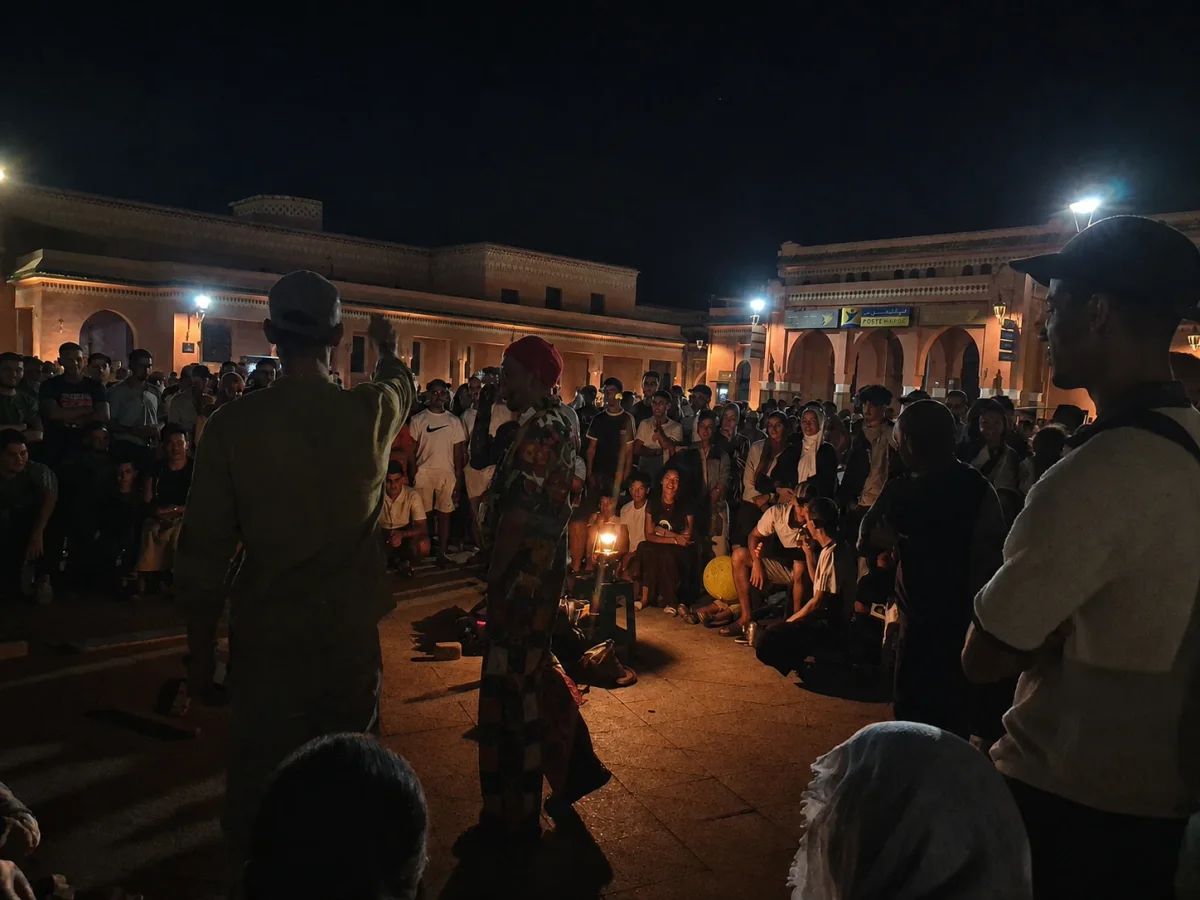
Crowds gather around performers.
The sounds of percussion, voices and conversations mix with the smells of cooking and the smoke rising above the square.
This spectacle is not a recent creation designed for tourists.
Jemaa el-Fna has long been a place of trade, social interaction and the transmission of oral traditions.
Jemaa el-Fna and UNESCO Intangible Cultural Heritage
The importance of Jemaa el-Fna extends far beyond Marrakech.
UNESCO has recognized the cultural space of Jemaa el-Fna Square for the richness of the traditions transmitted there.
The square also played an important role in the international recognition of the concept of intangible cultural heritage.
This heritage is not made of walls, palaces or objects preserved behind museum glass.
It is based on living practices:
oral storytelling, music, popular performances, gestures, knowledge and interactions between performers and audiences.
That is precisely what makes Jemaa el-Fna different from a traditional monument.
You do not simply visit it.
You experience it.
The Halqa: The Circle That Brings the Square to Life
To understand Jemaa el-Fna, you need to know one word: halqa.
In Arabic, the word literally refers to a circle.
On the square, a halqa is the circle that spectators spontaneously form around a storyteller, musician or performer.
For generations, these circles have served as genuine spaces for popular culture.
Storytellers shared tales, legends, religious stories, adventures and sometimes observations about society.
The performance depends as much on the audience as it does on the artist.
People approach.
They listen.
They laugh.
They react.
Then the circle disappears, while another one forms a few meters away.
The Storytellers of Marrakech
The tradition of the storytellers of Jemaa el-Fna is one of the most fascinating aspects of the square.
For generations, oral storytelling was an essential way of transmitting stories, values, humor and collective memory.
Today, this tradition is less visible than it once was, which makes it all the more important to recognize it as a fragile form of living heritage.
For international visitors who do not understand Moroccan Arabic, following the details of a story can sometimes be difficult.
But watching a halqa is still worthwhile.
The storyteller's gestures, the reactions of the audience and the way the circle forms already reveal an important part of this tradition.
Listening to Gnaoua Music in Marrakech
Marrakech at night also has a strong musical dimension.
Among Morocco's most important traditions is Gnaoua culture, deeply connected to the country's history and its long-standing links with sub-Saharan Africa.
Gnaoua traditions combine music, rhythm, poetry, spirituality and memory.
One of their most emblematic instruments is the guembri, a stringed instrument with a deep sound, generally accompanied by qraqeb, large metal castanets whose rhythm is instantly recognizable.
At Jemaa el-Fna and in some cultural venues in Marrakech, visitors may hear musicians performing repertoires inspired by this tradition.
Gnaoua Culture: Much More Than Music
Reducing Gnaoua culture to a simple musical performance would be incomplete.
Gnaoua practices have ancient spiritual, social and ritual dimensions.
They also reflect the human and cultural connections that linked Morocco with regions south of the Sahara for centuries.
In 2019, Gnaoua practices were inscribed by UNESCO on the Representative List of the Intangible Cultural Heritage of Humanity.
When listening to Gnaoua music in Marrakech, it is therefore worth experiencing it not simply as entertainment, but as the expression of a much deeper history.
Dinner on Jemaa el-Fna
After sunset, Jemaa el-Fna also becomes a vast open-air dining space.
Dozens of stalls set up tables, benches, grills and cooking pots.
Depending on the stall, you may find different Moroccan specialties: grilled meats, soups, fish, skewers, snails, juices and other popular dishes.
Eating on the square is not necessarily about finding the most refined gastronomic experience in Marrakech.
That is not really the point.
The experience lies mainly in the collective atmosphere.
You eat in the middle of the action, surrounded by travelers, Marrakchis, vendors and cooks.
MoroccoMuseum Tip
Before choosing a stall, take a few minutes to walk around the food area.
Look at what is being served and check the displayed prices when available.
You are never obliged to sit at the first stall whose vendor approaches you.
Seeing Jemaa el-Fna From a Terrace
Before heading into the crowds, it can be interesting to observe the square from a terrace.
The view is particularly impressive around sunset and during the early evening.
From above, the transformation of Jemaa el-Fna becomes much easier to appreciate.
The food stalls gradually form lines of light.
Smoke rises from the kitchens.
Crowds move between the different circles of performers.
In the distance, the Koutoubia minaret dominates the scene.
Then head back down to the square.
Jemaa el-Fna is impressive from above, but its true character is discovered at street level.
The Illuminated Koutoubia
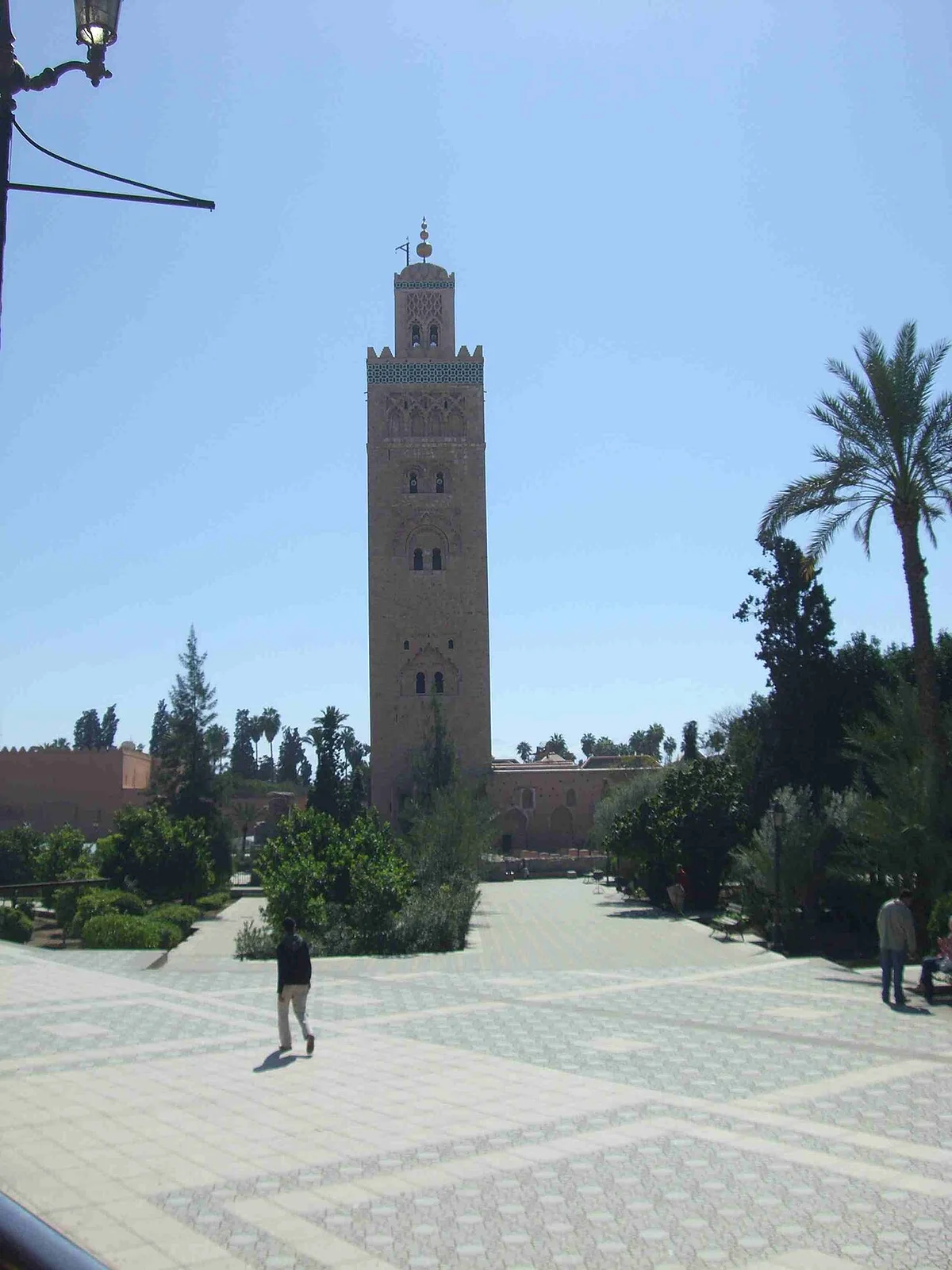
Just a few minutes from Jemaa el-Fna stands one of the great symbols of Marrakech: the Koutoubia Mosque.
Its minaret, built in the 12th century under the Almohads, has dominated the city's skyline for centuries.
At night, the lighting gives the monument a very different appearance from during the day.
A walk around the Koutoubia gardens can therefore provide a pleasant transition after the intensity of Jemaa el-Fna.
Non-Muslims cannot enter the mosque itself.
However, its exterior architecture, minaret and surrounding gardens can be admired freely.
Walking Through the Medina at Night
When the major monuments begin to close, the Medina does not stop.
Its rhythm simply changes.
Some commercial streets remain lively during the early evening, while others gradually become quieter.
It is an interesting time to experience Marrakech differently.
Instead of trying to visit another attraction every thirty minutes, you can simply walk, observe the doors, listen to workshops closing and discover the Medina's smaller squares.
The streets around Jemaa el-Fna, the Koutoubia and the main commercial routes are generally among the busiest areas in the evening.
Marrakech at Night Is a Different City
During the day, attention is naturally drawn toward monuments.
Bahia Palace, El Badi Palace, the Saadian Tombs, madrasas and museums easily structure an itinerary.
At night, the logic changes.
The doors close, but the city continues.
Heritage becomes less monumental and more human and sensory.
A conversation.
A musician.
The smell of food.
An illuminated doorway.
The sound of footsteps in a narrow street.
This too is part of discovering Marrakech's living heritage.
Mouassine in the Evening
The Mouassine district offers an atmosphere quite different from Jemaa el-Fna.
Located in the heart of the Medina, it brings together historic streets, riads, shops and remarkable elements of Marrakech's traditional architecture.
In the early evening, some parts of the neighborhood become quieter.
It is a good opportunity to observe façades and the organization of the streets without necessarily searching for a particular attraction.
As in any historic Medina, it is preferable to stay on routes you know or use reliable navigation when moving away from the main streets.
Arabo-Andalusian Music
Moroccan musical culture is obviously not limited to Gnaoua traditions.
Arabo-Andalusian music, inherited from musical traditions developed over centuries between Al-Andalus and the Maghreb, also occupies an important place in Morocco's cultural heritage.
It is particularly associated with historic cities such as Fez, Tetouan, Rabat and Chefchaouen.
In Marrakech, ensembles and musicians can sometimes be heard during cultural events, receptions, dinners or evenings organized by certain establishments.
Listening to this music in a traditional courtyard provides another way of approaching Morocco's cultural heritage.
Musical Evenings in Riads
Some riads and establishments in the Medina occasionally organize dinners accompanied by traditional music.
The atmosphere is very different from Jemaa el-Fna.
Instead of the crowds and noise of the square, the experience usually takes place around a courtyard or on a terrace.
Depending on the venue and program, musicians may perform different Moroccan repertoires.
Not every evening advertised as “traditional” offers the same level of quality or authenticity.
It is therefore useful to check exactly what is included before booking.
Dining in a Historic Riad or Palace
Architecture can also become part of the nighttime experience.
Marrakech has numerous riads, historic residences and restaurants located inside traditional buildings.
At night, courtyards, zellige, carved stucco and wooden ceilings take on a different character under softer lighting.
To better understand the architectural elements you see in these buildings, you can also read our guide to traditional Moroccan architecture.
Dining in a heritage setting can therefore provide a different way to continue the cultural discoveries of the day.
Fantasia and Traditional Performances
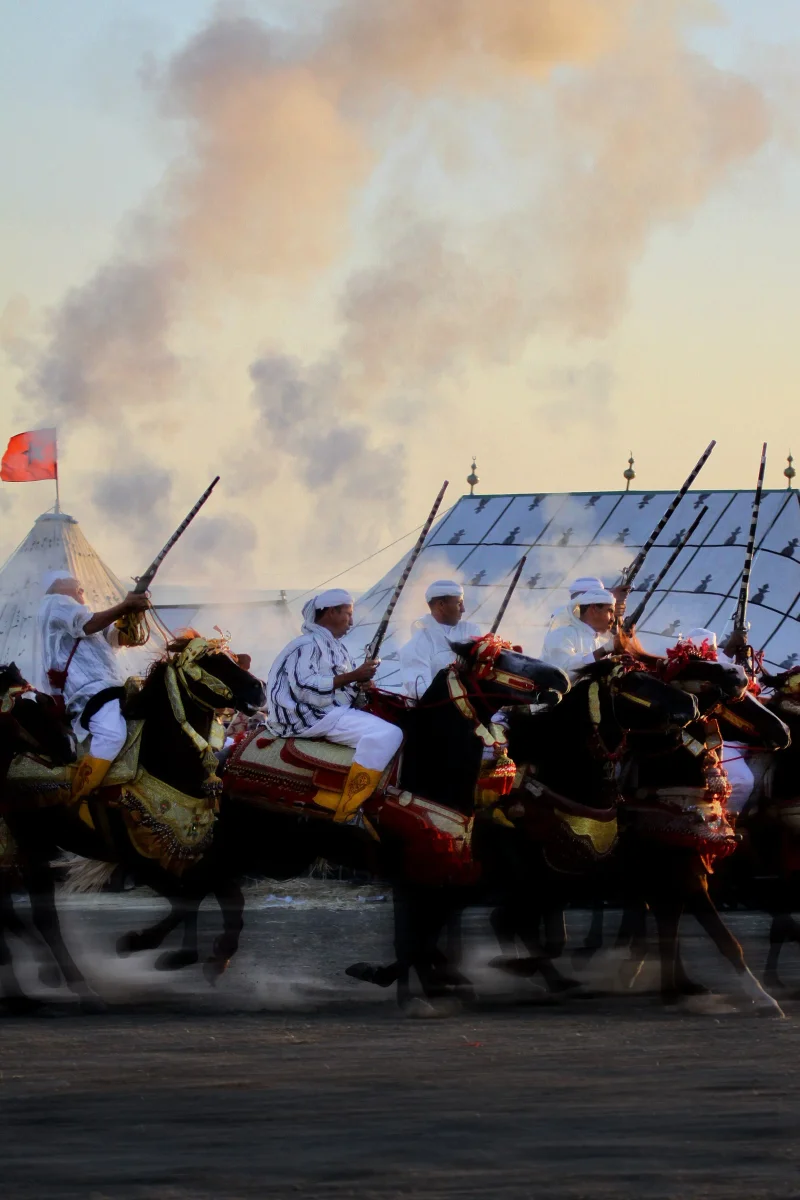
Another type of evening experience available around Marrakech is the fantasia, also known in the context of Moroccan cultural heritage as tbourida.
Tbourida is a spectacular Moroccan equestrian tradition.
Rows of horsemen launch their horses into a gallop before performing a coordinated discharge of blank-firing rifles.
Behind the spectacle, however, lies a rich tradition of horsemanship, regional customs, clothing, equipment and skills transmitted between generations.
In 2021, tbourida was inscribed by UNESCO on the Representative List of the Intangible Cultural Heritage of Humanity.
Chez Ali and the Large Fantasia Shows
Among the best-known performances around Marrakech is Chez Ali, located in the Palmeraie.
The concept generally combines a Moroccan dinner, music, costumes, horsemen and a large fantasia performance.
The experience is very different from spending an evening in the Medina.
It is a large-scale show designed to accommodate many visitors.
For families and travelers interested in seeing a spectacular presentation inspired by different Moroccan traditions, it can be an interesting evening experience.
However, to understand the tradition beyond the tourist performance, it is important to remember that authentic tbourida has a history and cultural practices that extend far beyond shows organized for visitors.
➡️ Discover and Book the Chez Ali Fantasia Evening
Other Folklore Experiences Around Marrakech
Other venues and spaces in Marrakech and its surroundings offer evenings combining food, music, dance, traditional costumes or equestrian performances.
The formats can vary considerably.
Some focus on large-scale entertainment.
Others offer a more intimate atmosphere.
Others concentrate primarily on the dining experience.
It is therefore better to choose an experience according to what you actually want rather than assuming that all “Moroccan evenings” are the same.
Experiences and Bookings
Some of these cultural evening experiences in Marrakech are now available through our partners, starting with dinner shows and large-scale fantasia evenings.
➡️ Discover and Book the Chez Ali Fantasia Evening
Other experiences (folklore evenings, additional dinner shows) will be added to this section progressively as they become available.
Can You Visit Marrakech's Monuments at Night?
Most of Marrakech's major historic monuments are visited during the daytime and close before the liveliest part of the evening begins.
It is therefore useful to organize your day in two stages.
During the Day
Discover the city's major monuments:
After Sunset
Leave more room for living culture:
Jemaa el-Fna, Moroccan food, music, a walk through the Medina, the illuminated Koutoubia or a cultural evening.
This approach allows you to experience two very different sides of Marrakech.
Tips for Enjoying Marrakech in the Evening
Marrakech is a major tourist destination, and the central areas of the Medina can become very busy in the evening.
A few simple habits can make exploring more comfortable.
Keep your personal belongings close to you in crowded areas.
Always ask permission before directly photographing a person or performer.
At Jemaa el-Fna, some performers may ask for a contribution if you photograph them.
If you do not know the Medina well, check your route before heading into quieter streets.
Most importantly, do not try to see everything.
Evenings in Marrakech are more rewarding when you take the time to observe.
An Ideal Cultural Evening in Marrakech
5:00 pm – Finish Your Heritage Visits
End the daytime portion of your itinerary with a palace, museum or historic monument in the Medina.
Sunset – Koutoubia
Head toward the Koutoubia and watch the changing light around its minaret.
Early Evening – A Terrace Overlooking Jemaa el-Fna
Have tea or another drink on a terrace overlooking the square and watch its transformation from above.
Evening – Jemaa el-Fna
Then head down into the square itself.
Take time to observe the halqas, musicians and food stalls.
Dinner
Choose between the stalls of Jemaa el-Fna, a traditional restaurant or dinner in a riad.
Later in the Evening – Medina
Finish with a relaxed walk along the Medina's main streets or around the Koutoubia.
Another option is to dedicate the entire evening to a dinner show or fantasia experience.
What If You Are Looking for Marrakech's Bars and Nightclubs?
Marrakech also has a contemporary nightlife scene, particularly in Gueliz and Hivernage.
Bars, lounges, clubs and entertainment venues offer a completely different experience from the one described in this guide.
We have deliberately separated the two subjects.
This article is dedicated to Marrakech at night through its culture, living heritage and Medina.
For a more party-oriented evening, read our guide to the best nightclubs in Marrakech.
Marrakech After Sunset: Heritage That Continues to Live
Palaces tell the story of dynasties.
Museums preserve objects.
Madrasas bear witness to education and architecture.
But some forms of Moroccan heritage cannot be locked behind a door.
They exist in a voice, a rhythm, a recipe, a horse galloping across an arena or a circle of spectators spontaneously gathering around a storyteller.
This is what makes Marrakech particularly fascinating after sunset.
The city does not stop being a heritage destination when its monuments close.
Its heritage simply takes another form.
Begin Your Evening With Marrakech's Heritage
Before discovering Jemaa el-Fna and the Medina after sunset, spend the day exploring Marrakech's palaces, museums and historic monuments.
🏛️ Discover Marrakech's heritage
📖 Read our guides & inspiration
Continue Discovering Morocco
Moroccan culture is not found only inside monuments.
Gnaoua music, equestrian traditions, gastronomy, craftsmanship, oral storytelling and popular celebrations are also forms of heritage transmitted from one generation to the next.
From Marrakech to Essaouira, from Fez to the High Atlas, every region has its own cultural expressions.