A painter in Marrakech
Jacques Majorelle (1886-1962), a French painter and the son of the Art Nouveau cabinetmaker Louis Majorelle, settled in the medina of Marrakech in 1919. In 1923 he bought a palm grove on the edge of the city. This is where the garden would be born.
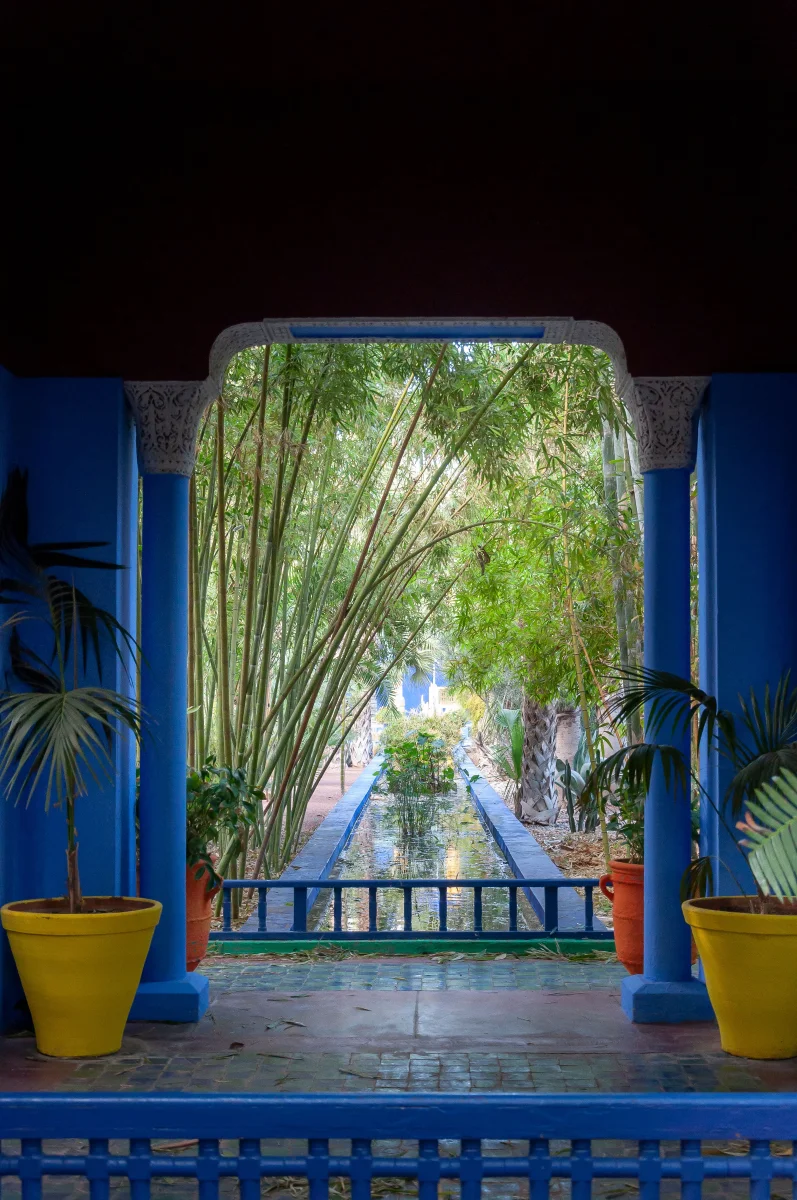
Around 1931 he commissioned the architect Paul Sinoir to build an Art Deco studio of great modernity: a vast painting studio on the ground floor and his living quarters upstairs. The garden is laid out around a long central pool, with varied settings and many exotic plants: cacti, yuccas, water lilies, palms and bamboo.
Majorelle blue
In 1937 Majorelle perfected an intense ultramarine blue, known today as Majorelle blue. He applied it to the studio walls, then throughout the garden: pools, planters, pergolas. Against the green of the plants and the ochre of the earth, the colour became the signature of the place, far beyond Marrakech.
1947: the garden opens to the public
In 1947 Majorelle opened his garden to visitors. After the car accident that forced him to return to Paris, where he died in 1962, the garden was gradually left to neglect.
1980: Yves Saint Laurent and Pierre Bergé save the garden
Yves Saint Laurent and Pierre Bergé discovered Marrakech in 1966. In 1980 they bought Majorelle Garden to save it from property developers, restored it and renamed the neighbouring villa the Villa Oasis. The landscape designer Madison Cox later added succulents native to Morocco and replaced the ground cover with pink gravel.
When Yves Saint Laurent died on 1 June 2008, his ashes were scattered in the rose garden of the Villa Oasis, where a memorial was later installed. Pierre Bergé then decided to donate the garden to the Fondation Pierre Bergé - Yves Saint Laurent; the site is now run by the Fondation Jardin Majorelle.
From garden to cultural hub
The Pierre Bergé Museum of Berber Arts was inaugurated in 2011 in Jacques Majorelle's former studio, then renamed in 2020. The Yves Saint Laurent Museum Marrakech opened on 19 October 2017 right next door. The garden covers nearly one hectare, has about 300 plant species and receives about 600,000 visitors a year.
What there is still to see today
- the central pool and its water lilies,
- Majorelle's blue studio, which houses the Berber museum,
- the cacti and bamboo, and the palm-lined paths,
- Yves Saint Laurent's memorial, at the Villa Oasis (private garden open every day except Wednesday).