Koutoubia Mosque in Marrakech: History and Heritage of an Almohad Masterpiece
Dominating the skyline of Marrakech for nearly nine centuries, the Koutoubia Mosque is far more than a landmark.
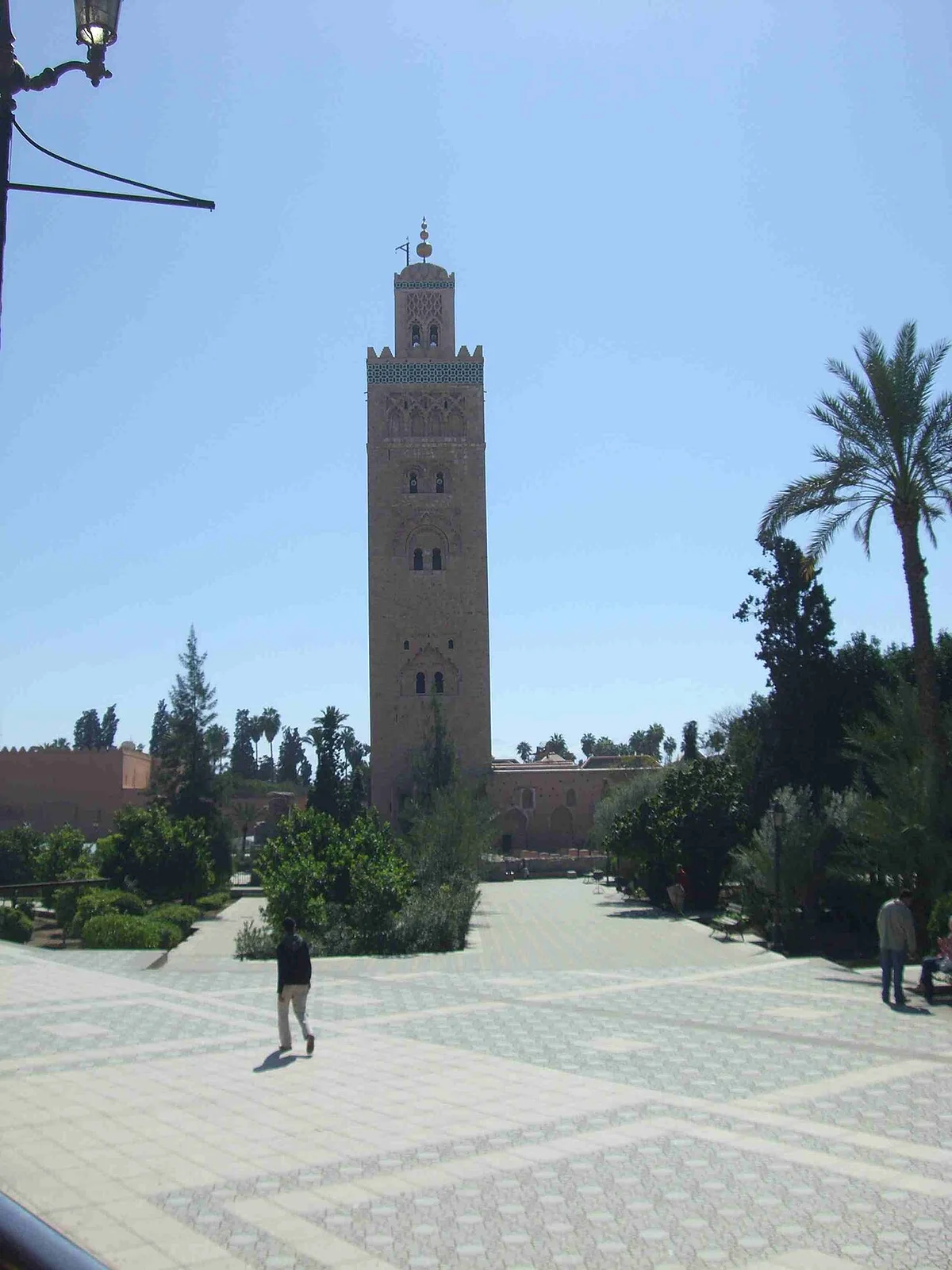
Its 77-metre minaret has become one of the great symbols of Marrakech and one of the most important surviving examples of Almohad architecture in Morocco.
Located close to Jemaa el-Fna, the Koutoubia belongs to a decisive period in the history of Marrakech, when the city became the capital of a powerful empire extending across the Maghreb and al-Andalus.
The mosque we see today also hides a fascinating story.
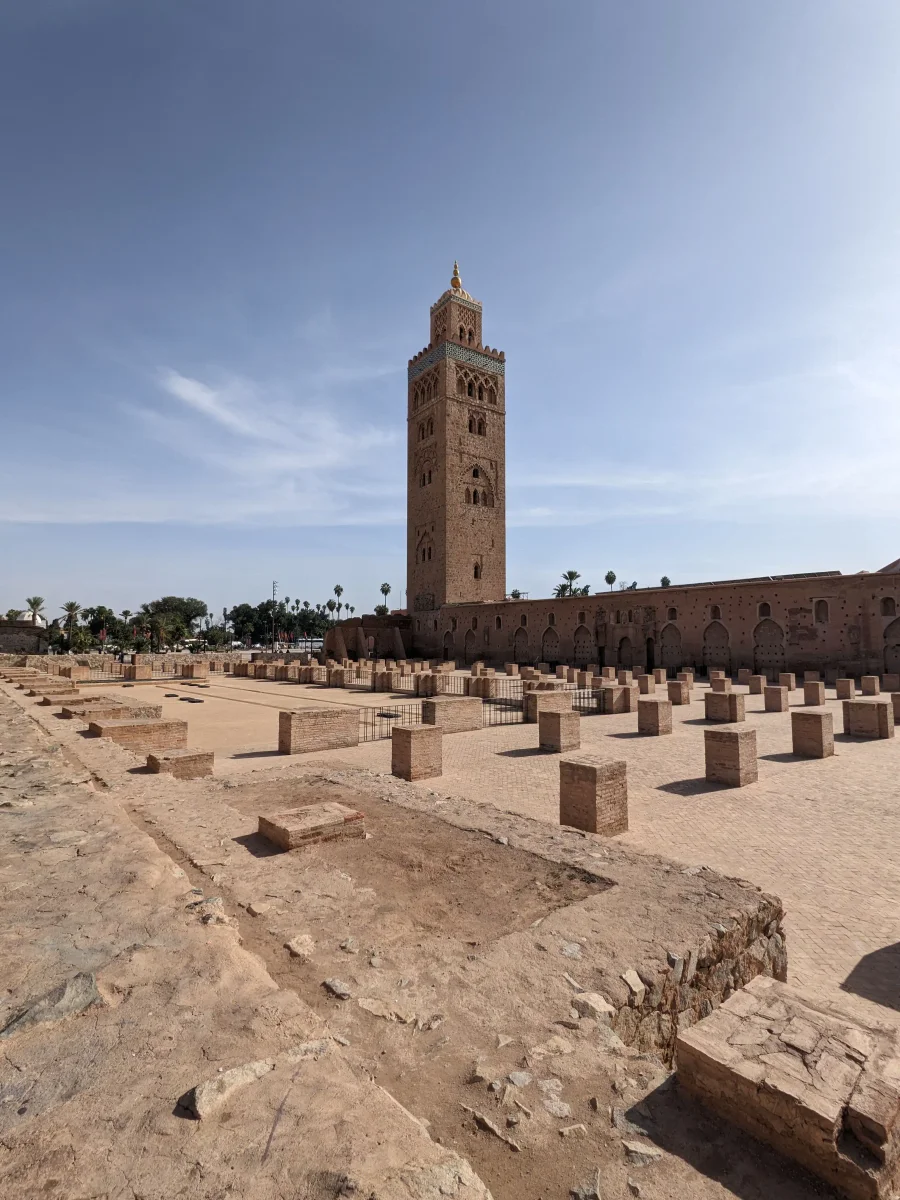
Two successive Koutoubia mosques were built on this site during the 12th century.
Understanding their history provides an insight into one of the most important periods in the architectural heritage of Marrakech.
Marrakech Before the Koutoubia
According to UNESCO, Marrakech was founded in 1070–1072 by the Almoravids.
The city quickly developed into an important political and economic centre.
The Almoravids constructed religious buildings and developed an urban infrastructure of which only a few traces survive today.
Among the rare monuments from this period is the Almoravid Qubba, located near the Ben Youssef Madrasa.
The Arrival of the Almohads
In 1147, Marrakech came under Almohad control.
The new rulers began transforming the capital.
The first Almohad caliph, Abd al-Mu'min, notably ordered the construction of a new great mosque.
This is where the history of the Koutoubia begins.
Why Were Two Koutoubia Mosques Built?
One of the most fascinating features of the monument is that not one but two Koutoubia mosques were constructed within a relatively short period.
Both buildings were commissioned under the Almohad caliph Abd al-Mu'min, who ruled from 1130 to 1163.
Historical sources cited by Discover Islamic Art provide particularly valuable information about the construction.
Work on the great mosque began in May 1158, and Friday prayer was celebrated there in September of the same year.
The First Koutoubia Mosque
The first mosque was constructed after the Almohad conquest of Marrakech.
Its orientation, however, became an issue.
According to heritage sources, the building was considered incorrectly aligned with the qibla, the direction of Mecca towards which Muslims pray.
Abd al-Mu'min subsequently ordered another mosque to be constructed immediately beside it.
The Second Koutoubia Mosque
The second mosque is the building that survives today.
The two structures once stood side by side, although their axes differed slightly.
This complex construction history helps explain some of the unusual characteristics of the present monument.
Remains of the earlier mosque can still be seen beside the existing building.
They provide a rare opportunity to understand that today's Koutoubia once formed part of a more complex architectural ensemble.
A Great Mosque of Almohad Architecture
The Koutoubia is one of the major surviving examples of religious architecture developed under the Almohads.
Its prayer hall follows a layout characteristic of major mosques in the western Islamic world during this period.
A T-Shaped Plan
The prayer hall consists of 17 aisles.
The central aisle leading towards the mihrab and the transverse aisle running along the qibla wall are wider than the others.
Together, they create what architectural historians describe as a T-shaped plan.
Similar arrangements appear in other important mosques of the western Islamic world.
The aisle along the qibla also contains several muqarnas domes, while the area around the mihrab is among the most richly treated parts of the building.
The Koutoubia Minaret
The minaret is now the most famous part of the monument.
Rising to approximately 77 metres to the top of its finial, it dominates the skyline of the Medina.
Its square base measures approximately 12.8 metres on each side.
Stone and brick were among the materials used in its construction.
Four Different Façades
One detail is particularly worth observing.
The four sides of the minaret do not have exactly the same decoration.
Each façade features its own arrangement of arches and geometric patterns.
These variations give the tower remarkable visual richness while maintaining a strong architectural unity.
The upper section consists of a lantern crowned by a finial.
Its silhouette has become inseparable from the identity of Marrakech.
Koutoubia, the Giralda and Hassan Tower
The influence of Almohad architecture extended far beyond Marrakech.
Three major 12th-century towers are frequently compared because of their shared architectural language:
- the Koutoubia in Marrakech
- Hassan Tower in Rabat
- the Giralda in Seville
These monuments belong to the political and architectural context of the Almohad Empire, which at its height extended across large parts of the Maghreb and al-Andalus.
Hassan Tower in Rabat
Hassan Tower formed part of an enormous mosque project initiated under the Almohad caliph Yaqub al-Mansur at the end of the 12th century.
The mosque was never completed.
Its unfinished minaret nevertheless became one of the most famous monuments in Rabat.
The Giralda in Seville
In Seville, the Giralda was originally the minaret of the city's great Almohad mosque.
After the Christian conquest of Seville in the 13th century, the mosque was gradually replaced by the cathedral.
The former minaret was preserved and later transformed into a bell tower.
Comparing these three monuments illustrates the geographical reach and architectural influence of the Almohads during the 12th century.
Why Is It Called Koutoubia?
The name Koutoubia, also written Kutubiyya or Koutoubiya, is associated with the Arabic term connected to books and booksellers.
Heritage sources describe the surrounding area as the booksellers' quarter.
This origin recalls an aspect of medieval Marrakech that is sometimes overlooked.
The areas surrounding major mosques were not exclusively religious spaces.
They could also become important places of trade, exchange and learning.
The presence of booksellers around the mosque left such a strong association that it survives today in the name of the monument itself.
The Remarkable Minbar of the Koutoubia
One of the greatest treasures associated with the Koutoubia is no longer kept inside the mosque.
It is the famous minbar, the pulpit traditionally used for the Friday sermon.
Its history actually begins before the construction of the Koutoubia.
A Masterpiece Made in Córdoba
An inscription provides particularly valuable information about its origins.
The minbar was commissioned by the Almoravid ruler Ali ibn Yusuf for the great mosque of Marrakech.
Its construction began in Córdoba in 1137.
When the Almohads captured Marrakech in 1147 and the mosque of Ali ibn Yusuf was destroyed, Abd al-Mu'min preserved the minbar.
It was installed first in the initial Koutoubia Mosque and subsequently transferred to the second mosque.
An Exceptional Example of Medieval Art
The minbar is distinguished by its extraordinarily refined woodwork, geometric compositions and inlays.
It remained in use at the Koutoubia until the 20th century before being removed for conservation.
The object provides exceptional evidence of the artistic connections between Marrakech and al-Andalus during the 12th century.
The Koutoubia at the Heart of Almohad Marrakech
To understand the mosque properly, it must be placed within the wider development of Marrakech.
Under the Almohads, the city became the capital of a vast empire.
New neighbourhoods, gardens, hydraulic systems and monumental buildings were developed.
The Koutoubia and the Menara
Abd al-Mu'min is also associated with the development of major hydraulic infrastructure and gardens in Marrakech.
The large reservoir of the Menara Gardens belongs to this wider history.
The Koutoubia and Menara therefore illustrate two complementary aspects of Almohad Marrakech: religious architecture and large-scale urban development.
From the Koutoubia to Saadian Marrakech
The monumental history of Marrakech did not end with the Almohads.
Several centuries later, the Saadians transformed the city once again.
They notably constructed the monumental El Badi Palace and developed the royal necropolis now known as the Saadian Tombs.
These monuments make it possible to compare different periods of Marrakech's architectural history.
The Koutoubia represents the power of the Almohads in the 12th century.
El Badi Palace and the Saadian Tombs illustrate the political and artistic revival of Marrakech during the 16th and early 17th centuries.
From the Koutoubia to Bahia Palace
Bahia Palace belongs to a much later period.
Built mainly during the late 19th century, it reveals another aspect of Moroccan architecture: the great palatial residences organised around courtyards, gardens and richly decorated apartments.
Combining the Koutoubia, El Badi Palace, the Saadian Tombs and Bahia Palace therefore allows visitors to explore several centuries of Marrakech's history.
The Koutoubia and Jemaa el-Fna
The Koutoubia is only a few minutes' walk from Jemaa el-Fna.
The two places are now inseparable from the historic centre of Marrakech.
From the square, the minaret is one of the main visual landmarks for navigating the Medina.
This proximity also demonstrates that the Koutoubia is not an isolated monument.
It forms an integral part of the historic urban fabric of Marrakech.
The Koutoubia and UNESCO World Heritage
The Medina of Marrakech has been listed as a UNESCO World Heritage Site since 1985.
In its description of the site's Outstanding Universal Value, UNESCO gives particular importance to the Koutoubia.
Its 77-metre minaret is recognised as a major monument of Islamic architecture, an important landmark in the urban landscape and a symbol of Marrakech.
The Koutoubia shares this international heritage recognition with other major elements of the Medina, including its ramparts, the Kasbah, historic gardens, El Badi Palace, the Ben Youssef Madrasa and the Saadian Tombs.
Can You Visit Inside the Koutoubia Mosque?
The Koutoubia remains an active mosque.
The interior is reserved for Muslims.
Non-Muslim visitors therefore discover the monument from the outside.
This does not prevent visitors from appreciating much of its architecture.
The minaret, exterior façades, remains of the first mosque and surrounding spaces provide plenty of opportunities to understand the historical importance of the monument.
The Koutoubia Gardens
The spaces surrounding the mosque offer another perspective on the monument.
The gardens provide enough distance to appreciate the proportions and decoration of the minaret.
They also form a pleasant transition between the Koutoubia, Jemaa el-Fna and the major avenues west of the Medina.
For practical information, see our guide to accessing the Koutoubia and visiting its gardens.
What to Visit Around the Koutoubia
The mosque's central location makes it easy to include in a walking itinerary through historic Marrakech.
Jemaa el-Fna
Just a few minutes away is Jemaa el-Fna, the most famous public space in the Medina.
El Badi Palace
El Badi Palace provides an introduction to Saadian Marrakech and the reign of Sultan Ahmad al-Mansur.
Saadian Tombs
The Saadian Tombs preserve one of Morocco's most remarkable royal necropolises.
Bahia Palace
Bahia Palace offers an immersion in Moroccan palatial architecture of the late 19th century.
Almoravid Qubba
The Almoravid Qubba takes visitors back to the period immediately preceding the Almohads.
It is one of the rare surviving architectural remains of Almoravid Marrakech.
Ben Youssef Madrasa
The Ben Youssef Madrasa provides another opportunity to explore the religious, intellectual and architectural history of Marrakech.
A Symbol of Marrakech Since the 12th Century
The Koutoubia has accompanied the history of Marrakech since the 12th century.
It has witnessed the succession of the Almohads, Marinids, Saadians and Alaouites.
The city around it has changed, new palaces have been constructed and new neighbourhoods have appeared.
Yet its minaret has remained one of the defining landmarks of the Marrakech skyline.
Above all, the Koutoubia reminds us that the architectural heritage of Marrakech did not begin with its most famous palaces.
Long before Bahia Palace or El Badi Palace, the Almohads had already transformed Marrakech into one of the great monumental capitals of the western Islamic world.
The Koutoubia remains one of the most powerful surviving witnesses to that history.
Read Also
- Koutoubia Mosque: practical visitor guide
- Koutoubia Mosque: access, gardens, opening hours and practical information
- Discover the Almoravid Qubba
- Visit the Ben Youssef Madrasa
- Discover El Badi Palace
- Visit the Saadian Tombs
- Discover Bahia Palace