Bab Dbagh: History and Heritage of Marrakech's Tanners
On the eastern side of the Medina of Marrakech, away from the city's most visited palaces and the bustle of Jemaa el-Fna, an ancient gate opens onto a neighbourhood historically associated with one of Marrakech's major traditional crafts: leatherworking.
Bab Dbagh, also spelled Bab Debbagh or Bab Ed-Debbagh, is known as the Gate of the Tanners.
Its significance goes beyond its architecture.
Bab Dbagh helps explain the relationship between Marrakech's medieval fortifications, the organisation of the medina and the traditional crafts that shaped the city over the centuries.
Even today, the tanning district is a reminder that the Medina of Marrakech is not simply a collection of historic monuments. It is also a living city where traditional crafts continue to survive.
Bab Dbagh, a Gate from the Almoravid Period
The history of Bab Dbagh is directly connected with the origins of Marrakech.
According to UNESCO, Marrakech was founded in 1070–1072 by the Almoravids and subsequently became one of the major political, economic and cultural centres of the western Islamic world.
The medieval city was gradually protected by a fortified enclosure consisting of ramparts and several monumental gates.
Bab Dbagh forms part of this heritage.
The official Visit Marrakech tourism portal attributes the gate to the Almoravid period and highlights one particularly remarkable architectural feature: its passage consists of five successive bends.
This complex layout distinguishes Bab Dbagh from simpler urban entrances.
To prepare your visit, also see Bab Dbagh: how to get there and when to visit.
Why Does Bab Dbagh Have a Bent Passage?
The gates of medieval cities were not simply designed to allow residents and goods to enter and leave.
They were also part of the city's defensive system.
A passage containing several changes of direction made an entrance more complex than a simple opening running directly through the wall.
At Bab Dbagh, this succession of bends remains one of the most interesting architectural features to observe today.
Before heading directly towards the tanneries, take a few minutes to examine the structure of the gate itself.
It reveals part of the military and urban history of Marrakech.
Why Is It Called Bab Dbagh?
The name of the gate is associated with the tanners and the traditional craft district to which it provides access.
The official Marrakech tourism guide specifically describes Bab Debbagh as the gate leading to the tanners' quarter.
This relationship between a city gate and the activity of the neighbouring district was not unusual in Moroccan medinas.
Different areas of the historic city were often associated with particular markets, crafts or professional communities.
In Marrakech, this organisation can still be seen in the souks and in the names of several neighbourhoods.
Bab Dbagh is therefore an interesting example of the connection between place names, urban organisation and craftsmanship.
The Tanners' Quarter of Marrakech
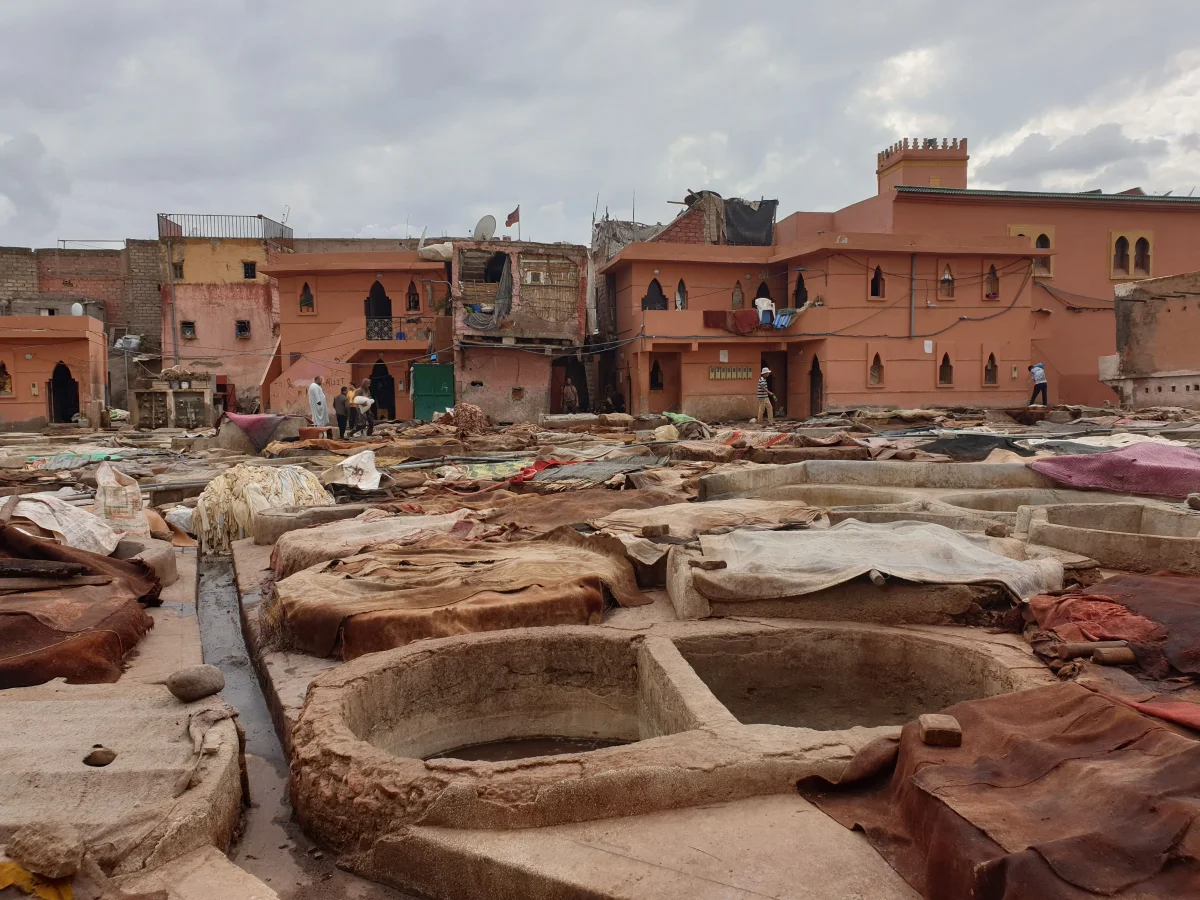
Beyond Bab Dbagh lies the area traditionally associated with the tanneries of Marrakech.
Tanning is the process of transforming raw animal hides into leather that can subsequently be used by other craftspeople.
The process involves several stages.
Depending on the techniques used, hides must be cleaned, prepared, softened, tanned, sometimes coloured and finally dried before they can be transformed into finished products.
It is important, however, not to assume that every artisan today uses exactly the same methods or substances that were employed during the Middle Ages.
Techniques, products and working conditions have evolved over time.
What remains particularly significant at Bab Dbagh is the continuity of a district historically associated with leatherworking.
From Tanning to the Finished Product
The work carried out around the tanneries represents only one stage in the production chain.
Once prepared, leather can be taken to other workshops throughout the medina.
There it can be cut, stitched, decorated and transformed into a wide range of objects, including:
- babouches;
- bags;
- belts;
- poufs;
- wallets;
- accessories;
- decorative objects.
This relationship between different crafts helps explain the historical organisation of Marrakech's souks.
The city's artisanal heritage does not depend on a single craftsperson but on a network of complementary skills and trades.
Traditional craftsmanship remains just as much a part of Marrakech's living heritage as its monuments.
The Tanneries as Living Heritage
One of the most interesting aspects of Bab Dbagh is that it demonstrates how a city's heritage extends beyond palaces, mosques, madrasas and museums.
Heritage can also consist of professional skills, techniques and knowledge transmitted between generations.
UNESCO describes the Medina of Marrakech as a historic urban environment containing souks, traditional houses, fondouks and numerous forms of commercial and artisanal activity.
Bab Dbagh illustrates this living dimension particularly well.
After visiting monuments such as the Bahia Palace, the Saadian Tombs or Ben Youssef Madrasa, exploring the tanners' quarter offers a very different perspective on Marrakech's heritage.
Bab Dbagh and the Ramparts of Marrakech
Bab Dbagh should also be understood as part of the wider system of historic fortifications surrounding Marrakech.
The ramparts and monumental gates are among the architectural elements that illustrate the development of Marrakech as an Almoravid and later Almohad capital.
UNESCO specifically identifies the city's ramparts and monumental gates among the important components of Marrakech's architectural heritage.
The fortifications continued to evolve under later dynasties as the city developed.
Today, the ochre-coloured walls remain one of the most recognisable features of Marrakech's urban landscape.
The Medina of Marrakech and UNESCO
The Medina of Marrakech has been inscribed on the UNESCO World Heritage List since 1985.
The designation covers a historic urban ensemble rather than a single monument.
UNESCO highlights major landmarks including the Koutoubia Mosque, the ramparts, monumental gates, gardens and numerous monuments constructed during later periods.
It also recognises the living character of the medina, with its narrow streets, traditional houses, souks, fondouks and craft activities.
Bab Dbagh and its surroundings are therefore best understood as part of this wider historic urban environment.
To explore another aspect of the city's early history, discover the Almoravid Qubba, one of the rare surviving monuments from the Almoravid period in Marrakech.
Bab Dbagh and the Tanneries of Fez: What Is the Difference?
When people think of Moroccan tanneries, the most famous images usually come from Fez.
The Chouara Tanneries have become one of Morocco's best-known artisanal landscapes, particularly because of the panoramic views available from surrounding buildings.
The tanneries of Marrakech offer a different experience.
The Bab Dbagh district is less centred around a panoramic visit to a vast complex of tanning pits.
Instead, the experience is more closely integrated into a walk through a working craft district within the medina.
It would, however, be misleading to describe the Marrakech tanneries as necessarily "more authentic" than those of Fez.
Both cities have their own artisanal histories and urban traditions.
Tanneries of Fez
In Fez, the Chouara Tanneries are particularly famous for their large concentration of tanning pits and the panoramic views available from surrounding terraces.
Tanneries of Marrakech
In Marrakech, discovering leatherworking around Bab Dbagh fits naturally into a walk through the eastern part of the medina and its traditional craft neighbourhoods.
The two experiences are therefore complementary rather than competing.
Understanding How the Medina Worked
Bab Dbagh also provides an opportunity to understand how a historic medina functioned as an economic system.
Raw materials arrived in particular districts.
Specialised craftspeople carried out the first stages of transformation.
Other workshops then continued the process before finished products were sold in the souks.
This organisation helps explain why certain crafts gave their names to streets, markets and entire neighbourhoods.
By walking from Bab Dbagh towards the souks, visitors can symbolically follow the journey from raw material to finished handcrafted product.
What to See Near Bab Dbagh
A visit to Bab Dbagh can easily be combined with several historic sites in the northern and eastern parts of the medina.
Ben Youssef Madrasa
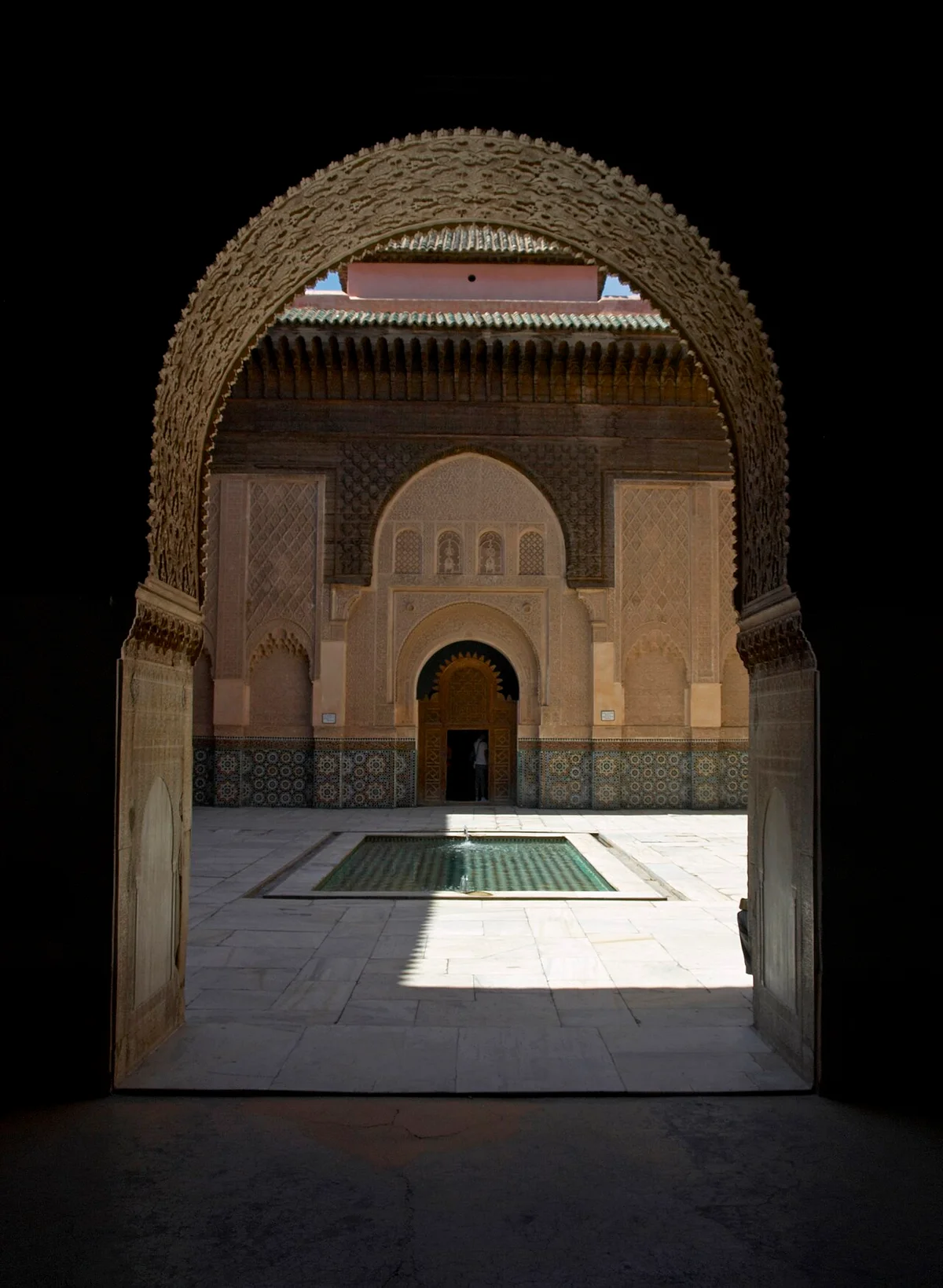
Ben Youssef Madrasa is one of Marrakech's most remarkable architectural monuments.
Its elaborate decoration provides a very different perspective on the heritage of the medina.
Almoravid Qubba
The Almoravid Qubba is particularly relevant when combined with Bab Dbagh because it provides further insight into Almoravid Marrakech.
Marrakech Museum
The Marrakech Museum, housed in the historic Dar Menebhi Palace, can also be included in the same itinerary.
Souks of Marrakech
On your way back towards the centre of the medina, explore the souks and discover workshops and shops where leather and other materials are transformed into handcrafted products.
Jemaa el-Fna
You can then continue towards Jemaa el-Fna, the lively heart of the medina and one of Marrakech's most emblematic places.
Suggested Almoravid and Craft Heritage Itinerary
For a half-day visit, consider the following route:
Ben Youssef Madrasa → Almoravid Qubba → Bab Dbagh → tanners' quarter → souks → Jemaa el-Fna
This itinerary introduces several dimensions of Marrakech:
- medieval history;
- architecture;
- fortifications;
- traditional crafts;
- souks;
- living heritage.
For practical access information and advice on the best time to explore the area, see Bab Dbagh: how to get there and when to visit.
Respecting a Neighbourhood That Remains a Workplace
The tanneries should not be regarded simply as a photographic backdrop.
They are first and foremost working spaces.
During your visit:
- respect areas reserved for artisans;
- avoid obstructing workers or the transport of materials;
- ask permission before taking close-up photographs of people;
- do not touch hides, tools or equipment without permission;
- agree on the price before accepting the services of a guide or entering private property.
For more advice before visiting the area, see our practical visitor guide to Bab Dbagh.
Bab Dbagh: Where Architectural Heritage Meets Living Craftsmanship
Bab Dbagh tells a different story from Marrakech's grand palaces.
The gate reflects medieval Marrakech and its defensive system, while the neighbouring tanners' quarter illustrates the essential role craftspeople have played in the economy and everyday life of the medina.
It is precisely this combination that makes the area so interesting.
Bab Dbagh is more than an old city gate.
It represents a meeting point between Almoravid architecture, urban organisation, leather craftsmanship and living heritage.
Continue exploring Marrakech with Bab Dbagh: how to get there and when to visit, our practical guide to Bab Dbagh and our guide to the Medina of Marrakech.