Salé: History, Merinid Heritage, and Corsair City Facing Rabat
Across from Rabat, on the opposite bank of the Bouregreg, Salé holds one of the most interesting historical medinas along the Moroccan Atlantic coast.
Less frequented than its neighbor, the city boasts a remarkable history shaped by Moroccan dynasties, exchanges with Al-Andalus, the arrival of the Moriscos, and maritime activity on the Bouregreg.
At the heart of its Medina, the Merinid Medersa of Salé reflects another dimension of this history: that of a religious and intellectual city where architecture, education, and Moroccan craftsmanship intersect.
The close proximity to Rabat also connects Salé to several major monuments in the capital, including Chellah, the Kasbah of the Oudayas, and the Hassan Tower.
Discover the sites and monuments of Salé
Salé, a Historical City on the Bouregreg
Salé develops on the northern bank of the Bouregreg estuary, directly opposite Rabat.
Today, the two cities form a large urban area, but each retains a distinct historical identity.
For centuries, Salé's location near the Atlantic facilitated trade and cultural exchanges with other regions of Morocco, the Iberian Peninsula, and the Mediterranean world.
The Medina still preserves part of this long history through its ramparts, monumental gates, religious sites, traditional houses, and ancient commercial streets.
To truly understand Salé, it is particularly interesting to explore it alongside Rabat.
Discover Rabat, its history, and its heritage
A History Older than the Corsairs
Salé is often associated with the famous corsairs of the Bouregreg.
However, the city's history begins long before the 17th century.
During the Middle Ages, its strategic position on the Atlantic coast fostered its development.
Several Moroccan dynasties contributed to the transformation of the city, notably the Almohads and later the Merinids.
The latter played a particularly important role in the development of Morocco's religious and intellectual architecture.
In Salé, this period left one of the city's most remarkable monuments: the Merinid Medersa.
The Merinid Medersa of Salé
Located in the heart of the Medina, the Merinid Medersa of Salé is one of the main reasons to explore the historic center.
Built in the 14th century under the Merinid dynasty, it belongs to the grand tradition of medersas developed in several Moroccan cities.
These institutions were linked to religious education and the transmission of knowledge.
But they also served as true demonstrations of the architectural and decorative expertise of their time.
In Salé, the medersa stands out for the richness of its decoration.
Zellige, Carved Wood, and Chiseled Stucco
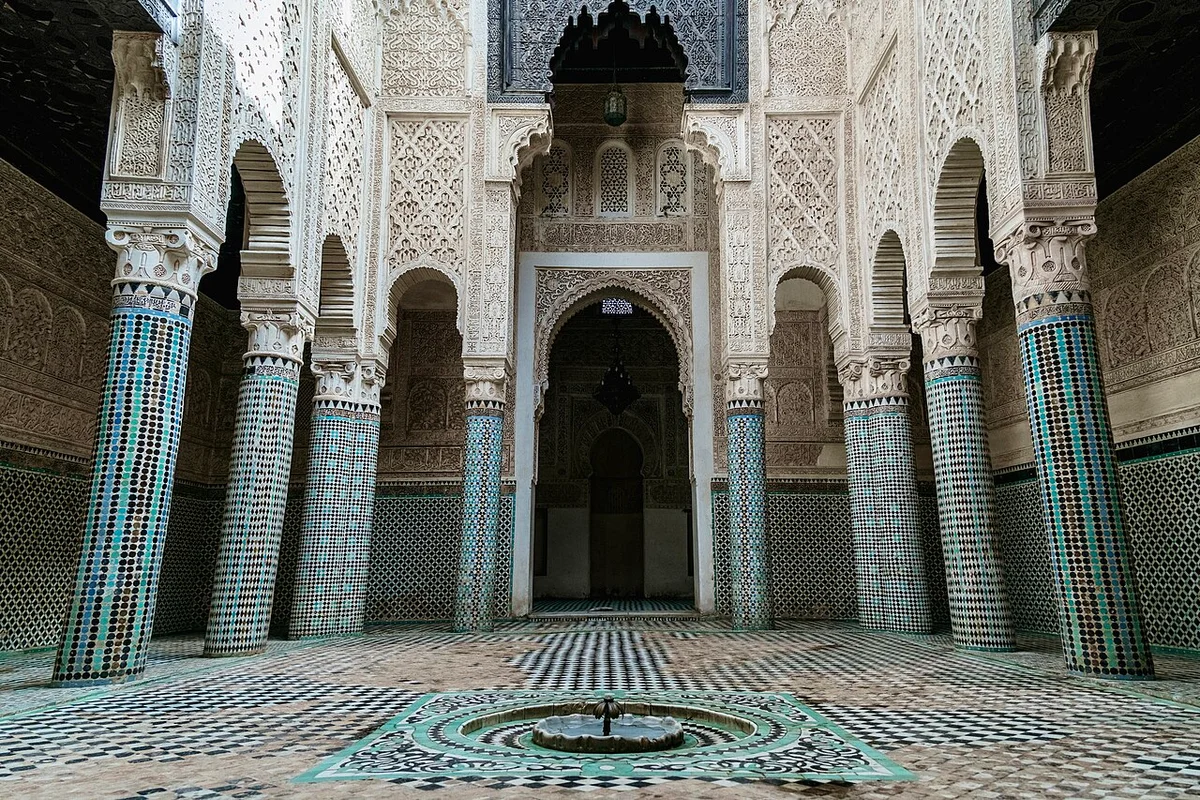
Despite its relatively modest size, the Merinid Medersa features several characteristic elements of medieval Moroccan architecture.
Among them, one can observe:
- Geometric and polychrome zellige;
- Finely carved stucco;
- Worked wood;
- Plant and geometric motifs;
- Decorative calligraphy;
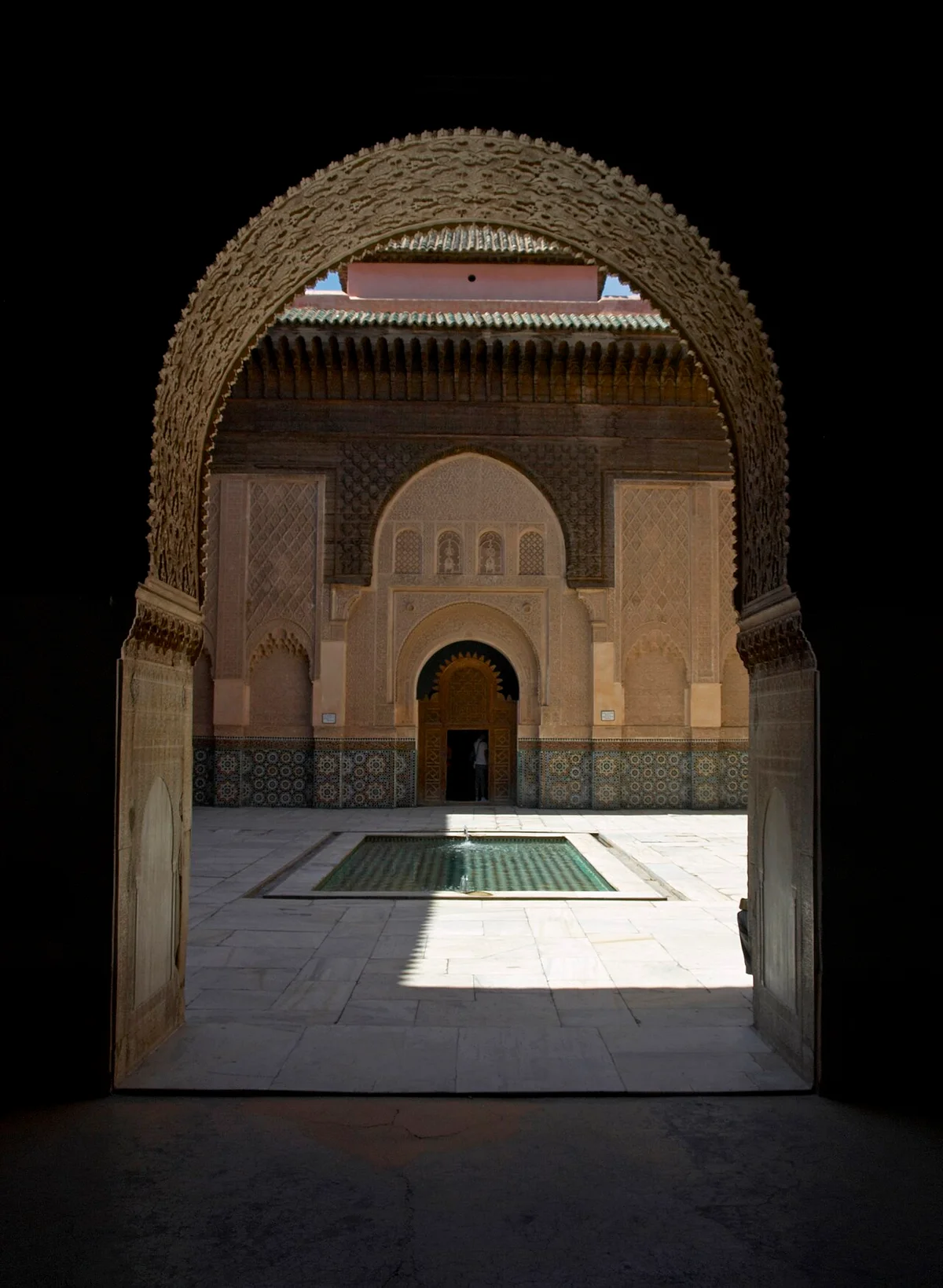
- Organization of spaces around an inner courtyard.
Each material contributes to a particularly refined architectural composition.
The visit allows one to understand that medersas were not merely places of education.
They were also monuments where architecture, craftsmanship, and spirituality formed a coherent whole.
Prepare your visit to the Merinid Medersa of Salé
Salé and the Great Merinid Heritage of Morocco
The Medersa of Salé should not be viewed as an isolated monument.
It is part of a much larger architectural ensemble developed under the Merinids in the 13th, 14th, and 15th centuries.
The dynasty left major monuments in several Moroccan cities, notably in Fez, Meknès, Rabat, and Salé.
This history creates a particularly interesting itinerary around Merinid heritage.
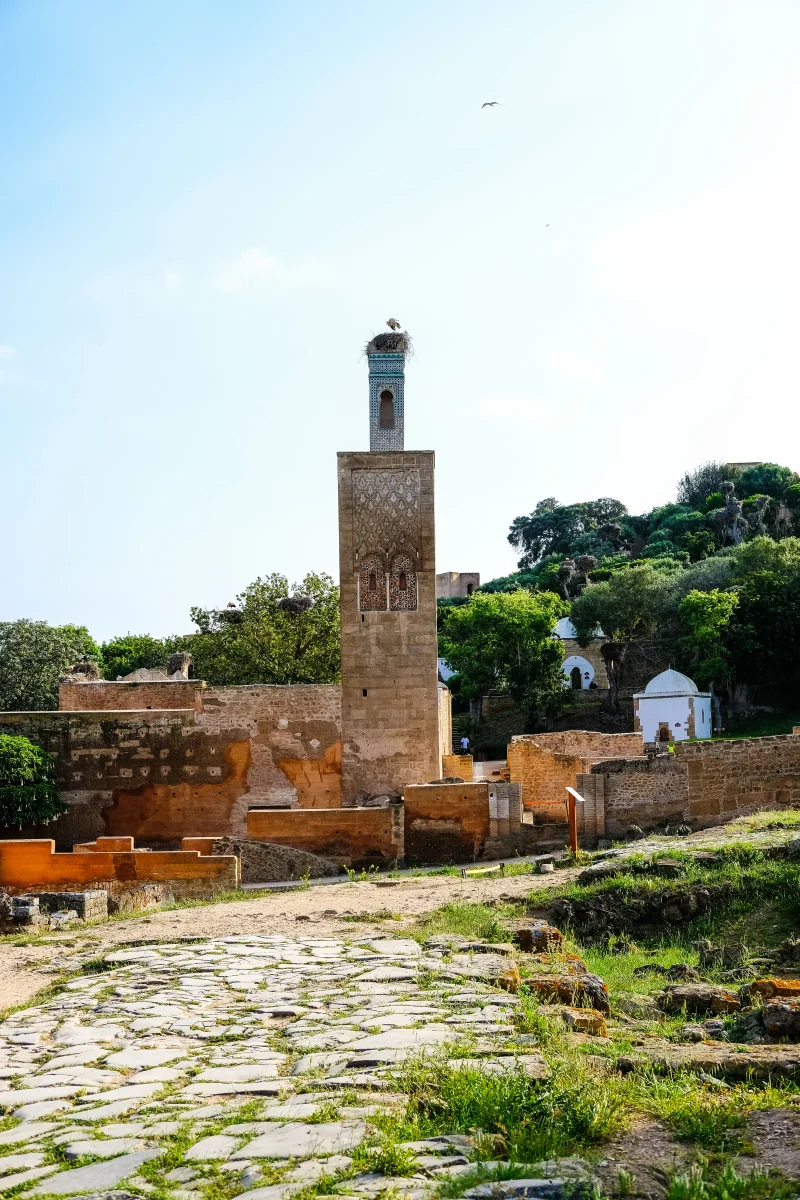
And just across the Bouregreg lies one of the most important complexes related to this dynasty: the Chellah of Rabat.
The Chellah: The Other Great Merinid Heritage of the Bouregreg
In Rabat, the Chellah allows for further exploration.
The history of the site is much older than the Merinid period.
The place retains traces of ancient occupation before becoming, several centuries later, an important necropolis under the Merinids.
Connecting the Chellah and the Medersa of Salé thus allows for the discovery of two different dimensions of the same dynasty.
In Salé, the medersa primarily evokes education, religion, and intellectual life.
At the Chellah, the Merinid heritage is notably linked to dynastic and funerary memory.
Both monuments are located on either side of the same historical territory of the Bouregreg.
For more information, check out our dedicated article: Chellah in Rabat: From the Ancient City of Sala to the Merinid Necropolis.
From Almohads to Merinids: Continuing the History in Rabat
Crossing the Bouregreg also allows one to delve into another significant period of Moroccan history: that of the Almohads.
Two emblematic monuments in Rabat help to understand its importance.
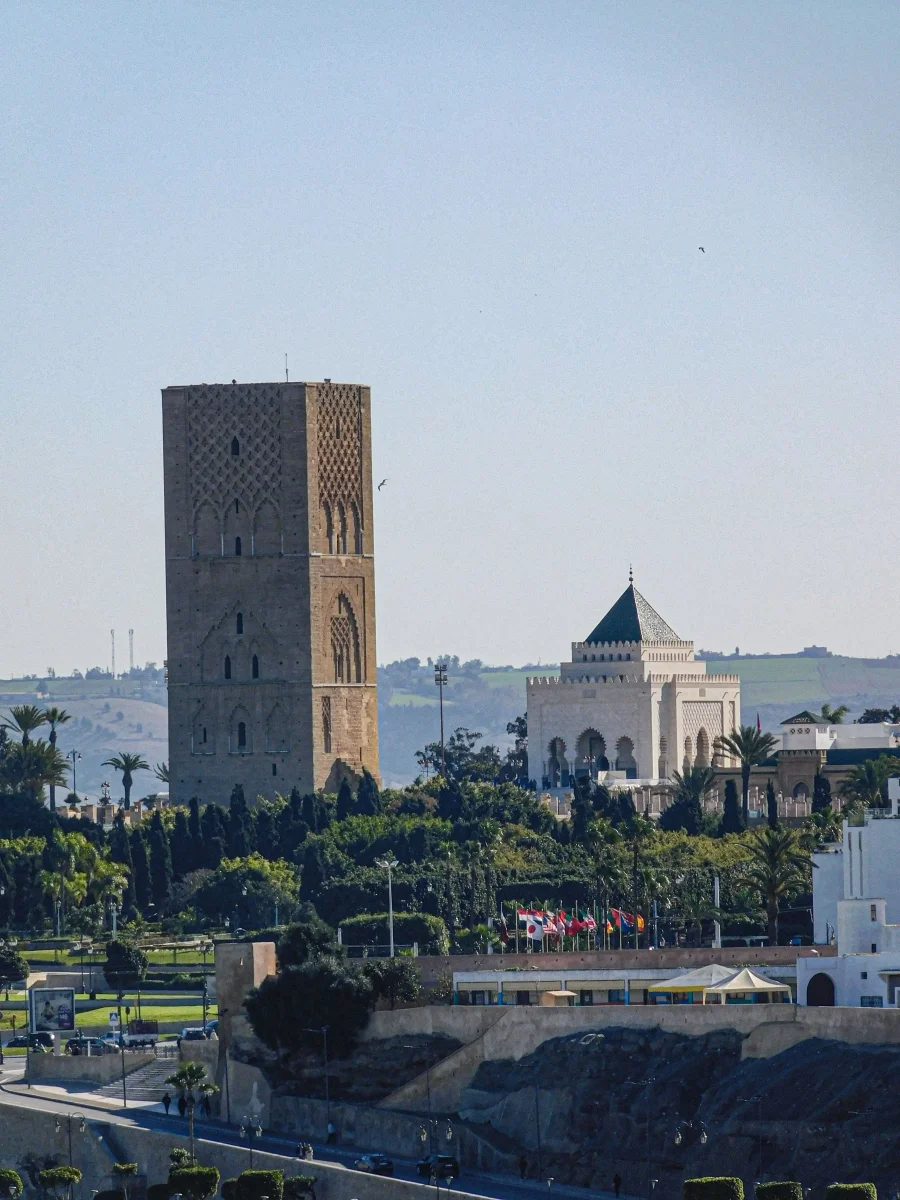
The Hassan Tower is one of the great witnesses to the monumental project developed in Rabat at the end of the 12th century.
Not far from there, the Kasbah of the Oudayas occupies a strategic position at the mouth of the Bouregreg.
These monuments help to place Salé within a much broader regional history.
In just a few kilometers, visitors can traverse several centuries of Moroccan history.
The Hassan Tower: The Grand Almohad Project in Rabat
This monument is one of the most recognizable in Rabat.
It was part of a vast mosque project initiated under the reign of the Almohad ruler Yacoub al-Mansour at the end of the 12th century.
The project remained unfinished, but the minaret and the many preserved columns still allow us to imagine the monumental ambition of the complex today.
The Hassan Tower thus provides an excellent complement to a visit to Salé.
It allows for the discovery of Almohad heritage before continuing to the Merinid period with the Medersa of Salé and the Chellah.
Discover the Hassan Tower and its history
For more information, check out our dedicated article: Hassan Tower and Mohammed V Mausoleum in Rabat: History and Visit.
The Kasbah of the Oudayas and the Mouth of the Bouregreg
This kasbah is another essential stop.
Situated on the heights overlooking the mouth of the Bouregreg and the Atlantic Ocean, it occupies an exceptional strategic position.
Its history is closely linked to the development of Rabat and the various dynasties that controlled this part of the coast.
From the vicinity of the Kasbah, the geographical relationship between Rabat, Salé, the Bouregreg, and the Atlantic becomes particularly evident.
This position also helps to understand why the estuary played such an important role in the maritime history of both cities.
Discover the Kasbah of the Oudayas
For more information, check out our dedicated article: Kasbah of the Oudayas in Rabat: History, Heritage, and Visitor Guide.
The Arrival of the Moriscos in the 17th Century
At the beginning of the 17th century, the history of the Bouregreg takes a new turn.
After their expulsion from Spain, Moriscos settled in several cities in North Africa.
Some of them joined the communities established around the Bouregreg.
Their arrival contributed to the economic and maritime development of the region.
Some possessed knowledge of the Iberian Peninsula, maritime routes, and European languages that played an important role in the commercial and corsair activities of the time.
Thus began one of the most famous chapters in the history of Salé and Rabat.
The Corsairs of the Bouregreg
In the 17th century, the communities settled around the estuary developed significant corsair activity.
The ships of the Bouregreg then sailed the Atlantic and the western Mediterranean.
This period is often associated with the Republic of Salé or Republic of the Bouregreg.
However, it is essential to avoid imagining a republic in the modern sense of the term.
It was a complex political organization, relatively autonomous at certain times, involving various communities settled around the estuary.
Its maritime activity combined trade, privateering, ship capture, and captivity.
This history gave Salé a reputation that far exceeded the borders of Morocco.
Salé and Rabat: A Shared Corsair History
The term "corsairs of Salé" can be misleading.
A significant part of this history actually concerns the entire territory around the Bouregreg, including areas that now correspond to Rabat.
Both banks participated in this maritime economy.
Thus, the corsair history should be understood on the scale of Salé, Rabat, and the Bouregreg rather than as the story of a single city.
This reality also explains why visiting both cities is so complementary.
The Bouregreg was not merely a border.
For centuries, it was also a route for circulation, trade, and exchanges.
Bab Lamrissa and the Maritime Memory of Salé
The maritime history of Salé remains visible in its heritage.
Among the city's emblematic monuments is Bab Lamrissa, a grand monumental gate linked to the medieval history of the city.
Its name recalls the ancient relationship between Salé and its port environment.
Today, the landscape has changed significantly, but the monument allows us to imagine the importance that the Bouregreg and maritime activities once had in the organization of the city.
Bab Lamrissa thus serves as an excellent complement to the visit of the Medina and the Merinid Medersa.
A Less Crowded Medina to Explore on Foot
One of the great interests of Salé lies in its historical Medina.
Unlike a visit focused solely on a monument, wandering its streets allows for placing the heritage within its urban environment.
Old gates, markets, religious buildings, traditional houses, and commercial streets still compose the landscape of the historic center today.
The Merinid Medersa then becomes a stop within a broader discovery of the city.
Take the time to walk around the monument and observe the surrounding architecture.
Salé reveals a different atmosphere from that of the Medina of Rabat located across the river.
What to See in Salé?
The Medina of Salé
Less frequented by visitors than that of Rabat, the Medina of Salé offers an immersion into a more everyday Morocco, between peaceful alleys and lively markets. Once a flourishing religious and commercial center, it retains a traditional urban fabric where the Great Mosque, the Merinid Medersa, and several zaouïas coexist.
Bab Mrisa (Bab Lamrissa)
This monumental gate, classified since 1914, once allowed boats to enter directly into a now-disappeared harbor basin. It testifies to Salé's past as a corsair city, a historical rival of Rabat on the other side of the Bouregreg.
The Enclosure of the Medina
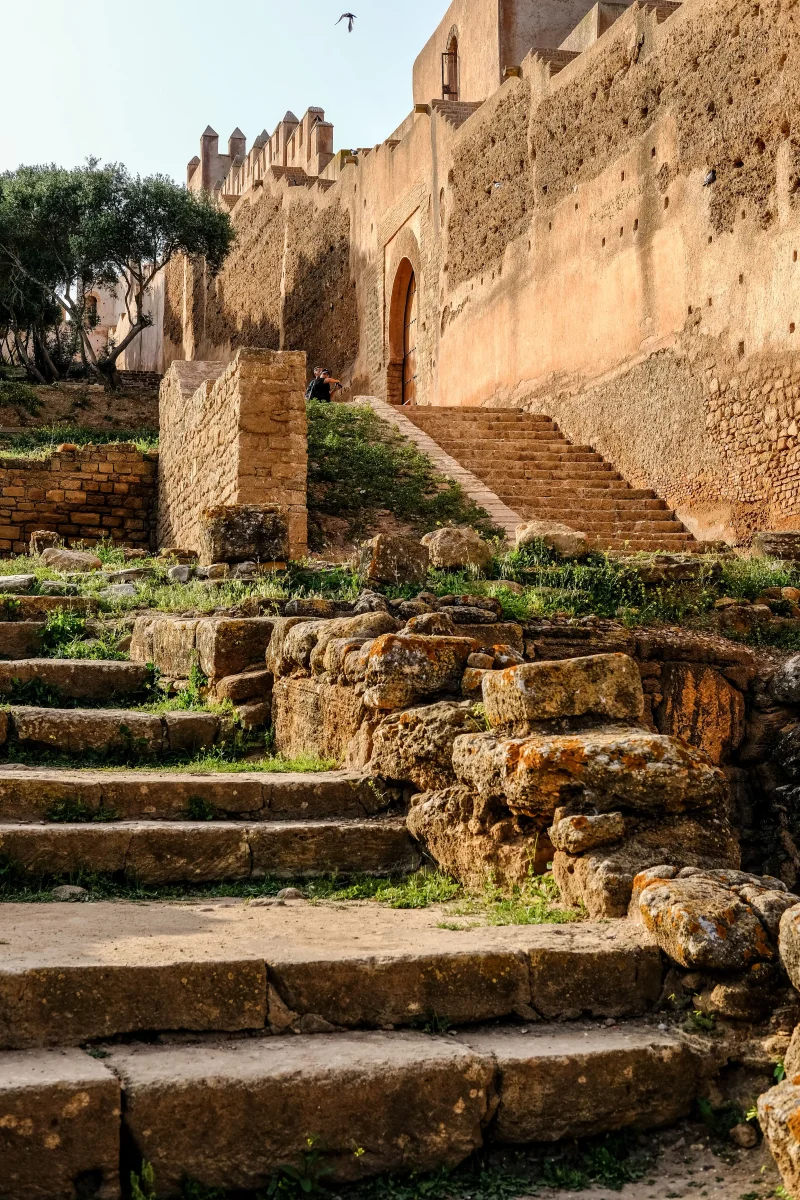
The ramparts that surround the Medina of Salé, also classified since 1914, punctuate its layout with several gates and bastions. Originally built to protect the city during the time of the Salé corsairs, they remain one of the best-preserved fortified ensembles along the Moroccan Atlantic coast.
Discover the enclosure of the Medina
The Sour El Kuas Aqueduct
This historic hydraulic work, classified as a monument by the Ministry of Culture, was part of the water supply system that fed the city before the modern era — a lesser-known testimony compared to the gates and bastions, but revealing the engineering deployed to support the urban development of the city.
Discover the Sour El Kuas Aqueduct
Bab Lakhmis
This gate, named after the Thursday market that used to take place there, is part of the classified monumental gates of Salé's enclosure and punctuates the layout of the ramparts towards an old market district.
The Great Mosque of Salé
Known as the Great Almohad Mosque, this building covers nearly 5,000 m² and is considered one of the largest mosques in Morocco after Hassan II in Casablanca and Al Quaraouiyine in Fez. It adjoins the Merinid Medersa, forming with it the monumental heart of the city.
The Kasbah of the Gnaouas
Classified as a historical monument, the Kasbah of the Gnaouas is part of Salé's fortified heritage. Its name evokes the historical presence of sub-Saharan populations in the city, whose musical and spiritual gnaoua culture has left a lasting mark on the region's intangible heritage.
Discover the Kasbah of the Gnaouas
The Church of Salé
Listed among the classified historical monuments of Salé, this church completes the plural religious landscape of the city alongside its mosques and medersas, a testament to the communities that coexisted in Morocco's Atlantic port cities.
Why Visit Salé and Rabat Together?
The proximity of the two cities presents an exceptional opportunity for travelers interested in the history of Morocco.
In a relatively compact territory, it is possible to discover several significant historical periods.
In Salé
- The historical Medina;
- The Merinid Medersa;
- Bab Lamrissa;
- The ramparts and ancient gates;
- The history of the Moriscos and the corsairs of the Bouregreg.
In Rabat
- The Chellah;
- The Hassan Tower;
- The Kasbah of the Oudayas;
- The Medina and various monuments of the capital.
This concentration of heritage allows for traversing several centuries of history without covering long distances.
Discover all the sites and monuments of Rabat
A Cultural Itinerary Between Salé and Rabat
For an initial discovery, it is possible to organize the visit around the major historical periods.
Step 1: The Medina of Salé
Start by exploring the Medina and discover the Merinid Medersa.
Merinid Medersa of Salé: History and Visit
Step 2: Cross the Bouregreg
Then head to Rabat.
This crossing immediately highlights the geographical and historical proximity between the two cities.
Step 3: The Kasbah of the Oudayas
Continue with this fortress, which overlooks the river's mouth.
Step 4: The Hassan Tower
Next, discover this Almohad tower and the monumental heritage of Rabat.
Step 5: The Chellah
Finish with the Chellah, where the ancient remains and Merinid heritage allow for extending the journey through several centuries of history.
This itinerary transforms the visit to Salé and Rabat into a true historical journey around the Bouregreg.
How Much Time to Allocate for Visiting Salé?
A half-day is sufficient to discover the main elements of the Medina of Salé.
However, travelers passionate about history, architecture, or photography can easily spend more time there.
If you combine Salé with Rabat, planning for at least a full day allows for discovering several important monuments in both cities.
For a more in-depth exploration of Rabat's heritage, a second day is preferable.
How to Reach Salé from Rabat?
Salé is located directly across from Rabat.
The two cities are connected by various means of transport, including the Rabat-Salé tramway.
This proximity makes the visit particularly easy to integrate into a stay in the capital.
Rather than viewing Salé as a distant excursion, it can be directly incorporated into your discovery program of Rabat.
When to Visit Salé?
Thanks to the Atlantic climate of the Rabat-Salé urban area, the city can be explored for much of the year.
Spring and autumn generally offer pleasant temperatures for walking through the Medina.
In summer, a morning or late afternoon visit often provides more comfortable conditions.
As the hours and access conditions for monuments may change, check practical information before your visit.
Prepare your visit to the Merinid Medersa of Salé
Continue Your Discovery of Rabat and Salé
Salé serves as an excellent gateway to understanding the historical heritage of the entire Bouregreg.
To continue your exploration, also check out:
- Merinid Medersa of Salé: History and Visit
- Discover the sites and monuments of Salé
- Rabat: History, Heritage, and Complete Guide
- Discover the sites and monuments of Rabat
- Chellah: History and Visit
- Hassan Tower: History and Visit
- Kasbah of the Oudayas: History and Visit
These pages allow for constructing a true itinerary around the heritage of Rabat and Salé, the Moroccan dynasties, and the history of the Bouregreg.
Sources and References
- Moroccan National Tourism Office — Culture and Heritage of Morocco
- Moroccan National Tourism Office — Rabat, Cultural City
- UNESCO — Rabat, Modern Capital and Historic City: A Shared Heritage
- Museum With No Frontiers — Discover Islamic Art
- Ministry of Youth, Culture, and Communication of Morocco
Salé: Another Way to Discover the Heritage of Rabat-Salé
Salé deserves much more than just a quick visit from Rabat.
Its Medina, its Merinid Medersa, and its monuments tell the stories of several significant periods in Moroccan history.
On the other side of the Bouregreg, the Chellah, the Hassan Tower, and the Kasbah of the Oudayas allow for continuing this journey through dynasties, architecture, and the maritime history of the region.
Visiting Salé and Rabat together means discovering two different cities connected for centuries by the same river and a deeply shared history.
With MoroccoMuseum, explore the heritage of Salé, prepare your visit to the Merinid Medersa, and continue your discovery in Rabat, from the Chellah to the Hassan Tower and the Kasbah of the Oudayas.